
 Print
Print Word
Word PDF
PDF|
This section contains 1,959 words (approx. 7 pages at 300 words per page) |

|
Overview
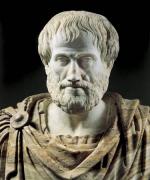
Aristotle's (384-322 B.C.) Physics was one of the most influential pieces of writing in science. It defined the field of physics for centuries after it was collated from Aristotle's notes by one of his students. It became the cornerstone of Western science as allowed by the Church. While many of the claims within the Physics are incorrect, it represents one of the first attempts to offer a coherent, logical, and natural explanation of motion and change within the physical world.
Background
Greek philosophy and speculation on the world has a long history before Aristotle. His writings build from, or criticize, earlier philosophical ideas about the world. One of the main directions in early Greek philosophy was to speculate on whether the world was made from many substances or simply one in many forms. For example, Anaximenes of Miletus (c. 545 B.C.) suggested air was...
|
This section contains 1,959 words (approx. 7 pages at 300 words per page) |
|



