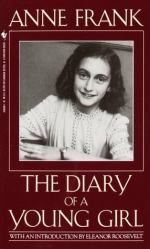
No single individual has come to represent the six million Jewish victims of the Holocaust more than the Dutch schoolgirl Anne Frank. Through the postwar publication of her diary Het Achterhuis (Anne Frank: The Diary of a Young Girl), millions of readers around the world came to know one of Hitler's victims personally and a face was put on an otherwise unfathomable and anonymous horror. Chronicling her life in hiding in Amsterdam from the summer of 1942 to the arrest of her family in August 1944, the diary is considered among the most powerful anti-war documents of the era and has been adapted for both stage and screen. Translated into more than 50 languages, the Diary ranks among the best-selling literary works of the twentieth century and has been praised by ordinary readers, literary critics, and political and humanitarian leaders throughout the world. Discussing its poignancy in the foreword to the first Russian edition of the book, the novelist and poet Ilya Ehrenburg wrote, "One voice speaks for six million—the voice not of a sage or a poet but of an ordinary little girl."
Anne Frank was born June 12, 1929 to a wealthy Jewish family in Frankfurt, Germany. With the rise to power of Adolf Hitler and the National Socialists in 1933, the Frank family relocated to Amsterdam, where Frank's father, Otto, a former officer in the German army, established a food preservative business with a combined office and warehouse in a building on the Prinsengracht Canal. Anne Frank attended Montessori school and enjoyed a comfortable life absorbed in the average pursuits of childhood. Following the Nazi occupation of Holland in 1940, a number of restrictions were placed on Jews, and Anne was required to transfer to a Jewish school. Among her friends and classmates she was popular and outgoing and was known as "Miss Chatterbox" because of her incessant talking. On the occasion of her thirteenth birthday in June 1942, Anne was given a cloth-covered diary and began recording her activities in the form of letters to an imagined friend whom she addressed as "Kitty." Soon afterward, Anne's 16 year-old sister, Margot, was summoned to report for transportation to the Westerbork concentration camp, and the family quickly went into hiding, installing themselves in makeshift living quarters arranged by Otto Frank in a "secret annex" at his company headquarters. The Franks were joined by Mr. and Mrs. Van Pelz and their 15 year-old son, Peter. Several months later, Albert Dussel, a dentist, also sought refuge with the group. For more than two years the group lived in the cramped quarters of the secret annex, unable to move around during the day or use bathroom facilities for fear of being discovered by workers in the offices below. Through a small group of protectors they received food and supplies, and at night they listened to war reports on the radio.
Anne and Margot continued their education under the guidance of their father, and Anne documented every facet of their restricted life in her diary, including the strained relations and petty bickering that often characterized interaction among the group. An unknown betrayer alerted police to the Franks' hiding place, and the secret annex was raided on August 4, 1944. The group was first sent to Westerbork and then was shipped by cattle-car to Auschwitz. Anne Frank died of typhoid fever in Bergen-Belsen concentration camp in March 1945, only two months before the surrender of Germany. She was 15 years old.
After the war, Otto Frank circulated typescript copies of Anne's Diary, which had been discovered in the aftermath of the police raid on the secret annex in 1944. The book was formally published in 1947 and was translated into English in 1952. While Anne herself wondered in the diary whether anyone would ever be interested in "the unbosomings of a thirteen-year-old schoolgirl," the Diary quickly became an international sensation, drawing praise for its documentary value as an account of Jewish life in hiding during World War II, but to a greater degree for its lively and perceptive self-portrait of an intelligent and talented writer maturing from child to adult. Its compelling setting offers a consideration of ordinary people facing death in extraordinary circumstances, while revealing Anne's understanding of universal moral issues and her interest in typical concerns of adolescence, including the difficult relationships of mother and daughter and the teenage yearning for love. After reading the diary many young readers felt compelled to write to Otto Frank and until his death in 1980 he corresponded with young people throughout the world. The immense interest in Anne Frank led to the establishment of several humanitarian foundations and educational centers, including a foundation in Amsterdam that also maintains the secret annex as a historic site open to the public. Summarizing the broad appeal of the Diary, theatrical director Garson Kanin concluded in 1979 that "Among other things, the vision of Anne Frank reminds us that the length of a life does not necessarily reflect its quality … [She] remains for us ever a shining star, a radiant presence, who, during her time of terror and humiliation and imprisonment, was able to find it within herself to write in her immortal diary, 'In spite of everything, I still believe that people are good at heart'."
Further Reading:
Ehrenburg, Ilya. Anne Frank Diary: Chekhov, Stendahl, and Other Essays. Trans. Tatiana Shebunia and Yvonne Kapp. New York, Alfred A. Knopf, 1963.
Frank, Otto H., and Mirjam Pressler, editors. The Diary of a Young Girl: The Definitive Edition. Trans.Susan Massotty. New York, Doubleday, 1995.
Kanin, Garson. "Anne Frank at 50." Newsweek. June 25, 1979, pp. 14-15.
Steenmeijer, Anna G., editor. A Tribute to Anne Frank. Garden City, New York, Doubleday, 1971.
This is the complete article, containing 952 words
(approx. 3 pages at 300 words per page).