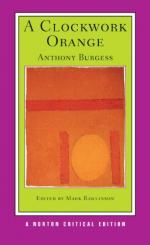
A Clockwork Orange
A Clockwork Orange is one of the finest sociological and science fiction films ever made. With its highly stylized and often comic violence, its over-the-top set decoration, and its unlikeable protagonist, the film has exerted a wide-ranging influence on popular culture. Opening in New York on December 20, 1971, to mostly ecstatic praise, A Clockwork Orange immediately revolutionized the science fiction film by opening the way for more elaborate dystopian narratives and intelligent cinematic analyses of social dilemmas.
Based on Anthony Burgess's 1966 novel of the same name, A Clockwork Orange tells the story of Alex (Malcolm McDowell), a brilliant young thug whose thirst for violence, rape, and aggression lands him in prison. To free himself from prison, he must submit to a perverse behavior modification technique that strips him of his free will. Director Stanley Kubrick's portrayal of conditioned-reflex therapy, behavioral psychology, and systematized and bureaucratic cruelty placed audiences in the uncomfortable position of feeling sympathy for a brutal and seemingly immoral character.
Kubrick counters Alex's brutality with that of the State police. Alex's earlier crimes pale in comparison to his torture by his old gang buddies-cum-cops. His medical rehabilitation by the Ludovico technique, which includes viewing endless scenes of rape, murder, lynching, and violence while listening to the music of Alex's beloved "Ludwig Van" (Beethoven), seems more egregious than any injury Alex inflicted. These juxtapositions force the audience to make an uncomfortable moral choice between the virtue of free will with all its perversions and the appeal of legislative/social control with its tendency toward totalitarianism. Though Kubrick had touched on these themes in his earlier films—including, Paths of Glory (1957), Dr. Strangelove, Or, How I Stopped Worrying and Learned to Love the Bomb (1964), and even Spartacus (1960) and 2001: A Space Odyssey (1968)—none illustrated his message as well as A Clockwork Orange.
Kubrick accentuates the moral choices in the film with brilliant cinematic couplings. He sets a murder/rape scene to "Singin in the Rain," a song celebrating the optimism and bliss of life. He pairs Alex's desire for pain and violence with his love and devotion to Beethoven, which is highlighted by Kubrick's use of both classical and electronic music throughout the film. His elaborate set designs contrast the blue-and white-collar worlds with the State. The Cat Lady's enormous penis sculpture and the submissive, objectified naked female sculptures at the Korova Milkbar are strikingly different from the "flatblock" State architecture of the prison and Alex's parents' home, which is an eerie twin of the Housing Authority projects littering the inner cities of the world. Kubrick also highlights the differences between the flatness of the "official" language and the vitality of the teenage argot, Nasdat: a home is called "HOME," but in Nasdat "horrorshow" means awe and pleasure and "in-out-inout" is a evocative term for sex.
These cinematic exercises are reflected by innovations in technique specific to Kubrick's filmmaking. His hallmarks include chilling natural lighting, extreme close-ups, interminable tracking or panning shots, jump-cut sequencing, extreme wide-angle lenses, and low-angle and slow motion shots. Kubrick's technical precision is matched only by his deeply intellectual consideration of timeless issues of freedom, pleasure, law, and punishment. Though New York Times film critic Pauline Kael criticized the lack of "motivating emotion" in the protagonist and comic violence, many film directors found much worth borrowing from it. Films using similar techniques include THX-118, Westworld, and A Boy and His Dog. Reflections of the movie's highly complex and ambiguous antihero can be seen in films by Martin Scorsese, David Lynch, and Quentin Tarantino. In addition, the midnight movie crowd adopted the film's unique language called Nasdat and would shout along with the movie on college campuses across the country. Kubrick's daring vision for A Clockwork Orange was rewarded with the New York Film Critics Award for Best Picture as well as four Academy Award nominations. The film placed its director in the company of the most influential and creative artists of the twentieth century.
A scene from the film A Clockwork Orange.
Further Reading:
Kagan, Norman. The Cinema of Stanley Kubrick, New Expanded Edition. New York, Continuum Publishers, 1995.
Nelson, Thomas Allen. Kubrick: Inside a Film Artist's Maze. Bloomington, Indiana University Press, 1982.
Walker, Alexander. Stanley Kubrick Directs, Expanded Edition. New York, Harcourt, Brace and Jovanovich, 1972.
This is the complete article, containing 708 words
(approx. 2 pages at 300 words per page).