 Print
Print Word
Word PDF
PDF

|
The Tin Drum Topic Tracking: Red & White
Topic Tracking: Red & White
Chapter 2
Red & White 1: Oskar's grandfather, Joseph Koljaiczek, paints a sawmill fence red and white in a fit of Polish national sentiment. His boss rips out one red and one white fence slat, hits Koljaiczek with them, then demolishes the fence. Koljaiczek then sets fire to the sawmill.
Chapter 4
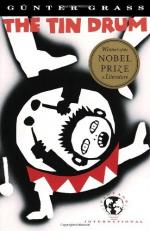
Red & White 2: Oskar refers for the first time to the triangular lacquered pattern on the outside of his drum, which is alternately red and white.
Chapter 6
Red & White 3: Oskar's kindergarten teacher Auntie Kauer starts to knit a harness of red yarn for her students to add to the several blue ones. Oskar laments that he never gets to wear the harness, thought he does roll up the yarn for his teacher.
Red & White 4: Stephan Bronski is beat up by a fellow kindergartener, making his nose bled even more red than Auntie Kauer's red yarn. The boy calls Stephan a "Polack" repeatedly as he hits him.
Chapter 7
Red & White 5: Oskar tries to get Greff to be his teacher by practicing his Sütterlin script with a red pencil on white cardboard. It is obvious that Greff, the boy scout leader, does not understand Oskar.
Chapter 10
Red & White 6: Oskar makes reference to the rallies in terms of their color - he says he broke up "brown rallies on a drum which though red and white was not Polish." Chapter 10, pg. 124
Brown = color of the Nazi uniforms
Red & White = color of both the Polish and Nazi flag
Red & White 7: Oskar sings a hole in a jewelry shop window so that the man he believes to be his father, Jan Bronski, can steal a necklace of red rubies set in gold. In that scene, he is compared to the mythological Parsifal, whose attention was captured by drops of red blood in white snow.
Red & White 8: After the war, Oskar trades the necklace for a briefcase and twelve cartons of Lucky Strike cigarettes - the label for Lucky Strikes is a red circle on a white background.
Chapter 12
Red & White 9: In his parent's bedroom, Oskar thinks back to his childhood doctor's visits, and focuses on Sister Inge's white nurse's suit and brooch with a red cross. He says she made him fall into a sleep "born of the folds of white fabrics" in which he saw the brooch "expand into heaven knows what: a sea of banners, the Alpine glow, a field of poppies, ready to revolt, against whom, Lord knows: against Indians, cherries, nosebleed, cocks' crests, red corpuscles, until a red occupying my entire field of vision provided a background for a passion which then as now was self-evident but not to be named, because the little word "red" says nothing..." Chapter 12, pg. 156
Chapter 15
Red & White 10: After sitting on the granite banister outside the Maritime Museum waiting for Herbert, he describes slipping off the banister and his drum hitting against the rock - little pieces of red and white lacquer chip off and lie on the steps.
Chapter 17
Red & White 11: Oskar describes how his grandmother Anna would not like him under her skirts when the family was around, because they would remind her of begetting Agnes with Joseph Koljaiczek in the potato field. On such occasions, Anna would blush red. Oskar says her blushing was becoming to her, because her hair at the time was white, since she was almost sixty.
Chapter 21
Red & White 12: On the way to the beach with Maria, Oskar sets up a parallel between the painfully white walls of Saspe cemetery, where Jan Bronski is buried, and the salvation of Maria's necklace, a string of red wooden cherries.
Chapter 29
Red & White 13: Oskar relates that the mere sight of his son Kurt's knuckles would make his nose gush blood, simply because the boy's fists were clenched so tightly that his knuckles were white.
Chapter 30
Red & White 14: The Rennwand brothers perform Mass with mister dressed in their red and white choirboy uniforms. So as not to blind Oskar, Narses and Bluebeard use the red beam on their flashlights to light Oskar on the statue. When the police come in, they use their white beams only.
Chapter 39
Red & White 15: Raskolnikov, the brilliant art student who paints the masterpieces of Oskar and Ulla together, is described as having fiery red hair.
Chapter 45
Red & White 16: To save Victor Welhun from execution, Oskar drums the Polish national anthem, and ghostly spirits of the Polish cavalry, carrying the red and white banners of Poland, emerge from the ground and carry off both Victor and his executioners.