 Print
Print Word
Word PDF
PDF

|
The Tin Drum Author/Context
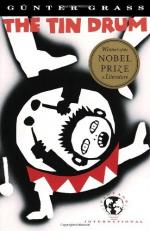
Günter Grass was born on October 16, 1927 in Danzig, a northern port city in Poland. His parents owned a small retail grocery store. He attended both elementary and high school in Danzig, and later became an anti-aircraft gunner. He served as a soldier in World War II and was wounded by the Russians during an advance in 1944. In 1945, he was kept as a military prisoner by the American forces in Bavaria for several months. He became a farm and mine worker in the Rhineland after his release, then became an apprentice stone carver in Düsseldorf. Once the Düsseldorf Art Academy opened in 1948, he studied sculpture and painting there for two years. After that, he began to travel in Italy and France, and then resumed his art study in Berlin in 1953. The next year he married a Swiss ballet dancer named Anna Schwarz, and won third prize in a poetry competition. In 1956, he moved to Paris and held his first art exhibition in Stuttgart. In 1956 and 1957, he finished his first plays, then in 1958, he received prizes of stipends to proceed with his writing career. In 1959, he became famous with the publication of Die Blechtrommel (The Tin Drum), winning several international awards, including the Nobel Prize in Literature. He is most well-known for his fiction, which include Katz und Maus (1961; Cat and Mouse,1963), Hundejahre (1963; Dog Years,1965), Der Butt (1977; The Flounder,1978), Kopfgeburten: oder die Deutschen sterben aus (1980; Headbirths: or, the Germans Are Dying Out,1982), and Unkenrufe (1992; The Call of the Toad,1992). The Tin Drum was later made into a motion picture (1979). Grass has been heavily involved in politics throughout his life, and his political essays have been influential in the thinking of the Social Democratic Party in Germany.
Grass' fiction borrows much of its influence from twentieth century movements such as Expressionism and Theater of the Absurd. He is known for his use of objects and objective correlative to propel his story line, instead of strict narrative. Grass sees a separation between the man-made categories of morality and logic and the actual thread of events. His chosen objects take on a certain ambiguity of meaning and lack straightforward morality. His objects take an individual personality in his novels, becoming extended metaphors and motifs that hold throughout the text. In the same vein, Grass plays with time in his work, both extending and foreshortening traditional narrative distance and flow. This holds for point-of-view as well - Oskar in The Tin Drum uses several points of view, sometimes layered simultaneously. Grass' work also represents success as parody; The Tin Drum's style is a parody of Goethe's novel Wilhelm Meister, which follows a young man through his education to maturity.
Bibliography
Cunliffe, W. Gordon. Günter Grass. Twane Publishing. New York, 1969.
Grass, Günter. The Tin Drum. Vintage International, Vintage Books. New York, 1990.
"Grass, Günter Wilhelm." Microsoft Encarta Encyclopedia '99. Microsoft Corporation, 1999.