 Print
Print Word
Word PDF
PDF

|
A Tale of Two Cities Author/Context
Charles John Huffam Dickens was born on February 7, 1812, in Portsmouth, England. He moved with his family to London and later to Chatham, Kent, where he had many happy childhood experiences. His father was a well-paid clerk in the Navy pay office, but was extravagant and wasteful with his money. He eventually landed in a debtor's prison, and Charles was forced to quit school and work in a factory, an experience that scarred him. Though he detested his brief foray into the working class, the experience acquainted him with the struggles and poverty of the lower classes, and he gained a sympathy for them that appeared in his later works. After his father's release from prison, he re-entered school briefly but left at age 15. After briefly working for two legal firms, he learned shorthand and became a court reporter, which gave him the legal knowledge he later used in his novels. He became romantically involved with Maria Beadnell, a woman who would haunt him for years after their affair cooled because she deemed his family and his prospects unsatisfactory. She briefly reentered his life years later, an experience that proved disappointing and disillusioning to Dickens.
After acting on the London stage and seriously considering a career in the theater, Dickens became a parliamentary reporter for the Mirror of Parliament and the True Sun. His experiences as a reporter left him with a life-long affection for journalism and a suspicion of law and parliament. He published his first sketch, "A Dinner at Poplar Walk," in the Monthly Magazine in 1833. In 1836 he married Catherine Hogarth, became editor of Bentley's Miscellany, and published Sketches by "Boz." A year later, "Oliver Twist" began to appear as a serialization in Bentley's Miscellany. A year later, "Nicholas Nickelby" began to appear, and the first of his nine children was born. After the publication of "Barnaby Rudge," he visited the United States. Though he was warmly welcomed, the experience left him disillusioned with the country. Following the publication of "Martin Chuzzlewit," and "A Christmas Carol" and the births of several more children, he served briefly as the editor of the Daily News. In 1849, he began serialization of "David Copperfield," probably his most successful novel.
As a personality, Dickens was popular and engaging; he was considered to be one of the best after-dinner speakers in London and was popular in his circle of sophisticated and illustrious friends. Dickens relished his public popularity and long maintained a deep affection for his public. He was convivial, yet complicated; his creative process was marked by a deep commitment to punctuality and organization, along with the long walks through the London streets that became essential to his creativity. He was devoted to his children and prided himself on maintaining a happy home and family life. This happiness eventually deteriorated, however, in later years. Tragedy struck when several of his children died. He also fell out of love with his wife, and some of his other children proved to be disappointing to him.
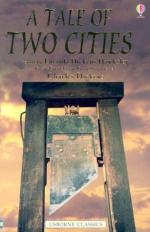
In 1856, he collaborated with Wilkie Collins, a close friend, on a play, "The Frozen Deep." When the play was produced a year later, Dickens fell in love with one if the actresses, Ellen Ternan. His scandalous affair led to his separation from Catherine in 1858, but it did nothing to dim his immense public popularity. His romance with Ternan continued until his death. After his separation from Catherine, he began to perform public readings, an act he greatly enjoyed and would continue for many years. Also that year, he began to publish installments of A Tale of Two Cities.
A Tale of Two Cities was one of Dickens' final novels and a departure from his usual style. It was a dense narrative that relied less on humor, dialogue, and characterization than usual. Though it remains a staple on high school reading lists, it is not generally regarded from a critical standpoint as one of his major works. While many readers, and Dickens himself, found Sydney Carton's self-sacrifice to be extremely moving, many critics are now more impressed with Dr. Manette as an achievement in characterization. The following year, he published Great Expectations, which is considered to be less ambitious than earlier novels but still his finest literary achievement. In 1864, he published Our Mutual Friend, another novel of social criticism. Though his health was by now deteriorating, he nonetheless embarked on a second reading tour of America. During this time, critics became more hostile to him, and he struck friends as being sadder than before. His sons continued to cause him worry and disappointment, though he still loved the country house, Gad's Hill, which became his permanent home until his death.
In 1865, he was injured in a railway accident; an experience that left him badly shaken and that proved to be the beginning of a descent into poor health. He collapsed in 1869 during a farewell reading tour. He gave one more short series of readings in London and began writing his last novel, Edwin Drood. The novel was never completed; Dickens suffered a stroke and died at Gad's Hill on June 9, 1870, at age 58. He was buried at Westminster Abbey.
Despite the critical hostility he faced in his later years, he is now considered to be ranked second only to Shakespeare in the canon of English authors.
Bibliography
Dickens, Charles. A Tale of Two Cities. New York: Barnes and Noble Books, 1993.
Marzials, Frank T. Life of Charles Dickens. London: Walter Scott, 1887.
Murray, Brian. Charles Dickens. New York: Continuum, 1994.
The New Encyclopedia Britannica, Volume 17. Chicago: The University of Chicago, 1992.
Priestly, J.B. Charles Dickens: A Pictorial Biography. London: Thames and Hudson, 1961.