 Print
Print Word
Word PDF
PDF

|
To Kill a Mockingbird Author/Context
Nelle Harper Lee was born April 28, 1926 in Monroeville, a small Alabama town. Lee, a descendant of Confederate General Robert E. Lee, is the daughter of Amasa Coleman and Frances Fincher Lee.
Lee's father was a lawyer in Monroeville, much like Atticus Finch in Maycomb County. Lee was educated in the public schools of Monroeville, and was a childhood friend of Truman Capote, author of In Cold Blood, The Glass Harp, and Breakfast at Tiffany's. After high school, she attended Huntington College in Montgomery, Alabama from 1944 to 1945. Four years later, Lee went to the University of Alabama to study law. While there, Lee contributed to several campus publications. She left the university six months before completing her degree and struck out for New York and a literary career.
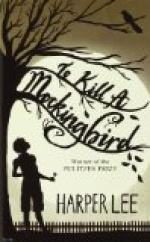
During the 1950s Lee worked as a reservations clerk before she gave up the job to focus intensely on her writing. A literary agent who'd read her manuscript of three essays and two short stories encouraged her to expand one of the stories into a novel. This work became her first and last novel, To Kill a Mockingbird (1960). This work won the 1961 Pulitzer Prize for Fiction as well as the Alabama Library Association Award and the Brotherhood Award of the National Conference of Christians and Jews. In 1962 she received the Bestsellers' paperback of the year award. Lee's novel remained on the bestseller list for over eighty weeks. To Kill a Mockingbird has been translated into ten languages and adapted for film by Horton Foote. The movie was released in 1962 and starred Gregory Peck as Atticus Finch.
"Although occasionally faulted as melodramatic, To Kill a Mockingbird is widely regarded as one of the most sensitive and revealing portraits of the American South in contemporary literature."
Edgar H. Shuster is quoted in World Literature Criticism as saying, "The achievement of Harper Lee is not that she has written another novel about race prejudice, but rather that she has placed race prejudice in a perspective which allows us to see it as an aspect of a larger thing; as something that arises from phantom contacts, from fear and lack of knowledge or 'education' that one gains through learning what people are really like when you 'finally see them.'"
Since the publication of To Kill a Mockingbird in 1960, Lee has contributed a few nonfiction pieces to national magazines, but has written nothing else of great note.
Bibliography
Blackwell, Louise. "Lee, Harper." Southern Writers: A Biographical Dictionary. ed. Robert Bain, Joseph M. Flora, and Louis D. Rubin, Jr. Louisiana State University Press: Baton Rouge, 1979.
Lee, Harper. To Kill a Mockingbird. New York: Warner Books, Inc., 1960.
"Lee, Harper." Biographical Dictionary. New York: Chambers Harrap Publishers Ltd., 1997.
"Lee, Harper." World Literature Criticism: 1500 to present. ed. James P. Draper. vol. 4. Detroit: Gale Research Inc., 1992.