 Print
Print Word
Word PDF
PDF

|
The Color Purple Author/Context
Alice Walker (1944 - ?)
Born on February 4, 1944 to two sharecroppers in Eatonton, Georgia, Alice Walker was the youngest of eight children. Her parents, Willie Lee and Minnie Lou Grant Walker, filled her with stories about their hardships and those of their families as a black family in the south. As part of a large family, Walker was constantly physical with her brothers and sisters, playing and fighting in the fields. One accident turned nearly fatal when her one of brothers' BB guns went off in her direction, causing her to lose sight in one eye. Despite her partial loss of eyesight, Walker was a diligent student, finishing her classes with top grades. She graduated as the valedictorian of her high school class, securing a space at Spelman, the all black women's college in Atlanta. After two years of study, Walker transferred to Sarah Lawrence College and took full advantage of its opportunities. She participated in an exchange program in Africa and traveled around New York until graduation in 1965. She worked for several years in New York before returning to the south.
She began writing about black women living in America, seeing first hand the difficulties faced as a people. Because her youth was so filled with persecution and separation, Walker found herself involved heavily in the Civil Rights Movement of the 1960s. She wrote articles, went to speeches, and even marched on Washington with Martin Luther King, Jr. As one of the earliest and most celebrated contemporary African-American writers, Walker found inspiration in Zora Neal Hurston and served as a source of inspiration for writers such as Toni Morrison and Maya Angelou. Since The Color Purple, she has continued a prolific career in writing novels, poetry, and essays. Her wide body of work includes: Once (Poems), The Third Life of Grange Copeland, In Love & Trouble: Stories of Black Women, Langston Hughes: American Poet (editor), You Can't Keep a Good Woman Down: Stories, The Color Purple, In Search of Our Mothers' Gardens: Womanist Prose, To Hell With Dying, Living by the Word, The Temple of My Familiar, Possessing the Secret of Joy, Warrior Marks, The Same River Twice: Honoring the Difficult, Anything We Love Can Be Saved: A Writer's Activism, By the Light of My Father's Smile, and The Way Forward Is With a Broken Heart.
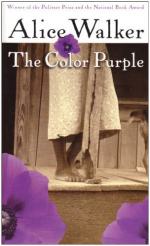
The Color Purple was published in 1982 to instant critical acclaim and popular success. It won, among numerous awards, the Pulitzer Prize for fiction in 1983, and was quickly made into an Oscar-winning film in 1985 by Steven Spielberg. According to Publisher's Weekly, the novel is "a saga filled with joy and pain, humor and bitterness, and an array of characters who live, breathe and illuminate the world."
In addition to the Pulitzer, Walker is the recipient of numerous other prestigious awards and honors. They include the Lillian Smith Award from the National Endowment for the Arts, the Rosenthal Award from the National Institute of Arts & Letters, a nomination for the National Book Award, a Radcliffe Institute Fellowship, a Merrill Fellowship, a Guggenheim Fellowship, and the Front Page Award for Best Magazine Criticism from the Newswoman's Club of New York.
One critic claims that "Alice Walker's best writing is like balm: soothing, restorative, and earthy...Walker's lovely prose rarely falters. Her gifts are evident on almost every page." She lives in Northern California and continues to write and lecture.
Bibliography
Anniina's Alice Walker Page. 10 September 2002.
Biography.com - Alice Walker. 10 September 2002.
Mitgang, Herbert. "Alice Walker Recalls the Civil Rights Battle." The New York Times. April 16, 1983.
Walker, Alice. The Color Purple. Washington Square Press, New York: 1983.
Walker, Alice. The Way Forward is with a Broken Heart. Ballantine Books, New York: 2000.