 Print
Print Word
Word PDF
PDF

|
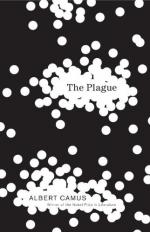
The Plague Notes & Analysis
The free The Plague notes include comprehensive information and analysis to help you understand the book. These free notes consist of about 40 pages (11,996 words) and contain the following sections:
These free notes also contain Quotes and Themes & Topics on The Plague by Albert Camus.
The Plague Plot Summary
The book is divided into five sections, each of which tells of a distinct period in the plague's takeover of Oran, the port city in northern Algeria where the story is set. Part 1 describes Oran as it was before the plague and just after the disease has taken hold. Bernard Rieux, the town doctor, notices a dead rat in the hallway of his apartment building one ordinary morning, and thereafter, nothing in his or anyone's life in Oran is normal. Thousands of the town's rats die, then cats and dogs, and finally the disease starts to infect people. Jean Tarrou, a visitor trapped in Oran, keeps a journal about the plague's effect on the people of Oran, and it includes stories about characters like Joseph Grand, an insignificant city worker, and Cottard, a man who is mysteriously happy about the outbreak of the plague. By the end of this section, the people of Oran are forced to realize their dull and habitual ways may be gone for good. The town gates are shut, and Oran is now a prison cell, where no one can go out or come in.
Part 2 of the book tells what happens when the plague becomes "the concern of all of us." (67). In this section, the townspeople struggle to fight their individual battles against the plague and the suffering and separation it forces them to endure. Characters like Raymond Rambert, who begins negotiating with smugglers, try to imagine ways to escape the city and meet up again with their loved ones. Father Paneloux, the town priest, preaches a fiery sermon that claims that God has sent the disease upon the people of Oran as a punishment for their sins. Tarrou starts voluntary sanitary squads in town, and many people, including Grand and Rambert, volunteer to help.
By the beginning of Part 3, "the plague had swallowed up everything and everyone. No longer were there individual destinies; only a collective destiny, made of plague and the emotions shared by all." (167). In this short third section, the narrator tells us of the worst period of the disease, the brutally hot summer months when the plague kills so many people that there's no space left to bury them. The town crematorium is burning bodies at top-capacity and everyone in the city suffers terrible feelings of pain and exile.
In Part 4 there is more attention paid to the emotions of some of the main characters. Cottard is still strangely cheerful about the plague. Rambert's getaway plans seem ready to go through, but the journalist has a last-minute change of heart and decides to stay in Oran to help fight the disease. Many of the story's main characters, including Dr. Rieux, Joseph Grand, Jean Tarrou, and Father Paneloux, are affected profoundly when they witness the death of a young child. After this experience, Paneloux gives a second sermon, and it shows far more sympathy for the suffering people of Oran. One evening, Tarrou explains his life philosophy, which centers on a passionate opposition to the death penalty, to Dr. Rieux. Grand falls ill and seems certain to die of the plague, but makes a sudden and miraculous recovery. The same "resurrection" happens to a woman in town, and by the end of this section, the rats, alive now, have begun to resurface in the city.
In the final section, the plague leaves just as suddenly as it came. After a public announcement that the epidemic seems to be over, a big celebration is held in the streets. Then the gates are opened, and families and lovers--including Rambert and his wife--are reunited. Cottard, despairing that the plague has gone and left him alone with his suffering again, has a crazy shooting fit, which ends with him being dragged away by the police. At this point, Dr. Rieux reveals that he is the story's narrator. Though he has suffered greatly, and now finds out that his own wife is dead, he says he hoped to retell the book without it being his story. He wanted to "take the victims' side," sharing with them the feelings of love, exile, and suffering that all felt during the time of the plague. The book ends with the haunting observation that although the plague bacillus can go into hiding for years and years, it never dies or disappears for good.