 Print
Print Word
Word PDF
PDF

|
Mythology Author/Context
Edith Hamilton was born in 1867 in Dresden Germany. Her family immigrated to the United States and she was educated both at home and in a private school for girls. She learned Greek, Latin, German and French. While attending Bryn Mawr, she was awarded the European Fellowship. She studied in Europe for several years. When she returned to the United States, her families fortunes had changed. She went into teaching. The Bryn Mawr School offered her their head position and she taught there until her retirement in 1922. It was not until 1930 that she began to write books. Her endeavor began as she translated Aeschylus for friends. Over the next 35 years, she wrote many books and gained much public acclaim. In 1957, after the publishing of her final book, she was made an official citizen of Athens, Greece. She received many honorary awards and degrees in the U.S. She died five years later at the age of 96.
Hamilton was a very popular schoolteacher of the Classics at Bryn Mawr. Her writing began as translation and explanation exercises for friends and escalated into full-scale scholarship. Her interest began in the individuality of the Greek persona in literature and mythology. She found the study of this to be highly relevant to modern Western civilization. This was the focus of her first book The Greek Way. The Roman Way followed similar themes in Roman literature, culture, religion, and history.
As she continued to write and translate, Hamilton realized that there was a need for an easy to read compendium of Greek Mythology for the every day reader. Readers of her translations and other books had no frame of reference for many of the myths to which she was referring. In her foreward:
"My hope is that those who do not know the classics will gain in this way not only a knowledge of the myths, but some little idea of what the writers were like who told them - who have been proved, by two thousand years and more, to be immortal."
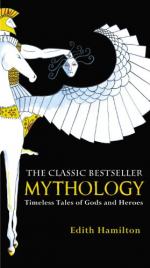
She created her Mythology after going to primary sources such as Hesiod, Homer, Ovid, Virgil and Sophocles. Published in 1942, the book was received well in the public but she never expected it to be the success it turned out to become.
Her following books continued to deal with mythology but also branched off into Christian religion. Readers found that her background in the Classics gave them a new and profound insight into Biblical text and interpretation. Spokesman for God was one of her more popular books in this genre.
At the age of ninety, Hamilton published her translation of Prometheus Bound. Although many modern scholars and critics have qualms with her interpretation, her work has become a mainstay of public education. While her other books have gone out of print, Mythology has been reprinted many times. As a woman scholar, she paved the way for more women to work in a traditionally male-dominated field. She was respected, and more important, financially successful. Sixty years after its publishing, it has become, as Ken Moore says, "the premier book dealing with the ancient myths of Greek Roman and Norse Lore."
Bibliography
Hamilton, Edith. Mythology. New York: Little, Brown and Company, 1998, 1942.
Moore, Ken. ' Mythology by Edith Hamilton.' Naples Daily News, October 10, 1998.
Reid, Doris Fielding. Edith Hamilton: An Intimate Portrait. New York: Norton and Company, 1977.
Weatherford, Doris. American Women's History. New York: Prentice Hall General Reference, 1994.