 Print
Print Word
Word PDF
PDF

|
Little Women Author/Context
Louisa May Alcott was born in 1832 in Germantown, Pennsylvania. She was the second of four girls. Her father, Bronson Alcott, was philosopher and teacher who had a difficult time earning money for the family because of his untraditional methods and ideas. Because of this, the family was constantly on the move in areas in and around Boston, Massachusetts.
Bronson Alcott, friend to essayist Ralph Waldo Emerson and writers Henry David Thoreau and Nathaniel Hawthorne, brought his family up in an atmosphere of intense moral convictions. The family did not wear cotton, as it was produced by slave labor in the south. At one point, Bronson Alcott had his own school for children; he was forced to close it after he admitted a black girl. The family lived for a while in a utopian community called Fruitlands, a project started by Alcott and his friends. The community failed after two years. After briefly courting the idea of becoming Shakers, the family instead opted to live at a house called The Wayside in Concord, near Emerson and Thoreau. Although they still moved several times after this, they finally settled in the Orchard House, which Emerson purchased for them. Louisa wrote Little Women in the Orchard House and based the March family story there.
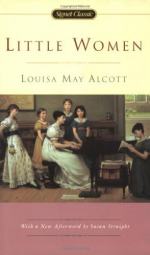
Louisa began writing adventure stories and fables at a young age and published what she could, earning little notice. It was not until she published the semi-autobiographical novel Little Women in 1868 that she began to achieve acclaim. She followed Little Women with several other successful novels, such as Little Men and Jo's Boys. She was able to establish financial security for her family through the success of her writing. She also became active in the women's suffrage movement and the temperance movement.
In 1862, during the Civil War Louisa worked as a nurse in Washington. Here she contracted mercury poisoning from medicine used to treat the wounded. She suffered from the effects of mercury poisoning for the rest of her life, finally dying of it in Boston in 1888.
Bibliography
Alcott, Louisa May. Little Women. New York: Pocket Books, 1994.