 Print
Print Word
Word PDF
PDF

|
The Handmaid's Tale Author/Context
Margaret Atwood was born on the eighteenth of November, 1939, the daughter of a forest entomologist. She traveled for much of her childhood between the wilderness of Northern Ontario and the capital, Ottowa. Atwood went to high school in Toronto, majoring in home economics, but at the age of sixteen determined to become a writer. She received her undergraduate degree from the University of Toronto and her graduate degree from Radcliffe College. In 1966, Atwood's first published collection of poetry, The Circle Game, gained critical praise, and in 1969 her first novel was published, The Edible Woman. It was made into a film soon after. Atwood was one of the most sudden literary successes in Canadian history.
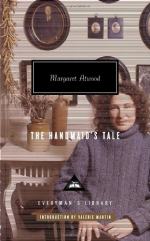
In 1986, The Handmaid's Tale was published and became a bestseller. It was written during the anti-feminist backlash of the 1980s in which feminists were criticized for breaking up the traditional home. The book is composed of two parts: the Handmaid Offred's diary and the Historical Notes, which provide more historical context for the Tale and another fictional perspective of Offred's society. Atwood wrote The Handmaid's Tale in an attempt to illustrate the logical extension of anti-feminists statements such as "it is every man's right to rule supreme at home" and "a woman's place is in the home." The Handmaid's Tale is often described as a feminist dystopia (negative utopia) because it is set within an imperfect society of the future, and addresses the misogyny of patriarchal culture. Other influences on the book acknowledged by Atwood include her studies of the American Puritans and the Iranian monotheocracy of the 1970s and 1980s.
Throughout her career Margaret Atwood has received numerous awards and honorary degrees. She is the author of over 23 books fiction and nonfiction. Her work is published in more than 25 countries. Atwood currently lives in Toronto with novelist Graeme Gibson and their daughter.
Bibliography
Atwood, Margaret. The Handmaid's Tale. New York: Anchor Books, 1986.
Brooks Bonson, J. Brutal Choreographies. Amherst: The University of Massachusetts Press, 1993.
Davey, Frank. Margaret Atwood: A Feminist Politics. Vancouver: Talon Books, 1984.