 Print
Print Word
Word PDF
PDF

|
The Good Earth Author/Context
Pearl Comfort Sydenstricker was born on June 26, 1892 in Hillsboro, West Virginia. Her father, Absalom Sydenstricker, a West Virginian, was a preacher who was afflicted by the missionary craze of the 1880s. Pearl's mother, Carie Stulting, had met Absalom Sydenstricker, a minister of the Southern Presbyterian Church, in Hillsboro, her birthplace. The couple married in 1880, and set out for California where they would board a steamer that would take them to China. As Presbyterian missionaries and God's agents, they arrived in Hangchow, China to save the unfortunate Chinese who were ignorant about Christianity.
Pearl was sixth of the seven children of Absalom and Carie. She was born in the United States during her parents' year of home leave from China. She was taken to China when she was three months old. As a precocious child, she asked many questions and read everything that came within her reach. She was educated at home by her mother and a Chinese tutor, fist publishing in the Christian Observer as a girl of six. She began to write regularly for the Shanghai Mercury, an English newspaper that offered rewards for children's stories and essays. Pearl was encouraged by her mother to write every week, and later decided to become a novelist. Living in Chiangking, Pearl learned Chinese before any other language, and played with Chinese children. She grew up with Chinese customs and traditions, even having a Chinese governess. Later she said that as a child, she simultaneously belonged to two worlds-an American missionary world and a Chinese world. This explains her wish as a novelist to encourage intercultural understanding among different peoples.
During the time Pearl was growing up in China, the country was restless and violent, and hatred against foreigners culminated in the Boxer Uprising of 1900. During the fearful time, Pearl and the rest of her family, except for her father, went to live in Shanghai. In 1901, the family, including Absalom, went to the United States, but returned to Chiangking after a year. During adolescence, Pearl was sent to a nearby missions school for girls. Pearl wanted to attend college in the United States, and attended Randolph-Macon Woman's College in Virginia, a Christian institution. Finding encouragement and academic stimulation at Randolph-Macon, Pearl adapted well to her collegiate life, but continually felt like an outsider because she embraced a culture that Americans found alien. She studied Philosophy, and teacher assisted Psychology for a year after graduating.
After graduating, Pearl stayed in America, but sought a passage to China when she received news of her mother's illness. In China, she met John Lossing Buck, an American agricultural missionary who arrived after the Chinese Revolution. Pearl and Lossing were married in Chiangking in 1917, and immediately moved to Ahnwei where Pearl gathered ideas for The Good Earth. Although the marriage lasted for eighteen years, it was hardly a happy one.
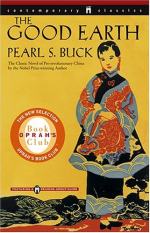
Pearl began writing during what she called a "fantastic era," a period of turmoil for China. She published stories in Nation, The Chinese Recorder, Asia, and Atlantic Monthly. Her first novel was East Wind, West Wind which was published by the John Day Company in 1930. She later divorced Lossing, and married John Day's publisher, Richard Walsh, who published everything Pearl wrote. East Wind, West Wind received favorable review, but Walsh knew that Pearl could write better. The Good Earth was published in 1931, and became the best-selling book of 1931 and 1932, bringing Pearl the Pulitzer Prize, the Noble Prize for Literature, and many other literary honors. Pearl's exquisite storytelling and the appeal of a story about land were two of the many reasons for its high success in America. The novel was translated into over thirty languages, made into a play and an MGM motion picture. Other non-fictional work and novels quickly followed The Good Earth including A House Divided, Dragon Seed, Pavilion of Women, and The Time is Noon.
Pearl S. Buck died in Danby, Vermont on March 6, 1973.
Bibliography
Buck, Pearl S. The Good Earth. New York: Pocket Books, 1958.
Conn, Peter. Pearl S. Buck: A Cultural Biography. Cambridge: Cambridge University Press, 1996.
Stirling, Nora. Pearl Buck: A Woman in Conflict. New Jersey: New Century Publishers, Inc. 1983.