 Print
Print Word
Word PDF
PDF

|
A Farewell to Arms Author/Context
Ernest Miller Hemingway was born in 1899 to a young doctor and his wife, a professional singer. He was the second of six children. His first short story was published in 1916 as part of his high school anthology. Two years later, he enlisted in the reserves for World War One. He was stationed in Italy. After the war, he spent many years of his life as an expatriate between France, Italy, Spain, and Cuba where his wife lived after his death. His first serious novel, The Sun Also Rises, was published in 1926. His father, who had spent most of his life wrestling with depression, committed suicide in 1928. Hemingway was divorced and married several times and sired a couple of children. He won the Nobel prize for literature in 1954 for The Old Man and the Sea. Seven years later, after a few accidents and sicknesses, Ernest Hemingway took his own life at the age of 62.
Hemingway lived during a tumultuous time period of international conflict (World War I and World War II). . This period saw a new development of prose in the works of James Joyce, F. Scott Fitzgerald, and William Faulkner, as well as poetry with Ezra Pound and T.S. Eliot. Hemingway was close associate of Fitzgerald, who often commented on his books. He was also an admirer of Joyce and a financial supporter for an aging Ezra Pound. While other authors, such as George Orwell, were social commentators, Stephen Cooper maintains that "Hemingway seemed to resolutely pursue his own interests" because to him literature was more important than politics. His other novels and short stories such as For Whom the Bell Tolls, and To Have and Have Not, support this focus on the individual. Hemingway flaunted his interest in big game hunting and bullfighting; this was part of what Peter Messent calls "that public persona which the writer himself was only too keen on occasions to foster."
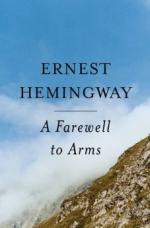
A Farewell to Arms was first published as a series in the United States in 1929. The series was banned in some cities, most notably Boston, for its sexual content. This banning, however, did not affect Hemingway's growing popularity. A Farewell to Arms made its film debut three years later, a debut which Hemingway refused to attend. Hemingway crafted this novel from a wealth of personal experience. He was stationed in Italy in 1918 and wounded that July. During his Hospital stay, he began and ended a relationship with a nurse. Later, when he was free-lance writing in Greece and Turkey, he witnessed the retreat of the Greek army and its civilians.. All of these experiences provided Hemingway with the palette he used to create this tale.
Hemingway's effect on modern American literature is difficult to gauge, but tangible nonetheless. Drastically different authors such as Kerouac have claimed him as an influence. Recent scholarship has panned Hemingway for narrow-mindedness and misogyny, but his work remains indispensable for understanding an important period of our history. As Raymond S. Nelson says, "Hemingway tried to tell the truth about his times, to correct the 'lies' which former generations told, whether wittingly or unwittingly."
Bibliography
Beegel, Susan F. Hemingway's Craft of Omission. Ann Arbor: U.M.I. Research Press, 1988.
Burwell, Rose Marie. Hemingway: The Postwar years and the Posthumous Novels. Cambridge: Cambridge University Press, 1996.
Cooper, Stephen. The Politics of Ernest Hemingway. Ann Arbor, U.M.I. Research Press, 1987.
Hemingway, Ernest. A Farewell to Arms. New York: Scribner, 1929, 1951, 1995.
Messent, Peter. Ernest Hemingway. New York: St. Martin's Press, 1992.
Nelson, Raymond S. Hemingway: Expressionist Artist. Ames. Iowa State University Press, 1979.
Reynolds, Michael. Hemingway: An Annotated Chronology. Detroit: Omnigraphics Inc., 1991.