 Print
Print Word
Word PDF
PDF

|
Emma Author/Context
Jane Austen was born in Steventon, England, in 1775, the seventh of eight children. Her father was a preacher, and the family lived a modest life at the rectory. Education was important to them, and her father was a classics scholar in addition to a preacher. All the children were schooled at home, but Austen also spent several years studying at a school away from home. Her childhood was from all accounts happy; her family often read aloud to each other and performed plays. Her mother was prone to bouts of hypochondria, but otherwise the family was healthy and happy. Everyone encouraged Austen's talent and intellect, and she began writing during her teenage years.
Bath, the area of England most associated with Jane Austen, was her home only for four years, from 1801 to 1805. The family moved there when her father retired, and moved to Southampton in 1805 after her father's death. She lived in Southampton until 1809, when she moved to Chawton. The period during Austen's residence in Bath and Southampton was a stark one from a literary perspective-- Austen wrote little during this time. Travel and tedious social engagements kept her busy in Bath; in Southampton she was troubled by city life and a noisy infant recently added to the household.
Likely because marriage figures so prominently in her novels, much has been made of Austen's decision not to marry. Though there exists little evidence to support any romances, as many of her more intimate letters were destroyed, there is much speculation on the topic. Being unmarried in one's twenties qualified one as a spinster, but Austen accepted and then quickly rejected a proposal made to her at the age of twenty-seven. There is also rumor of a love in her childhood whom she was unable to marry due to her small fortune, and a somber tale of a mystery man who died soon after Austen fell in love with him. Dedicated to her writing and protective of her privacy, there is no record of her complaining about her single life. She became the beloved Aunt Jane to her brother's children, and this seemed to suite her fine.
Austen worked hard on her novels, constantly revising them. She wrote her first work, a satire, at the age of 15. Sense and Sensibility, Pride and Prejudice, and Northanger Abbey were all begun in the 1790s and revised greatly before their publication, with Sense and Sensibility not published until 1811. Pride and Prejudice appeared in 1813,
Mansfield Park the following year, and Emma in 1816. Publishing her novels was important to Austen, though nearly all were published long after they were written; Northanger Abbey and Persuasion were published posthumously. Her desire to publish anonymously was not unusual; for a woman writer, fame could often lead to infamy. It was not until after her death, in 1818, that a biographical note was added to her novels and her authorship was established.
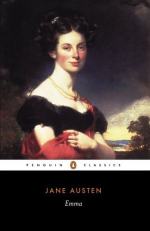
The novelist Virginia Woolf said of Jane Austen, "Of all the great writers she is the most difficult to catch in the act of greatness." Austen was a keen observer of social class and customs, and Emma is no exception. Considered the author's masterpiece, Austen believed she had created "a heroine whom no one but myself will much like." A comical book largely about Emma's errors of judgment, Austen adeptly keeps us from disliking her blundering heroine. She had family and friends read and rate the book, and many preferred other of her works. But readers liked Emma, both novel and character, and this admiration is a credit to the author's skill.
Though a master of prose and observation, Austen did not receive much acclaim by the time she died of Addison's disease in 1817. Today she is the respected and well-read author she worked hard and desired to be.
Bibliography
Austen, Jane. Emma. New York: Bantam Books, 1981.
Bush, Douglas. Jane Austen. New York: Macmillan Publishing Co., Inc., 1975.
Joyce, Elizabeth. "Jane Austen." British Women Writers: A Critical Reference Guide. Ed. Janet Todd. New York: Continuum, 1989.
Stapleton, Michael, ed. Cambridge Guide to English Literature. Cambridge: Cambridge University Press, 1983.
Tomalin, Claire. Jane Austen: A Life. New York: Alfred A. Knopf, 1997.