 Print
Print Word
Word PDF
PDF

|
Dracula Author/Context
Abraham (Bram) Stoker was born in Dublin, Ireland in 1847. Until the age of seven, he was bedridden, always on the verge of death. Nonetheless, after recovering fully from his illness, he became a star athlete at Trinity College, in Dublin.
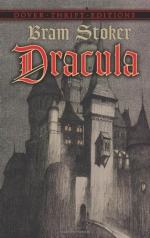
Although Stoker managed to write a number of novels, he was not primarily an author by profession. In 1878 he began to work with his friend, the famous actor Henry Irving, as a manager at London's Lyceum Theatre. His first novel, The Snake's Pass, was published in 1890. That same year he began work on Dracula, which was first published in 1897. In 1900, a paperback version was released. Few people still read The Mystery of the Sea (1902), The Jewel of the Stars (1903) or The Lair of the White Worm (1911); Dracula is generally considered Stoker's only great novel.
Dracula is an example of Gothic literature, a genre that began over a century earlier with Henry Walpole's The Castle of Otranto (1764). Few Gothic novels, though, have enjoyed the long-lasting popularity of Dracula. While some doubt its value as literature, there can be little doubt of its longevity and allure. However, Dracula was one of the last books of the genre. Nonetheless, its effect can be seen in modern-day writers such as Joyce Carol Oates and Anne Rice.
Part of that allure comes from the dark sexual implications of the novel. The irony is that Stoker himself believed immoral sexual content should be censored, a view he out forth in an article called "The Censorship of Fiction" published in Nineteenth Century and After in 1908.
Bram Stoker died in 1912.
Bibliography
Farson, Daniel. The Man Who Wrote Dracula: A Biography of Bram Stoker. New York: St. Martin's Press, 1975.
Fisher, R.L. "Introduction." Dracula. New York: Tom Doherty Association Book, 1988.
Hindle, Maurice. "Introduction." Dracula. Penguin Classics, 1993.
Stoker, Bram. "The Censorship of Fiction." Nineteenth Century and After. LXIV:July-Dec(1908).
Stoker, Bram. Dracula. Penguin Classics, 1993.
Wolf, Leonard. "Introduction." Dracula. Signet Classic, 1992.