 Print
Print Word
Word PDF
PDF

|
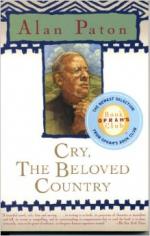
Cry, The Beloved Country Author/Context
Alan Paton was a political activist and a devout Christian, and these two concerns are constantly in the background, and sometimes the foreground, of his most famous novel, Cry, the Beloved Country. Until 1948, he worked as the principal of Diepkloof Reformatory, a place much like the reformatory where Absalom stays. That year, he says, a life-changing event occurred: the publication of Cry. It was a great success-many people were deeply moved by it, politically and spiritually-and it allowed him much more professional freedom. Paton resigned his principalship and decided to try to write full-time. Soon after, another momentous event took place. The Afrikaner Nationalists came to power, and brought with them the notorious policies of racial separateness (called, in their language, apartheid). This meant that Paton, a white man, was hated and disdained by many people around the world who thought that apartheid was unfair, because he benefitted from apartheid, even though he opposed it. In his autobiography, Journey Continued, Paton gives an admittedly oversimplified account of what made many South Africans want to completely avoid the other races of their country. He writes that South Africa was colonized by Dutch and British merchants, and these were later joined by European (Dutch, German, French) farmers called Boers, or Afrikaners. The Boers resented the Dutch and British rule, so they moved north, away from the colonies. To do so, they pushed the indigenous tribes off their land (they had guns, after all, and the tribes did not) giving the tribes tiny bits of land as compensation. Slowly, a small, white minority of the population began to control almost all of the land. The tribal peoples were forced into such poverty (their land was overcrowded and could not be farmed successfully) that they had to work for the white people just to stay alive. South Africa continued to develop in this way, until native crime and white prejudice got so bad that people began to say it would be better if they were separated entirely-right down to the churches and schools. Thus, the idea of apartheid was born.
Paton was strongly against racial prejudice: his parents had raised him as a devout Anglican, and he believed that love and compassion, not political power struggles, were the only hope for South Africa. Though he recognized that white people were to blame for many of South Africa's problems, and white people sometimes come off badly in the book, Paton largely avoids simplistic ideas about race. Instead, he tries to show people as individuals, trying to transcend their races in order to promote brotherhood. Cry thus focuses on one case of native crime (Absalom Kumalo killing Arthur Jarvis) and its effects on the individuals who knew both those men. The book implies that South Africa will be saved one person at a time, whenever people like James Jarvis forgive people like Stephen Kumalo, and whenever people like Stephen Kumalo reach out in Christian kindness to people like James Jarvis. These ideas came from Paton's own experiences with black and white South Africans: he knew that they were individuals with their own hearts and minds, and should be treated as such. Cry is admired for its beautiful language, but it is more famous for its worth as a political treatise. Paton intended it as a novel that could easily be applied to South Africa's real situation at the time of writing.
Cry has been made into a movie, starring Sidney Poitier as Msimangu, as well as a stage production, and even a musical. Paton's other books include Too Late the Pharalope, a lyrical analysis of South Africa's problems similar in some ways to Cry, and a memoir of his life with his first wife Dorrie, For You Departed. He also wrote many essays, poems and stories about South Africans. It can perhaps be said that Cry is Paton's most complete expression of ideas that haunted him all his life: racial prejudice, Christian compassion, and the possibility of renewal for a nearly destroyed but much loved land.
Bibliography
Hartnett, Connor P. Paton's Cry, the Beloved Country and Too Late the Pharalope (A Critical Commentary). New York: Monarch Press, 1965.
Paton, Alan. Cry, the Beloved Country. New York: Macmillan Publishing Co., 1987.
Paton, Alan. Journey Continued. New York: Charles Scribner's Sons, 1988.