 Print
Print Word
Word PDF
PDF

|
The Aeneid Author/Context
Publius Vergilius Maro (commonly known as Vergil or Virgil) was born in October of 70 B.C.E. near Mantua, Italy. He was well educated and went to Rome at the appropriate time for a member of his middle upper-class. He came of age as a writer during a tumultuous period in Roman history. During his lifetime there were several civil wars. Julius Caesar was assassinated by republican loyalists. His nephew, Octavian (Augustus) and Marcus Antonius took up the fight on his behalf. After the defeat of the republicans they turned on each other culminating in Antonius' defeat at Actium in 31 B.C.E. At some point during this time, Vergil entered the circle of a patron named Maecenas who was close associate of Augustus. He died around 19 B.C.E. away from Rome. Some accounts claim that his final orders for the unfinished Aeneid were to have it destroyed. This story, however, remains unsubstantiated.
He began publishing around 40 B.C.E. His first works are called the Eclogues, a collection of pastoral poetry done in the same meter as the Aeneid (dactylic hexameter). This work was influenced by the Greek bucolic genre. Although they are idealistic to a certain extent, they deal with real issues of the time such as land confiscation. Eclogue 4 bears a prophecy of a child who would bring peace. Later, Christians took this as a prediction of the birth of Christ. His next work was the Georgics, a four part didactic poem about farming and the rural life. In this he drew on many influences from earlier antiquity and some more contemporary writers.
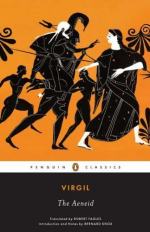
Vergil's final work was the Aeneid. He planned for it to be the Romans' version of the Iliad and the Odyssey put together. For this endeavor, he combined many foundation myths and focused on the Aeneas myth harkening back to Homeric legend. Although his version of the myth has become canonized, many of his details were inventions or alterations. The work was crafted to glorify the rulers of the Imperial age, chiefly Augustus, for having created peace after so many years of war. Vergil spent the last decade of his life working on it and died with it incomplete. When Augustus found the mostly complete manuscript, he had two other scholars prepare it for publication because he liked it so much.
Vergil was a member of what is now called the golden age of Latin Literature. Other poets in this tradition were Catullus, Horace and Ovid. Vergil is, by far, the most widely read of these today. Horace shared Maecenas as a patron with Vergil and Catullus, though dead over a decade before Vergil published, was a member of a very influential movement called Alexandrianism, the elements of which permeate certain parts of Vergil's works. His work was adored by the Caesars and quickly became part of the traditional Roman school and literature program. It became as widely read as the Homeric epics in Latin-speaking areas. His manuscripts were frequently copied and later enhanced with elaborate illustrations. Besides the Homeric epics, his works represent the best manuscript tradition from Classical antiquity.
Because it was so commonly read and respected, the Aeneid became the most well-preserved example of Latin literature from this period. It influenced early medieval authors such as Milton and Dante. Late Renaissance and Elizabethan writers also found Vergil a good source of inspiration. In the twentieth century, Vergil has retained a wide readership through many levels of education, while maintaining influence on writers from Ezra Pound and T.S. Eliot to Robert Frost. According to Theodore Ziolkowski: "Virgil has permeated modern culture and society in ways that would be unimaginable in the case of most other icons of Western civilization" (ix).
Bibliography
Anderson, William. The Art of the Aeneid. Englewood Cliffs: Prentice-Hall, 1969:
Cruttwell, Robert. Vergil's Mind at Work. Westport: Greenwood Press, 1947.
Putnam, Michael C.J. Virgil's Aeneid: Interpretation and Influence. Chapel Hill: University of North Carolina Press, 1995.
Spawforth, Antony and Hornblower, Simon, eds. "Virgil" . Oxford Classical Dictionary. Oxford: Oxford Press, 1996.
Virgil. Aeneid. Allen Mandelbaum trans. New York: Bantam Books, 1961.
Ziolkowski, Theodore. Virgil and the Moderns. Princeton: Princeton University Press, 1993.