
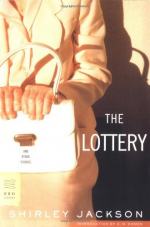
Summary:
A short plot summary of Shirley Jackson's "The Lottery," which is a cautionary short story about the dangers of unexamined traditions and the dark side of human nature.
In her short story "The Lottery," Shirley Jackson reveals a dark look into society that lampoons traditions, families, and the cruelty that humans can reveal towards each other. I feel that Jackson's view of traditions, families, and society were slanted because of her own bitter life.
The story of "The Lottery" takes place on a normal morning in June, in a small village of about 300 people. Everyone is gathering together for the annual lottery drawing. The air is festive and the children's attitudes would even suggest a town picnic. Everyone in the village must participate regardless of age. As the reader quickly realizes this not a picnic, nor is it a normal lottery drawing.
Thereis quiet a dawning of realization as we find ourselves wondering about this "shabby black box" (B & R, 356). Why would they give away a wonderful lottery prize in an old battered box? Then we feel the uneasy prick of awareness that something is wrong. Why would this special box, that's been around for many years in the town not be respected? The author states that the box is only kept in a coal safe at Mr. Summers' coal company prior to the morning of the lottery, but throughout the year it stored in various other places.
The families we meet at first seem to be the typical family make up. We meet the children first. They seem as normal as would be expected in a small town where everyone knows each other. Some are gathering rocks in their pockets and others are stacking piles by their feet in readiness. Shirley Jackson has presented us with a picture of innocent children playing together. They seem eager for the lottery to take place. It is obvious that the lottery is satisfying to them, otherwise we would see this anticipation. By the time we reach an understanding of what is lottery is, we will be left with a scary look at what type of children these people are raising.
We will be able to make connections to what we feel about truth and values in bringing up children. We see how traditions, whether right or wrong influences all we do and affect our children; like in the case of Old Man Warner. He is against changing the lottery. He feels that the town's traditions are utmost vital to who they are. He scoffs at other towns that have stopped using the lottery by calling them a "pack of crazy fools" (B & R, 258).
This is the complete article, containing 417 words
(approx. 1 page at 300 words per page).

