
BookRags.com Literature Guides Literature
Guides
Criticism & Essays Criticism &
Essays
Questions & Answers Questions &
Answers
Lesson Plans Lesson
Plans
My Bibliography Periodic Table U.S. Presidents Shakespeare Sonnet Shake-Up
Research Anything:        
History | Encyclopedias | Films | News | Create a Bibliography | More... Login | Register | Help

Not What You Meant?  There are 5 definitions for Nikolay.  Also try: Tsar Nicholas.

Student Essay on The Last Tsar: Nicholas II

Print-Friendly  Order the PDF version  Order the RTF version
About 2 pages (595 words)
Nicholas II of Russia Summary

Bookmark and Share Questions on this topic? Just ask!

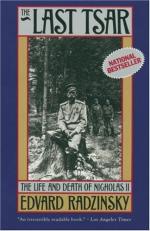
The Last Tsar: Nicholas II

Summary:   Describe Nicholas II was the last empror of Russia before the Bolshevik revolution in 1917. Facts about his leadership ability, personality and involvement in World War I.


Nicholas II Alexandrovich Romanov was the last emperor of Russia, with his reign ending in 1917 by his abdication and the Russian revolution, where the Bolsheviks came to power. His reign for a time did bring prosperity to the country, but near the end, his reign was marked "domestically by increasingly sharp conflict between class and ethnic groups," as well as wars against Japan and Germany.

Nicholas led a somewhat sheltered life and the lack of friends from outside the clan of European royalty deprived Nicholas of the benefit of understanding the way his future subjects lived. He never gained a sense of confidence and self reliance.

Nicholas was seen as too soft by his father, immature and not ready to assume the throne. Nicholas' father, Alexander III with his authoritarian personality, impressive stature and political ideas made him the ideal Russian autocratic emperor, but resulted in his sun standing in his shadow. When Nicholas came to the throne in 1894, he had no political ideas of his own, and limited experience in government. Nicholas was unfit to be Tsar at the time of his coronation, only knowing how to act like a Tsar, not to be one. He had no aspirations for the country, to make it better.

Nicholas II was a very sensitive person, and his attitude towards politics and politicians was that of deep distrust. Since Nicholas was seen as an incompetent ruler, his officials and prominent older family members tried to take advantage of his naivety, and increase their own power and status. Though he had a deep distrust towards his officials, Nicholas was incapable of running the country without assistance, and tended to believe them when it was about preserving his reign.

Nicholas had a disliking for people of different ethnic backgrounds especially for Japanese, because while he was tsarevitch, he travelled through Japan where he was attacked by a sword wielding man. It left him with a scar on his head and a deep hatred for the empire of Japan. Nicholas with his inability to govern properly, helped propel instability into Revolution in 1905 with the catastrophic foreign policy he pursued into Asia.

Russia's defeat by Japan ruined the monarchy's prestige and led to development of opposition movement. In 1905, a misinterpretation of the emperor's orders lead to the Bloody Sunday massacre, with peaceful protestors being shot after asking for constitutional and social reforms. This resulted in riots, demonstration, worker's striking and peasants attacking land lords. The population was unhappy and unsatisfied with their emperor. His people now believed that he was not fit to be Tsar. To appease opposition, and regain support for the regime, Nicholas was forced to create a constitution, so an elected legislative assembly, the "duma" was made.

In 1914, Russia was involved in WWII against Germany; Nicholas II was against his own cousin Kaiser Wilhelm. The war brought Russia major military successes as well as defeats. Losses in 1915 resulted in political crisis which triggered unrest among Russia's lower classes. People came to hate the war after Russia suffered heavy casualties. Nicholas' decision to take part in the war turned his people and his army against him. Abandoned by his generals, he was no longer fit to be tsar. Nicholas abdicated in 1917.

Nicholas II was not ready to be tsar and his attitude towards his role and his people did not make him a good Tsar, as his weak character was over dominated by family members and politicians. Nicholas was born a ruler, but was not fit to be one.

Bibliography

Nicholas II of Russia- http://en.wikipedia.org/wiki/Nicholas_II

Alexander Palace www.alexanderpalace.org/palace/AlexPalaceNRbio.html

Nicholas II-www.mnsu.edu/emuseum/history/russia/nicholas.html

This is the complete article, containing 595 words (approx. 2 pages at 300 words per page).

More Information
  • View The Last Tsar: Nicholas II Study Pack
  • 5 Alternative Definitions
  • Search Results for "The Last Tsar: Nicholas II"
  • Add This to Your Bibliography
  • More Products on This Subject
    Nicholas, II
    Nicholas II (1868-1918), the czar of Russia from 1894 to 1917, was a staunch defender of autocracy.... more

    Nicholas Ii
    (born May 18, 1868, Tsarskoye Selo, near St. Petersburg, Russia—died July 16/17, 1918, Yekate... more


    Ask any question on Nicholas II of Russia and get it answered FAST!
    Answer questions in BookRags Q&A and earn points toward
    discounted or even FREE Study Guides and other BookRags products!
    Learn more about BookRags Q&A
    Copyrights
    The Last Tsar: Nicholas II from BookRags Student Essays. ©2000-2006 by BookRags, Inc. All rights reserved.

    Join BookRagslearn moreJoin BookRags


    About BookRags | Customer Service | Report an Error | Terms of Use | Privacy Policy

