
BookRags.com Literature Guides Literature Guides Criticism/Essays Criticism/Essays Biographies Biographies My Bibliography Periodic Table U.S. Presidents Shakespeare Sonnet Shake-Up
Research Anything:        
History | Encyclopedias | Films | News | Create a Bibliography | More... Login | Register | Help
Not What You Meant?  There are 17 definitions for Socrates.  Also try: Snub or Socratic.


Student Essay on "Allegory of the Cave" -- Socrates

Print-Friendly  Order the PDF version  Order the RTF version
About 1 pages (423 words)
Socrates Summary

Bookmark and Share

"Allegory of the Cave" -- Socrates

Summary:   A reflection upon Socrates' "Allegory of the Cave" and how it applies in today's society. The situation raises the question of what reality truly is.


Allegory of the Cave Reflection

The idea that all of humankind is completely in the dark or completely in the light on subjects is a little unerring. Socrates implies in the allegory that all people are either in the cave, subject to the shadow images, or out in the light, facing the truth. There really is no common ground, no synthesis in this matter. One is either in the presence of lies and falseness or completely enlightened, experiencing the true facts and figures of life. One can't be partway, with an understanding of both the deceit of the cave and the reality of the world. For one cannot believe that both deceit and truth are in fact truth, can he? Because if he believes that any of the lies are true, then all of the truth in his life may be lies as well.

The whole situation brings up the question: What is reality? The poetic and lofty definition may be that reality is whatever you make it. However, seeing something in a different way that someone else does not justify your reality, or their reality for that matter, to be the one in truth. For instance, if a red pen and a blue pen is shown to a man once and, then, the same set a second time and he decides the pens aren't the same colors as before does not mean that his reality has changed. Reality may not be changed, but one's perception of that reality can have as many variations as humanly possible.

It is in this context that the cave-dwellers and the enlightened one's are placed. The cave slaves are completely content with their settings because they have no perception of the truth and, thus, take the lies to be their way of life instead. The same goes for the ones in the light: they know there are in the truth, seeing things clearly, and are conditioned to see the shadows of the cave as horribly wrong. But what if the truth the ones in the light see is a lie also? What then is the true essence of our reality. Reality doesn't seem to be something we as humans can pinpoint and live out, for there is always the possibility that we are living the lies rather than the truths, in the dark rather than the light, without knowledge rather than with it. Which brings us back to the beginning: How then can humans live a life of truth when there are so many reflexive lives of lies?

This is the complete article, containing 423 words (approx. 1 page at 300 words per page).

More Information
  • View "Allegory of the Cave" -- Socrates Study Pack
  • 17 Alternative Definitions
  • Search Results for ""Allegory of the Cave" -- Socrates"
  • Add This to Your Bibliography
  • More Products on This Subject
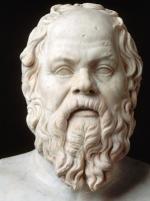
    Socrates
    The Greek philosopher and logician Socrates (469-399 BC) was an important formative influence on Pl... more

    Biography of Socrates
    Throughout history there has been many notable people that stand out and are unique. Many people hav... more


    Copyrights
    "Allegory of the Cave" -- Socrates from BookRags Student Essays. ©2000-2006 by BookRags, Inc. All rights reserved.

    Join BookRagslearn moreJoin BookRags


    About BookRags | Customer Service | Report an Error | Terms of Use | Privacy Policy

