
Summary:
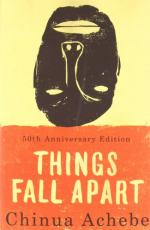
In his novel Things Fall Apart, Chinua Achebe depicts how British colonisers destroy the traditional Ibo life. One of the pillars of the tribe is the chain of fathers and sons together in life and after death. This is best described towards the end of the story when the protagonist Okonkwo has driven away his son, Nwoye, to the Christian church.
The Broken Chain - an Essay on Chinua Achebe's Things Fall Apart
In his novel Things fall apart, Chinua Achebe depicts how British colonisers destroy the traditional Ibo life. One of the pillars of the tribe is the chain of fathers and sons together in life and after death. This is best described towards the end of the story when the protagonist Okonkwo has driven away his son, Nwoye, to the Christian church. Okonkwo is in a state of confusion and fury, afraid that his other five sons will follow Nwoye: "He saw himself and his fathers crowding round the ancestral shrine waiting in vane for worship and sacrifice and finding nothing but ashes of bygone days, and his children the while praying to the white man's god."(142) This sentence is the core of the narrative. Here the two main conflicts are exposed clearly, the father-and-son conflict, aswell as the conflict between the Ibo people and the British colonisers, embodied in disparate religious beliefs.
Okonkwo is the strong, successful son of a weak father, Unoka. This has formed his character and will eventually destroy him . "And so Okonkwo was ruled by one passion- to hate everything that his father Unoka had loved."(17) Nwoye is presented as being similar to his grandfather, or at least that is Okonkwo's greatest fear: "Nwoye was then twelve years old but was already causing his father great anxiety for his incipient laziness. At any rate, that was how it looked to his father." (17) Here the narrator interferes in defense of Nwoye; what it looks like to his father may not be the truth about the boy.
But who is Nwoye? He is very much a shadow-like figure. He does not have a voice of his own until late in the narrative. He is depicted by the narrator's delicate words: "Nwoye was developing into a sad-faced youth" (17) or by his father's abusive language: "I will not have a son who cannot hold up his head in the gathering of the clan. I would sooner strangle him with my own hands."(34) Even though Nwoye, aswell as grandfather Unoka, are elusive characters, they are important in the narrative, creating the framework in which Okonkwo rages and curses. They are all part of the chain that is about to break.
Ikemefuna, a boy who ends up in Okonkwo's household through the unfortunate death of a young girl, becomes the support Nwoye needs. He slowly gains strength in the warmth of their friendship, and they " became quite inseparable." (30)
Three years go by and they are becoming men. Okonkwo often invites them to sit in his hut in the evenings, telling them stories "of violence and bloodshed"(52) But Nwoye prefers his mother's: "That was the kind of story that Nwoye loved. But he knew that they were for foolish women and children, and he knew that his father wanted him to be a man. And so he feigned that he no longer cared for women's stories. And when he did this he saw that his father was pleased, and no longer rebuked him or beat him." (53) Nwoye tries to play the part his father requires of him. With the help of Ikemefuna it seems possible.
But then the disaster occurs. Ikemefuna is taken away by the elders to be killed. The boys are told that Ikemefuna will go back to his village, but when Okonkwo returns alone Nwoye is certain his friend is dead: "something seemed to give way inside him, like the snapping of a tightened bow. He did not cry.(59) Some of the traditions of the Ibos are impossible for Nwoye to accept. This is one, and it starts the process of alienation from his tribe.
The family is forced to move to Okonkwo's motherland because of another killing. Not much is said about Nwoye, besides Okonkwo's degrading remarks. The first time Nwoye gets a voice is when Obierika, an old family friend, visits them talks about a mutual friend. " 'Is he well?' asked Nwoye."(131) It is almost shocking to hear him speak. Nwoye's character is very much shaped in the gap between the narrator's gentle words and Okonkwo's harsh language. The abscence of voice is a distinguishing mark. But when he speaks, his words have great impact.
The next time he appears is when Obierika sees him in Umuofia among the missionaries and asks him what he is doing there: " 'I am one of them' replied Nwoye. 'How is your father?' Obierika asked, not knowing what else to say. 'I don't know. He is not my father', said Nwoye, unhappily."(133-134) The few words Nwoye utters are powerful. He denies his father and the chain is broken.
Although he is setting himself free in one way, he loses much of his cultural inheritance. It is immensely sad. The fear of his father Okonkwo has come true and they will all be "waiting in vane for worship and sacrifice and finding nothing but ashes of bygone days"(142) Things have fallen apart.
Works cited:
Achebe, Chinua. Things Fall Apart. Greenwich: Fawcett Publications Inc., 1969
This is the complete article, containing 840 words
(approx. 3 pages at 300 words per page).

