
BookRags.com Literature Guides Literature
Guides
Criticism & Essays Criticism &
Essays
Questions & Answers Questions &
Answers
Lesson Plans Lesson
Plans
My Bibliography Periodic Table U.S. Presidents Shakespeare Sonnet Shake-Up
Research Anything:        
History | Encyclopedias | Films | News | Create a Bibliography | More... Login | Register | Help

Not What You Meant?  There are 23 definitions for August.

Student Essay on A Father's Misguided Protectionism in "Fences"

Print-Friendly  Order the PDF version  Order the RTF version
About 3 pages (989 words)
August Wilson Summary

Bookmark and Share Questions on this topic? Just ask!

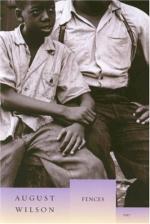
A Father's Misguided Protectionism in "Fences"

Summary:   "Fences" by August Wilson is a story about a father, Troy, whose mistakes and experiences lead him to be overprotective of his son, Cory. Troy secretly is jealous of the opportunities that Cory gets.


Troy's decisions within this play are influenced by many factors that create his behavior. Fences was written by August Wilson in 1986. It portrays the story of a man that has been scarred by the prejudice he has suffered in his life. Ironically, the only way this character knows how to deal with his past experience destroys his son's opportunity to succeed in life. There is a major argument between Troy and his youngest son, Cory, that has to do with both Cory's future in football and, what Troy thinks the kid should do with his life. Through this discussion we can learn a great deal from Troy as one can find several factors that steer him to decide on his decision. Some of the "factors" that will be discussed in this essay include Troy's past experiences with baseball, his resentful attitude towards his son's chance to reach greatness or at least a future greater than that of his own, his struggle for respect, and his duties and responsibilities as a man. Troy is a complicated man who has both conscious and unconscious reasons as to why he stands so firmly against his son, Cory, playing football.

An unconscious reason why Troy doesn't allow his son to play football may be because he is scarred from when his baseball career was tragically terminated and wants to protect his son from a lot of grief and regret. In the beginning of the play, when Troy says that "the white man aint never gonna let him get nowhere with that football" (8), Troy is living in the past. He himself tried to do in baseball what his son is in the process of achieving in football; but Troy was never able to play in the Major Leagues due to the color of his skin. Rose, his wife, then states that, "Times have changed since you was playing baseball, Troy" (9). Troy notices the change, but is aware that times haven't changed enough. Colored players may play professional ball, but he thinks they don't get to play nearly as much as they should compared to white people. He also points out that a colored man must be twice as good as a "cracker" to even be given the opportunity to play pro ball.

Cory, Troy's son, was set to have it all, play college football as well as getting a college education, perhaps Troy was unconsciously envious of all the opportunities his son had. After Rose revealed that Cory had caught a recruiters eyes, Bono said to Troy that "aint but two men ever played baseball as good as you" (9); and yet he is portrayed as a man barely making his way through life, not owning a T.V. because he's saving up for the cost of repairing his roof. And now his son is ready to leave him in his dust. Who wouldn't be resentful? Cory tells his father that he "gets good grades" and "that's why the recruiter wants to talk with you [Troy]" (36). He also states that if he keeps his grades up, "I'll be going to college" (36). What Troy doesn't understand is that Cory isn't going to go out and play college football hoping to make it his career, but to get a college education and make something of himself.

Troy, as Cory's father, has full authority over him, and he consciously knows this, but Cory seems to never make that connection, which makes Troy lose his temper. Troy feels threatened because Cory's passion for football is getting in the way of the father's control over him. Maybe Troy just wants to get back at him for disobeying his orders. An example is when Cory repeatedly answers "yeah" to what Troy has to say. And then corrects him by making him say "yessir"(31). Troy feels he deserves the right respect for all he's done for the son. Cory must be corrected three times before he remembers this. Another example of how Troy's rage can get out of control is when he fights with Cory about how he can't hold a job and play football. He yells "I don't care what nobody else say. I'm the boss... you understand? I'm the boss around here. I do the only saying what counts" (36). His lust for power and authority is his only way of expressing what he has left, authority over his son. His conscious desires for control of those around him are destructive to himself and his son's future.

There is evidence that Troy conscientiously has neither respect nor compassion for his son, Cory. An example of this is when Cory asks his father "how come you ain't never liked me?" (37) And Troy replies, "liked you? Who the hell say I gotta like you?.".. "It's my job. It's my responsibility." (38). In that argument Troy reveals his true emotions toward his son. He basically tells him how much of a burden he is to him. He doesn't want anything to do with him, and yet, it is his responsibility to take care of him. Earlier, one can make the connection as to how Cory has been a burden when Troy says to Bono and Rose that "the only thing I say about the A&P is I'm glad Cory got that job down there. Help him take care of his school clothes and things" (8). He says this with an attitude of relief because it is less money he has to spend on him. Life is much simpler when you have to spend less money on you son.

In conclusion, Troy is driven by a whole mess of both conscious and unconscious thought. Even though one may not know it, or at least fully acknowledge it everyone takes even their own unconscious thoughts into consideration in every action they take part in. In the case of Troy, this may account for some of his destructive behavior he enacts in the story.

This is the complete article, containing 989 words (approx. 3 pages at 300 words per page).

More Information
  • View A Father's Misguided Protectionism in "Fences" Study Pack
  • 23 Alternative Definitions
  • Search Results for "A Father's Misguided Protectionism in "Fences""
  • Add This to Your Bibliography
  • More Products on This Subject
    August Wilson
    Two-time Pulitzer Prize-winning American playwright August Wilson (Frederick August Kittell; born 1... more

    August Wilson
    August Wilson is one of the leading American playwrights of the late twentieth century. He has been... more


    Ask any question on August Wilson and get it answered FAST!
    Answer questions in BookRags Q&A and earn points toward
    discounted or even FREE Study Guides and other BookRags products!
    Learn more about BookRags Q&A
    Copyrights
    A Father's Misguided Protectionism in "Fences" from BookRags Student Essays. ©2000-2006 by BookRags, Inc. All rights reserved.


    Join BookRagslearn moreJoin BookRags


    About BookRags | Customer Service | Report an Error | Terms of Use | Privacy Policy

