
Summary:
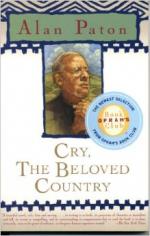
The novel "Cry, the Beloved Country" written by Alan Paton is a book about racial differences in South Africa. The book speaks about differences in the way the black and the white people are treated and the main character's battles with racial controversy.
The main character of the story is a poor black priest; Stephen Kumalo, who lives in a small village called Ndotsheni. He lived a good life with his wife, although they missed a lot of their family members. Stephen's brother John and sister Gertrude and his son; Absalom, had gone to Johannesburg, a huge and dangerous city, and had not been heard from for a long time, for "they go to Johannesburg, and there they are lost, and no one hears of them at all."
One day Stephen and his wife received a letter from a priest in Johannesburg called Msimangu. The letter was regarding Stephen's sister. The letter stated that Stephen should come to Johannesburg and fetch Gertrude for she was in a bad state. Stephen was worried, but left for Johannesburg immediately, taking with him all the money he had, which was not much for a black man who is a priest. Priests received a very small pay compared to other professions. He was also intending to look for his son and brother while he was in Johannesburg.
After arriving in Johannesburg Stephen finds that his sister has turned to prostitution and now has a small son. She repents when she meets him and Stephen takes them with him to stay with him in a place near Msimangu's mission house. He also discovered that his brother John had turned to politics and does not want to have anything to do with Stephen.
His search for his son proves a lot harder. He searched everywhere for him with the help of Msimangu; who had become a good friend, and tracked Absalom down in many places, including the state reformatory, but he was not to be found. He did, however find a girl who was pregnant with Absalom's child. Stephen took the girl to stay with him and Gertrude.
While Stephen was in Johannesburg, a white man named Arthur Jarvis who worked for racial equality was murdered. Arthur Jarvis was the son of James Jarvis, a respected white man who lived in Ndotsheni and whom Stephen knew by his face. The murderers were found out to be three black men. Absalom was one of them. One of the other two men was Matthew, John Kumalo's son. After the police tracked them down, they were arrested and trialled, but Absalom's accomplices lied and said that they had nothing to do with the crime, for Absalom had been the one who shot the bullet that killed Arthur Jarvis. Absalom, aware of his crime, confessed and said that he had only fired the gun out of fear, but it was his friend's idea to break into Arthur's house. The judge however, believed the others and sentenced Absalom to be hanged alone, while his accomplices were set free. Stephen Kumalo was forlorn, but knew that it was fair justice, for what his son did was extremely wrong.
Not long after this, Gertrude runs away in the middle of the night, leaving her son to Stephen and his wife's care. After this, Stephen decided to return to Ndotsheni with his nephew and the pregnant girl, who had become kind and good under Stephen's guidance and had forgotten her immoral ways. Although grieving for his son who was now dead, Stephen bore his sorrow bravely and looked after his new family members well. Life in the quiet village of Ndotsheni continued peacefully with new life and hope, for the land that had been dry for a long while had finally started to cultivate. Stephen also found a new friend in James Jarvis, who decided to take on his dead son's wishes to help the black and helped Ndotsheni through its troubles.
I enjoyed reading this book and would recommend it to people willing to put time and effort into reading. This is a book to be read with full attentiveness. The book describes the troubles of Stephen Kumalo well, and gives a lot of insight into the injustice that the black people in South Africa had to undergo while white government prevailed. It also highlights the acceptance of the consequences by Stephen and how he transforms them in a constructive way. It is a living testimony of love. I learnt a lot from this book about the life of a black man and his troubles in a racist society. The story may seem a little long and dreary while reading, but "Cry, the Beloved Country" is a book truly worth reading.
This is the complete article, containing 787 words
(approx. 3 pages at 300 words per page).

