
Summary:
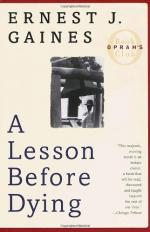
Racial prejudice has become deeply embedded into the fibre of the society, creating cynicism and despair in African-American people. In Ernest Gaines' novel A Lesson Before Dying, Jefferson's sacrifice enables Grant, and the reader, to see how to halt the cycle of human despair associated with racial prejudice.
In Ernest Gaines novel, 'A Lesson Before Dying' the story unfolds from the cataclysmic trial of Jefferson. It takes Jefferson's sacrifice for Grant to learn parallel to Jefferson the importance of dignity and love for one another in an abject environment. Racial prejudice has become deeply embedded into the fibre of the society, creating cynicism and despair in the black people. As demonstrated by former teacher Matthew Antoine's attitude "it doesn't matter anymore. Just do the best you can. But it won't matter."
The racial prejudice is evident in both the socio-economic and legal structure of Bayonne. Haines uses Jefferson's unjust trial in which he is wrongly convicted of murder "by twelve white men" and sentenced to death by electrocution. Jefferson's defence attorney, in an attempt to sway the jury, portrays Jefferson as a 'hog' and a "thing to dig ditches", "a thing to load bales of hay." By dehumanising Jefferson he encapsulates the attitudes of the white population in Bayonne.
Grant feels impotent because he understands that the verdict and penalty were inevitable for any African-American. Likewise he also has been deprived of liberty. He was barred from attending university in Louisiana, thus he went to university in California. The town of Bayonne is separated into two entities, into facilities for whites and facilities for blacks. The churches for whites being "uptown" and "a Catholic church back of town for coloureds."
The transformation that Jefferson goes through, in the face of centuries of abuse, plays a role central to the embryonic diminishing of human despair. Initially Jefferson can't even look at his well-meaning visitors, believing himself to be worth nothing more than a 'hog'. His whole life had been a wretched affair. The declarations "I never asked to be born" and "I never got nothing I wanted in my whole life" epitomise not a greedy man, but someone who has been deprived of human privileges.
Although Jefferson finds it difficult to grasp the meaning of a hero he understands the significance of his position, that he must be like on of Mr. Farrell's slingshot handles "it came from an old piece of wood...And that's all we are, all of us on this earth, a piece of driftwood, until we-each one of us individually - decide to become something else." Jefferson becomes a hero to his people. He had worked in the cotton fields since the age of six; he was suffering "the most heart-rending pain [Grant] had ever seen."
However Jefferson, with perseverance form Grant, uses his innocence and ill-educated life to become a stronger man, to regain his human dignity and most of all believe in his own worth. Jefferson realises that he can "chop away at the myth- that white men are better than anyone else on earth."
Grant is filled with frustration and anger because he fears the system, which convicted Jefferson, will never change, thus he becomes an unwilling ally for Jefferson. All Miss Emma requests is for "a man to go to that chair on his own tow feet." However Grant is more educated and he can see a more profound reason. She wants Jefferson to regain his dignity and a reason to believe himself to be a "human."
This is a very challenging task as Grant is in danger of repeating the "vicious circle"; he is tempted to take Matthew Antoine's advice and "run." With perseverance in Jefferson, he eventually reaches him so that Jefferson feels "like someone who has just found religion" and ends up being "the strongest man in that crowded room." Jefferson's ability to break the prevailing white man's myth that blacks are only "three-fifths human" is deeply moving. Grant recognises his won part in Jefferson's transformation. He learns from this that one man can make a difference and that he can teach dignity and the importance of lobbing one another.
Grant's attitudes prior to Jefferson's demise are displayed in the quote "They look at their fathers, their grandparents, their uncles, their brothers -all broken." Grant being an educated black male was expected by the women to be better than this. Grant, through Jefferson's and Paul's examples, learns to "chip away at the myth" and of the intrinsic significance of self-worth and being a 'human'. The cycle of human despair can now begin to be broken with Grant being the one spreading the word and king deeds.
This is the complete article, containing 720 words
(approx. 2 pages at 300 words per page).

