
BookRags.com Literature Guides Literature
Guides
Criticism & Essays Criticism &
Essays
Questions & Answers Questions &
Answers
Lesson Plans Lesson
Plans
My Bibliography Periodic Table U.S. Presidents Shakespeare Sonnet Shake-Up
Research Anything:        
History | Encyclopedias | Films | News | Create a Bibliography | More... Login | Register | Help

Not What You Meant?  There are 9 definitions for Hooke.

Student Essay on Robert Hooke

Print-Friendly  Order the PDF version  Order the RTF version
About 3 pages (839 words)
Robert Hooke Summary

Bookmark and Share Questions on this topic? Just ask!

Robert Hooke

Summary:   Robert Hooke was probably the single greatest experimental scientist to come out of the seventeenth century. He was one of the most diverse of all scientist of his time contributing major findings to almost all fields of science.


ROBERT HOOKE

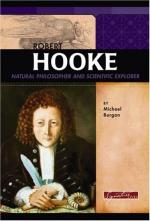
Have you ever thought about what Robert Hooke looks like? Well if you have you will have to use your imagination, because there is no known picture of him in existence. This seems strange since many biographers have said that Robert Hooke was probably the single greatest experimental scientist to come out of the seventeenth century. He was one of the most diverse of all scientist of his time contributing major findings to almost all fields of science.

There is not much written about Hooke's early life. We do know that he was born on July 18, 1635 in England and died March 3, 1703 in London. He was educated by his father, John, until the age of thirteen when his father committed suicide by hanging himself. At that time Robert was admitted to Westminster School. At Westminster, he lodged with the headmaster, Dr. Richard Busby, who saw Hooke's great ability encouraged his education. During his first week at Westminster, he masters all six books of Euclid's Elements in a week. From Westminster he furthered his education at Oxford University, graduating with a master's degree in 1663. His time at Oxford proved very beneficial because some of the best scientist in England were working there at that time. Robert Boyle who was impressed with his skills at designing experiments and building equipment soon hired him as his assistant. They would become life-long friends and - unknown to them at the time - would ultimately become the 'team' instrumental in the design and rebuilding of London after the great fire in 1666.

In 1662, while still a student at Oxford University, Robert Hooke was responsible for demonstrating experiments to other scientist at a weekly gathering of scientist. He was given the title of "Curator of Experiments." This was Robert Hooke's first professional position and proved to be very beneficial to him, because many fellow scientists soon learned just how brilliant this young student was. This gathering of scientist each week was called the "Royal Society." The "Royal Society" was later known to have a membership of some of the most renowned scientist in history. Members included Robert Boyle, Otto Guericke, and Sir Isaac Newton.

Robert Hooke was one of the most diverse men of all men studied in the field of Scientist. This fact only gives reliability to his genius. He was gifted in the areas of music, art, architecture, astronomer, biologist, inventor, and what is now known as paleontology. Hooke was a restless man and was never comfortable working on just one project; in fact, he seemed at his best when his mind was jumping from one idea to another.

Hooke's contributions are so vast and so diverse that it is difficult to organize them in any type of sequential order. However, it appears that his first big invention for which he is noted is the compound microscope. He may have been overshadowed by many other scientists, such as Sir Isaac Newton, but he is unsurpassed as the best inventor and designer of scientific instruments. Some of his inventions include the spring control of the balance wheel in watches, the wheel barometer; and the universal, or Hooke's joint, found in all vehicles. He contributed to many instruments used in the study of astronomy such as the reflecting telescope which enable the observation of Mars rotation and noted one of the earliest examples of a double star. However, most students know Hooke for two major contributions; Hooke's Law and the inventor of the first compound microscope. With his compound microscope he studied many object none more important than cork. While looking at the tissues of cork he discovered the cells in plants. Hooke also reported seeing similar structures in wood and in other plants.

In fact, he is the one who first used the term "cells."

Hooke first achieved worldwide scientific fame in 1665 when he published a book of beautiful drawings of objects he had observed under the microscope he had made himself. His book was entitled Micrographia.

As he grew older, Hooke genuinely felt that others had stolen ideas which he had been first to put forward. It is easy to see why this happened. Hooke did indeed come up with many brilliant ideas. Many of which were claimed by others not because they wished to steal them from him, but rather because Hooke never followed through developing his ideas into comprehensive theories. He would later make reference to some of these colleagues such as Sir Isaac Newton, in lectures and papers. As he aged, some report that he grew more and more bitter.

He later became Gresham Professor of Geometry at Gresham College, London, where he had a set of rooms and where he lived for the rest of his life. This was a meager position for a person who had made a wealth of contribution to the field science. His health deteriorated over the last decade of his life and died in London on March 3, 1703 without wealth or many possessions.

This is the complete article, containing 839 words (approx. 3 pages at 300 words per page).

More Information
  • View Robert Hooke Study Pack
  • 9 Alternative Definitions
  • Search Results for "Robert Hooke"
  • Add This to Your Bibliography
  • More Products on This Subject
    Robert Hooke
    The English physicist Robert Hooke (1635-1703) was one of the most ingenious and versatile experime... more

    Robert Hooke
    One of the preeminent scientists of the seventeenth century, Robert Hooke is perhaps best remembere... more


    Ask any question on Robert Hooke and get it answered FAST!
    Answer questions in BookRags Q&A and earn points toward
    discounted or even FREE Study Guides and other BookRags products!
    Learn more about BookRags Q&A
    Copyrights
    Robert Hooke from BookRags Student Essays. ©2000-2006 by BookRags, Inc. All rights reserved.

    Works by Author
    Join BookRagslearn moreJoin BookRags


    About BookRags | Customer Service | Report an Error | Terms of Use | Privacy Policy

