
BookRags.com Literature Guides Literature Guides Criticism/Essays Criticism/Essays Biographies Biographies My Bibliography Periodic Table U.S. Presidents Shakespeare Sonnet Shake-Up
Research Anything:        
History | Encyclopedias | Films | News | Create a Bibliography | More... Login | Register | Help


Student Essay on Antigone by Sophocles

Print-Friendly  Order the PDF version  Order the RTF version
Sophocles
About 2 pages (632 words)
Antigone (Sophocles) Summary

Bookmark and Share

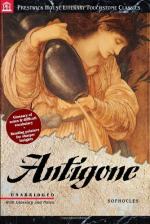
Antigone by Sophocles

Summary:   Antigone by Sophocles


Antigone

By Sophocles

"Tragedy, then, is an imitation of an action that is serious, complete, and of a certain magnitude; in language embellished with each kind of artistic ornament, the several kinds being found in separate parts of the play; in the form of action, not of narrative; with incidents arousing pity and fear, wherewith to accomplish its katharsis of such emotions. . . . Every Tragedy, therefore, must have six parts, which parts determine its quality--namely, Plot, Characters, Diction, Thought, Spectacle, Melody." (Literature, p.85) -Aristotle

Antigone and Oedipus very well fit the description of Aristotle's definition of tragedy. They are very serious stories that have great magnitude. The speech is very lengthy and is usually drawn out. Many times it might take a couple of pages for the characters to complete a single thought. When Antigone says, "Do not spend fear on me, Shape your own course" (Antigone, p.4) she is just telling her sister to just worry about herself in a longer more complex way. Also in certain parts of Oedipus and Antigone the words have a rhythm or harmony to them which makes them flow together and make it easier to read.

Plot is the most important part of a tragedy. If you don't have a good plot then you won't have a good story. "The Plot is the imitation of the action-for by plot I mean the arrangement of the incidents" (Literature, p.85). Aristotle is saying that the plot is not the actual story but the way the incidents are presented to the audience. Sophocles does this very well in his plays. The plot is continuously building throughout the whole story and at the end everything falls into place.

Another very important thing for a tragedy to have is a tragic hero, "an exceptional character, though not perfect, who undergoes a morally significant struggle which ends disastrously," (Literature p.58). In Antigone, I think that Creon best fits Aristotle's definition of a tragic hero. At the very beginning of the story Creon thought that he was doing the right thing by not burying Polynices. He ruled it against the law and even made it punishable by death. Creon had a huge tragic flaw though, "a weakness or defect which along with fate helps to bring about his downfall." "It should come about as the result not of vice, but of some great error or frailty of character," (Literature p.87). Like many people similar to him, one of his greatest flaws was pride. He thought that he was doing the right thing and no matter what other people told him, he wasn't going to change his mind. Creon's son Haemon, who was Antigone's fiancé, couldn't even convince him not to put Antigone to death. Creon's pride showed through greatly when he decided that he was not only going to kill her, but he was going to kill her right in front of Haemon himself. None of the people in the city wanted Creon to kill her but he wouldn't listen to them. Finally, Tireseas convinced Creon and the Senator that it was the god's will to let Antigone free and bury Polynices "Go, set free the maiden from the vault, and build a tomb for that dead outcast", (Antigone, p.41). By the time Creon realized that he had done wrong, everything was falling apart around him. When he went to free Antigone she had already killed herself. Haemon ended up killing himself followed by Creon's wife Eurydice doing likewise. "The change of fortune should be not from bad to good, but, reversely, from good to bad," (Literature p.87). I believe that Creon was the tragic hero because he started off doing what he thought was best for his people and ended up having his whole family dead and his people hating him.

This is the complete article, containing 632 words (approx. 2 pages at 300 words per page).

More Information
  • View Antigone by Sophocles Study Pack
  • Search Results for "Antigone by Sophocles"
  • Add This to Your Bibliography
  • More Products on This Subject
    Morals Of The Heart
    "The limitation of riots, moral questions aside, is that they cannot win and their participants know... more

    Antigone: Antigone Vs. Ismene
    In the play Antigone, written by the Greek playwright Sophocles, the conflict of Polyneices' buri... more


    Copyrights
    Antigone by Sophocles from BookRags Student Essays. ©2000-2006 by BookRags, Inc. All rights reserved.

    Join BookRagslearn moreJoin BookRags


    About BookRags | Customer Service | Report an Error | Terms of Use | Privacy Policy

