
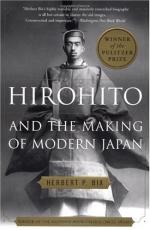
Summary:
The Showa Emperor Hirohito (1901-1989) served as the 124th emperor of Japan from 1928 until his death. In the wake of Japan's surrender that ended World War II, Hirohito relinquished his claim to being a sacred monarch, and political power was transferred from the emperor to a legislative parliament under a new Japanese constitution created by General Douglas MacArthur and civilian Japanese leaders.
On April 29, 1901, Hirohito was born at the Aoyama Palace in Tokyo. His father was the Crown Prince who later became known as Yoshihito, the Taisho Emperor, and his mother was Empress Sadako.
Soon after his birth, Michi no miya, as he was called in his childhood, followed the custom of being separated from his parents. Up until November of 1904 when he returned to the Akaska Palace, his parent's official residence, he was under the care of a vice admiral in the Imperial Navy.
Beginning in his childhood, Hirohito was trained to act with dignity and a sense of responsibility which would be required later in his life. He soon grew into a serious and shy boy. In April 1908 he was enrolled in the Gakushuin, a school for the children of the Japanese Aristocracy. He was in a special class of twelve boys, two of whom were his imperial cousins. General Maresuke Nogi, a hero of the Russo-Japanese war was the head of the school.
Hirohito's grandfather, Emperor Meiji, past away on July 30, 1912. On the day of Emperor Meiji's funeral, Hirohito's tutor, Maresuke Nogi, committed ritual suicide with his wife. Another military hero quickly took up the role as Hirohito's tutor. The new tutor was Admiral Heihachiro Togo who had won the victory over the Russian Navy in 1905.
Hirohito's father became the 123rd Emperor of Japan and he, Hirohito, became Crown Prince. His formal ceremony took place on November 6, 1916. A few years later, Hirohito became the regent of Japan on November 29, 1921 due to his ailing father who had begun to show signs of mental derangement.
In 1921, Prince Regent Hirohito took a six month tour of Europe. During the six months he visited five countries: England; France; Italy, Netherlands; and Belgium. His journey made him the first Japanese Crown Prince to travel abroad. England interested him most: he was attracted to their freedom and the informality of the English royal family.
At age 23, Hirohito married Princess Nagako. She was the eldest daughter of Prince Kuniyoshi Kuninomiya and one of his distant cousins. They were married on January 26, 1924. Together they had seven children: Princess Teru; Princess Hisa; Princess Taka; Princess Yori; Crown Prince Akihito; Prince Hitachi; and Princess Suga. The Crown Prince Akihito became the 125th emperor of Japan on January 9, 1990.
The death of Emperor Yoshihito on December 25, 1926 made Hirohito the 124th emperor of Japan. He was crowned on November 10, 1928 in Kyoto and was entitled Hirohito, the Showa Emperor. His reign name, Showa, means Enlightened Peace. He became the first Japanese emperor in several hundred years whose biological mother was his predecessor's
official wife.
In 1927, Japanese army officers planned the assassination of Marshal Chang Tso-lin, a warlord of Manchuria. The army had hoped to provoke Emperor Hirohito to take over that country. Instead, the event only angered him and he ordered Premier Giichi Tanaka to find and punish officers involved. In September of 1931 there was another event that angered Hirohito. The Japanese army took it upon themselves to invade and occupy Manchuria. Two of Hirohito's advisors, Count Nobuaki Makino and Prince Kimmochi Saionji, urged him to quietly and privately tell the army to retreat.
The events in Manchuria caused a period of domestic unrest. Young military officers allied with civilian radicals to plan many unsuccessful coups d'etat and a few successful assassinations. They were hoping to overthrow party cabinets to establish a regime that could govern with direct imperial rule.
On February 26, 1936 assassination bands occupied large areas of downtown Tokyo and murdered many leading public officials. The riot was quickly suppressed. Emperor Hirohito demanded that the rebels be punished, and because of that, many ranking generals who were thought to have encouraged the rioters were forced into retirement.
Japan was still floating towards war. Hostilities with China broke out in July of 1937. During the 1930s, Hirohito's advisors recommended that he directly intervene in the politics unless he was willing to put the position of the imperial family at risk. He followed the advice which would give consent to the policies the other governments decided on.
Emperor Hirohito felt very uneasy about the events occurring after 1940. He was not in favor of the alliance between Italy and Germany, but he made no efforts to break their ties. Hirohito began to grow doubtful of the judgments of the military leaders who kept trying to assure him that war in China was soon to end. On September 6, 1941, the final decision to go to war with the United States was made. The only opposition to the war that Hirohito had was his hope for peace.
During the war, air raids and fires demolished Tokyo. During all of this, Hirohito refused to leave the imperial palace. He wanted to share the hardships with the people of the city.
Public officials and military officers could see, in the summer of 1945, that defeat was unavoidable. Hirohito did not make the decision to surrender until after atomic bombs were dropped on Nagasaki and Hiroshima. He made it known, at a historical imperial conference on August 9, 1945, that he was in favor of surrendering to the Allies.
Japan's formal surrender was in September of 1945. Soon after, there was much speculation about whether Emperor Hirohito should be punished as a war criminal. Hirohito was willing to abdicate as a sign of responsibility for the war. American authorities such as General Douglas MacArthur decided that it would be better to let him remain as ruler. MacArthur intended to help create a democracy for Japan rather than to punish the defeated enemy. He had political prisoners released from jail and demanded the break-up of militaristic groups. MacArthur also demanded that Hirohito officially state that he was not a god. On January 1, 1946, Hirohito gave up his claims to being a sacred monarch.
MacArthur, as well as civilian Japanese leaders, made up a new constitution which disabled the emperor from holding all of the political power; calling him a "symbol of the state." He gave the power to a two-house legislative parliament called the Diet.
After having digestive problems for several months, Hirohito had surgery on his pancreas on September 22, 1987. This was the first time a Japanese Emperor underwent surgery. The doctors discovered he had duodenal cancer, but in conformance to Japanese Tradition they did not inform him. He seemed to be recovering from his surgery; however, a year later on September 19th he collapsed in his palace and his health worsened over the months. On January 9, 1989, at about 6:30 AM Hirohito had finally passed away. He is buried at the imperial mausoleum in Hachioji, along with many other past Japanese emperors.
This is the complete article, containing 1,116 words
(approx. 4 pages at 300 words per page).

