
BookRags.com Literature Guides Literature
Guides
Criticism & Essays Criticism &
Essays
Questions & Answers Questions &
Answers
Lesson Plans Lesson
Plans
My Bibliography Periodic Table U.S. Presidents Shakespeare Sonnet Shake-Up
Research Anything:        
History | Encyclopedias | Films | News | Create a Bibliography | More... Login | Register | Help


Student Essay on The Life of James Longstreet

Print-Friendly  Order the PDF version  Order the RTF version
About 8 pages (2,423 words)
James Longstreet Summary

Bookmark and Share

The Life of James Longstreet

Summary:   Confederate general James Longstreet (1821-1904) is considered one of the Civil War's interesting commanders. An 1842 graduate of West Point who served in the U.S. Army until 1861, Longstreet fought for the Confederacy in a number of major campaigns, including the Seven Days battles, Second Manassas, and Antietam.


One of the Civil Wars interesting commanders was James Longstreet. Longsteet was his parent's fifth child, and was born on January 8, 1821 in Edgefield, South Carolina. His parent's names were James Longstreet and Mary Anne Dent. They were married in 1814. Longstreet grew up around the woods and ridges of North Georgia where Indians were a recent memory and buckskins and long rifles were common sight. As a boy he enjoyed swimming, hunting, and fishing.

Longstreet had some rough edges that never disappeared. He knew his manners but could be coarse when no ladies were around. He was sometimes casual, even slovenly about his appearance and would never be mistaken for an aristocrat. Longstreet was self-reliant and very strong, as well as an excellent horseman and marksman. He was warm and friendly and made friends easily. He liked to play games and have fun.

The future soldier latter became related to his future friend, schoolmate, and military opponent, Ulysses Simpson Grant, whose wife and Longstreet were descended from two brothers, George and Peter Dent of Charles County, Maryland, in the fifth generation.

The kinship was not very close, perhaps, but still it was a bond that in future years asserted itself on important occasions. Through his great grandfather Marshall Dent, Longstreet was also related to John Marshall, the famous chief justice of the United States Supreme Court.

James Longstreet was appointed to the Military Academy of West Point from the Huntsville district of Alabama and entered as a plebe in the early summer of 1838. It was probably his unwillingness to except defeat, which alone pulled though, for he was third from the bottom of his class when he graduated, but on the drill ground things were different. His sportsmanship was excellent and his horsemanship superb. Even in sports, his great physical strength and endurance more than offset a certain lack of spring and dexterity. In spite of his standing and his studies, he received constant promotion as a caudate, chiefly because he was soon known as a natural leader.

Socially, too, he was a great success. He was voted the handsomest cadet a reputation, which may have had something to do with his unwillingness or inability too study. He roomed with W.S Rosecrans "Point Rosey," they called him and developed a lasting affection for this studious and brilliant soldier. "Old Pete" was Longstreet's own nickname. With his graduation in June 1842 Longstreet received the coveted commission as a brevet second lieutenant and was assigned to the Forth Infantry, which was commanded by Colonel John Garland, a splendid soldier of the old school, and stationed at Jefferson Barracks near St. Louis. After the customary graduation leave of absence, he reported for duty and entered at once upon the garrison life, which had its contact with the upper circles of St. Louis society. A year later to Longstreet's delight Ulysses S. Grant survived the course of instruction at West Point, and was assigned to the fourth infantry, and reported for duty at Jefferson Barracks. The two soon became constant companions of this period.

James Longstreet fell in love with Maria Louisa Garland, a daughter of the colonel of the regiment, James Garland. James and Maria were married in March 1848. In Carlisle Barracks, Pennsylvania Maria gave birth to their first child, John Garland Longstreet, who was born on December 26, 1848. From 1849 to 1851 Longstreet served pleasantly as commissary of the Department of Texas. On December 15, 1850 Longstreets second son, Augustus Baldwin Longstreet was born in San Antonio, Texas. On April 19, 1853 Longstreet's, third child, another son, William Dent Longstreet was born In San Antonio, Texas. On July 19, 1854 Longstreet's youngest child died, William Dent Longstreet in Washington D.C. While Longstreet was visiting Maria's parents in Santa Fe, New Mexico, Maria gave birth to a forth son James Longstreet named after his father. Maria gave Longstreet a fifth child named Mary Anne Longstreet on December 31, 1860, in Albuquerque, New Mexico.

On May 9, 1861 James Longstreet tendered his resignation as a Major and Paymaster of the United States Army. Going through military channels, it was received at the Federal War Department and accepted by Simon Cameron, the Secretary of War on June 1, 1861. Endorsements on this letter of resignation with circular attached indicate that all except transit accounts had been properly settled. By the middle of June 1861, he had put all his affairs in shape and with news of acceptance of his resignation arrived he was ready to start for Richmond, Virginia.

On June 29, 1861, he reported to the War Department at Richmond, and asked to be assigned for service in the pay department, in which he had recently served (for when he had left the line service, under appointment as pay master, he had given up all aspirations of military honor, and thought to settle down into more peaceful pursuits.) On the 1st of July he received notice of his appointment as Brigadier General, with orders to report at Manassas Junction, to General [P.G.T.] Beauregard.

Moxley Sorrel, a twenty-year-old Georgian, served as a volunteer aide during Manassas. He had difficulties securing a commission because he lacked military training, but he eventually became Longstreet's chief of staff and even later a brigadier General under A.P. Hill. Sorrel became particularly intimate with Longstreet, whom he described in his memoirs as

A most striking figure. . . . a soldier every inch, and very handsome, tall and well proportioned, strong, and active, a superb horseman and with an unsurpassed soldierly bearing, his features and expression fairly matched; eyes, glint steel blue, deep and piercing; a full brown beard, head well shaped and poised. The worst feature was the mouth, rather coarse; it was partially hidden, however, by his ample beard.

Goree was equally taken with the General, but in describing Longstreet in August 1861 to his kinfolk in Texas he noted both favorable and unfavorable characteristics.

General Longstreet is one of the kindest, best-hearted men I have ever known. Those not well acquainted with him think him short and crabbed, and he does appear so except in three places; 1st, when in the presence of ladies; 2nd, at the table; 3rd, on the field of battle. At any one of these places he has a complacent smile on his countenance, and seems to be one of the happiest men in the world.

If Longstreet seemed short and crabbed, perhaps overwork was responsible, for his first months of command were extremely hectic. But the truth is that Longstreet was in no sense genteel or courtly except when polite company required him to be so. In his day-to-day life his manners were too rough for some people's taste.

Lonstreet's wife and children had long since come from Texas, and were living comfortably with friends in Richmond, Virginia. Early in 1862 and epidemic of scarlet fever took the lives of three of the four Longstreet children (Mary Anne, James, and Augustus Baldwin) within a single week. The blow was almost too much for Longstreet. He hurriedly went to Richmond. It was some days before he could leave his wife, who was devastated by the tragedy.

By December 1862 James Longstreet had been in the Confederate army for almost a year and a half and had participated in five major campaigns. While Seven Pines represented a colossal blunder, Blackburn's Ford, Williamsburg, the Seven Days battles, Second Manassas, and Antietam gave him a reputation any soldier would envy.

A number of foreign visitors more or less attached themselves to the First Corps, which was under Longstreet's command during the war. The memoirs of these men provide an invaluable objective view of Longstreet during his most controversial campaign. The most prominent visitor was Arthur Fremantle, a British lieutenant colonel, who found Longstreet "a particularly taciturn man." He noted that Longstreet was "never far from General Lee, who relies very much upon his judgment. By the soldiers he is invariably spoken of as 'the best fighter in the whole army.'" Colonel Fitzgerald Ross of Austria-Hungary also commented on the closeness between Longstreet and Lee. Other observers who attached themselves to the General include Major Justus Scheibert of Prussia and two British newspapermen, Frank Vizetelly and Francis C. Lawley.

While trying to realign his men for an attack in the tangle of woods at the Wilderness campaign, Longstreet was wounded by a group of his own men. He was shot by a minié ball that hit him in the throat and exited through his right shoulder. Longstreet was shot in the same aria that Stonewall Jackson was killed exactly one year and one day before. Surprisingly Longstreet survived and lived to fight another day.

Longstreet's fall was recognized as a great blow to the South and a stroke of luck for the North. Many believed the battle would not have ended in a draw if Longstreet had been able to direct his counterattack in person. As a result of his wounds his once clear voice was now husky and his right arm was paralyzed. Because of this he was put on leave for a while, so he could rest and let the wounds heal. While at home he saw his new son, Robert Lee Longstreet; who was born the previous October, in 1863.

In Fremantle's Journal he talks about riding along with some troops who belonged to Johnson's division of Ewell's corps. Among them he saw, for the first time, the celebrated "Stonewall" Brigade, formerly commanded by Jackson. In appearance the men differ little from other Confederate soldiers, except, perhaps, that the brigade contains more elderly men and fewer boys. He thought all were Virginians except one regiment. Since they have nearly always been on detached duty, few of them knew General Longstreet, except by reputation. Numbers of them asked him whether the General in front was Longstreet; and when he answered in the affirmative, many would run on a hundred yards in order to take a good look at him. This he thought to be an immense compliment from any soldier on a long march.

After the war Longstreet got involved with the Republican Party and became known as a traitor to the South. In 1868 Longstreet endorsed his kinsman Grant for President. In less than a week after Grant became President of the United Sates, Longstreet was nominated for the position of surveyor for the port of New Orleans with a generous salary. In 1870 Longstreet was appointed adjutant general of the state. In January 1872 he was commissioned brigadier general in the state militia and was assigned responsibility for all the militia units and police forces in the city of New Orleans. At the end of the year he resigned his post as state adjutant general but kept his militia commission.

Longstreet was thought of as one of the best fighters, but over-deliberate in the opinion of many (especially adherents for the "Lost Cause"). In addition to Garland, Robert Lee, and James Jr., he had a new son and daughter. They were Fitz Randolph born in 1869 and the couples tenth and last child Maria Louisa born in 1872. Although the couple had lost five children during their years together, the five living in 1872 all lived to adulthood.

In January 1879 he was appointed postmaster of Gainesville, Georgia. In May of 1880 he was appointed the United States minister of Turkey. In June of 1881 he resigned from this position to become the Federal Marshall of Georgia at the age of sixty.

While in Georgia he had a very large two-story house built for him and his children to live in. In 1889 Longstreet's house burned to the ground. He lost all of his war souvenirs, including his Confederate uniform and sword, a sash Jeb Stuart had given him, and a pair of Mexican spurs he had worn in both the Mexican War and the Civil War. In January 1890 Longstreet's wife Louise died at the age of sixty two.

On September 8, 1897 at the age of seventy-six James Longstreet was married to his second wife Helen Dortch at the Governor's mansion in Atlanta. Longstreet and his thirty four year old bride honeymooned briefly near Atlanta and later took a trip to Mexico. In 1896 Longstreet was appointed the office of the United States Commissioner of Railroads.

On Saturday January 2, 1904 Longstreet contracted pneumonia and sank quickly. Large quantities of blood began to flow from his mouth, and he hemorrhaged so badly that the throat wound he had received forty-nine years earlier was reopened. Delirious for some time, he eventually lost consciousness and died shortly thereafter.

On January 6th when the services began, a local guard unit and representatives of the Longstreet Chapter, and the United Daughters of the confederacy attended the body. Two priests and Bishop Keiley, one of the general's old soldiers, conducted the services. All the children except James attended.

Once the services were conducted at the courthouse, pallbearers carried the casket to a hearse, which began the long procession to Alta Vista Cemetery. State and local dignitaries, militia units, Confederate veterans carrying flags, and other groups followed as church bells tolled. At the gravesite, Bishop Keiley gave a eulogy, after which guards fired their volley, and "taps" sounded with their haunting notes.

When the news of his death had spread across the country, many newspapers had extolled his virtues as a man and his prowess as a general. But as the pallbearers prepared to lower the casket, a Confederate Veteran walked to the grave. Without a word he laid part of his uniform and his enlistment papers on the lid of the coffin, and then stepped back. His comrades understood.

References

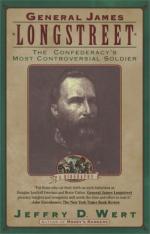
1.General James Longstreet

The Confederacy's Most Controversial Soldier

By Jeffry D. Wert

Simon and Schuster

Copyright 1993

2.James Longstreet

Part One: Soldier

By Donald Bridgman Sanger

Part Two: Politician, Officeholder, and Writer

By Thomas Robson Hay

The Louisiana State University Press

Copyright 1968

3.Lee's Tarnished Lieutenant

James Longstreet and His Place in Southern History

By William Garrett Piston

The University of Georgia Press

Copyright 1987

4.The Civil War

An Illustrated History

Narrative by Geoffrey C. Ward

Based on a Documentary by Goeffrey C. Ward, Ric Burns, and Ken Burns

Published by Alfred A. Knopf inc.

Copyright 1999

5.Three Months in the Southern States

April-June 1863

By Lt. Col. Arthur James Fremantle of the Coldstream Guards

Introduction by Gary W. Gallagher

The University of Nebraska Press

Copyright 1991

6.This is a web source; the web address is:

http://sunsite.utk.edu/civil-war/cong_l.html

7.These pictures of General Longstreet's greave are from a website; the website is:

http://www.longstreet.org/projects.htm

8.The pictures of General Longstreet are from a website; the website is:

http://www.generalsandbrevets.com/sgl/longstreet4.htm

This is the complete article, containing 2,423 words (approx. 8 pages at 300 words per page).

More Information
  • View The Life of James Longstreet Study Pack
  • Search Results for "The Life of James Longstreet"
  • Add This to Your Bibliography
  • More Products on This Subject
    James Longstreet
    General James Longstreet (1821-1904) fought on the side of the Confederacy in almost every major ba... more

    Longstreet, James
    (born , Jan. 8, 1821, Edgefield District, S.C., U.S.—died Jan. 2, 1904, Gainesville, Ga.) U.S... more


    Copyrights
    The Life of James Longstreet from BookRags Student Essays. ©2000-2006 by BookRags, Inc. All rights reserved.

    Join BookRagslearn moreJoin BookRags


    About BookRags | Customer Service | Report an Error | Terms of Use | Privacy Policy

