BookRags.com Literature Guides Literature
Guides
Criticism & Essays Criticism &
Essays
Questions & Answers Questions &
Answers
Lesson Plans Lesson
Plans
My Bibliography Periodic Table U.S. Presidents Shakespeare Sonnet Shake-Up
Research Anything:        
History | Encyclopedias | Films | News | Create a Bibliography | More... Login | Register | Help

Not What You Meant?  There are 6 definitions for The Rover.

Student Essay on Cross-dressing and Disguise in Aphra Behn's the Rover

Print-Friendly  Order the PDF version  Order the RTF version
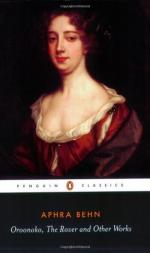
Aphra Behn
About 7 pages (2,106 words)
The Rover (play) Summary

Bookmark and Share Know this topic well? Help others and get FREE products!

Cross-dressing and Disguise in Aphra Behn's the Rover

Summary:   In The Rover cross-dressing and prostitution, like the masquerade and carnival, provide a comic festival of misrule; like the festival, they can only be allowed as a temporary aberration.


Aphra Behn's The Rover is set during the interregnum, that is to say in the period of time before the restoration of Charles II. Furthermore, the action of the play takes place not in England but in Naples during the Carnival time. Consequently, disguising oneself and thus appearing incognito is a major aspect of the story. In The Rover, however, the element of disguise is not only restricted to simply being dressed up in fantasy costumes, but it is also present in one of the female protagonists' tendency of disguising herself as a member of the opposite sex. Furthermore, some characters, like for instance Hellena or Florinda, keep playing with their own identities, for instance, by letting other people see them as gypsies. Therefore, there are several instances when the fact that someone is mistaken for someone else leads to confusion. As a result, most of the characters deliberately make use of this special period of time in order to fulfil their deepest desires.

In the following essay I would like to argue that such intentional attempts of disguising oneself can only be of a temporary success, because - like in the festival of Carnival - time will come when one simply has to show one's true face. First of all, I shall try to define some general characteristics of disguise. Then I will take a closer look at the individual characters and their intentions of concealing their own identities as well as the consequences of their masquerades. Consequently, the dangerous potential lying in the use of disguise will be discussed. Finally, I would like to elaborate on the way in which the author hides herself within her play and try to establish in which characters elements of Aphra Behn herself may be manifested.

Generally, it is justified to claim that for the characters in Aphra Behn's play disguising themselves is a means of celebrating liberty and freedom. That is to say, through changing their external appearance the protagonists manage not only to remain incognito but also to free themselves from the chains of everyday life. Consequently, they succeed in doing away with common class relations and reversing the gender roles of the 17th century society. As a result, women suddenly seem to be in the predominating position and are thus finally able to pursue their individual - sexual or economic - motives. Hellena and Florinda's gypsy clothes, for instance, enable them do things they could never have done when being in their normal appearance. Even the male characters seem to benefit from the ladies' masquerades as this helps them to achieve sexual satisfaction.

Naturally, this liberation of their former roles may not only have positive consequences for the main characters. As the play 'emphasizes the readability and unreadability of signs such as dress, name, or location', doing away with these signs necessarily leads to confusion. For example, as a result of the ladies' masquerades the male characters are sometimes unable to know which class the women in question belong to. Therefore, a major element of the play lies in the ambivalence of carnival disguise. The whole story can thus be seen as a game involving both the male characters' and the audience's ability to quickly see through the appearances of the female protagonists in order to differentiate, for instance, between women of honour and prostitutes.

As mentioned above, one could say that all main characters make use of this 'momentary suspension of hierarchy' in order satisfy their individual desires. In the case of The Rover this leads above all to the fulfilment of the women's wishes who seem to play with the male characters in order to finally get what they are longing for. However, this also means that after having achieved their goals, all characters have to get rid of their disguises. Only when appearing in their real form again are they able to claim the price of their game.

There are different motives lying behind each characters use of disguise. Florinda, for example, has been promised to the nobleman Don Antonio against her will. For her the use of costumes proves to be an effective means of confusing her brother and thus tricking him into letting her marry the man of her heart's desire, namely the English gentleman Belvile. She dresses up as someone else in order to secretly meet her lover several times, although he does not always recognise her at first sight. It is especially her, who more than once experiences the dark sides of disguising. The first dangerous incident happens during Act III, Scene III while she is waiting for her lover in the garden. Suddenly Willmore turns up and is unable to recognise her as a woman of honour. Only the fact that he is very drunk spares her a rather unpleasant experience. Later in the play, there is another hint to the dangerous potential of carnival disguise, namely in Act IV Scene IV when the disguised Florinda finds herself in one room with the near-naked Blunt, who wants to use her to take revenge on the entire womanhood. Once again she only just manages to make a narrow escape from a very dangerous situation. In the end she finally reaches her goal and is given permission to marry her beloved Belvile. As a result, there is no need for her to keep up the masquerade any longer.

A far more complex motive for disguising can be found in the character of Florinda's sister, Hellena, who is to go to a nunnery against her will. She does not disguise for amorous reasons as does Florinda but wants to escape her destiny by deliberately making use of masquerade and cross-dressing. As a result she is able to catch the attention of the object of her desire, Willmore, whom she constantly outwits by appearing in different disguises. Consequently, he is never really sure what to think of her, "the Inconstant" as she calls herself later in the play. Thus, the rake gets interested in her, and finally even prefers this simple girl to the glamorous prostitute Angellica Bianca. As she has now succeeded in her pursuit of finding a husband who will preserve her from life in a nunnery, there is no need for her to disguise any longer. However, she still sticks to her masquerade by appearing dressed as a page once more in the final scene of the play. The reason for this may lie in her awareness of the fact that Willmore may not be a faithfully devoted husband all the time. That is why for her the time of disguise may still not be over as she constantly will have to try and outwit her prospective husband.

By way of contrast, Willmore appears to be the only character in the play who never participates in any kind of carnival disguise. This makes him only 'a figure of perpetual excess who has simply happened to coincide with a seasonal moment of transformation' . His inability to correctly interpret other people's disguises and thus his constant misreading of their intentions often results in him getting in the way of the other characters. This may even lead to rather serious mistakes, as we have seen in the description of the near-rape of Florinda earlier in this essay. On first sight, Willmore might seem to be a libertine who may not stick to rules but is always true to his word. However, I am of the opinion that he is simply unable to make up his mind concerning the object of his desire. Thus, the entire play is characterised by his switching between the two women interested in him, Hellena and Angellica. Therefore, one could claim that he serves as some sort of counterpart to most of the other characters, who may have to disguise themselves in order to reach their goals but are at least aware of their desired intentions. As a result, even at the end of the play, when all characters are finally undisguised, 'the audience is still uncertain about the [real] meaning of the marriage between Hellena and Willmore' .

The last character who may be relevant to this discussion is Angellica Bianca. She is probably one of the most successful masters of disguise in this play, although it is never quite clear which role Aphra Behn has designed for her. Once could claim that even her very name saves as a disguise, because she certainly is not the 'white angel' she pretends to be. One the one hand, she is constantly presenting herself as an exquisite prostitute who succeeds in rejecting all men desiring her whilst never desiring a man by herself. It is her ability to sell herself as a precious object which makes her become so powerful. On the other hand, however, she changes her masquerade by becoming a rejected lover in the final scenes of the play when she realises that Willmore has chosen Hellena instead of her. But instead of complaining about her pitiable fate she slips into another role by 'assuming the [shape] of a masculine outlaw' when threatening Willmore with a pistol. This final disguise, however, fails and she finally appears to be a very vulnerable person not wearing any masks anymore.

As I have highlighted, each of the protagonists has different intentions when disguising, which consequently leads to different outcomes of their masquerades. However, as shall be seen in this section of this essay, Aphra Behn's characters are not the only ones favouring to hide their true identity in this play. It is the author herself who can sometimes be found within the characters she invented. Let us take a look at the very end of the play, when Aphra Behn steps out in the Postscript and describes herself as a prostitute when she explains that '[she] hang[s] out the sign of Angellica ... to give notice where a great part of the wit dwelt' . This mirrors the common belief of that time that by selling their wit through their work women playwrights do not behave any better than common whores. Another example of the negative attitude towards female playwrights can be found in her first play The Forced Marriage. In the Prologue a male actor enters the stage and tries to warn the male audience of the danger approaching through this new weapon in the woman's arsenal. Writing was regarded as being mainly part of the male world. Thus, one could even see the character of the rogue Willmore as a manifestation of this masculine side of Aphra Behn. Finally, it is important to mention that at the beginning of her career as a writer Aphra Behn did not officially declare to be a woman. That is to say, not much unlike the characters in The Rover she was hiding her true identity in order to achieve her goals and to gain freedom for herself. However, she finally revealed her true identity and - just like her protagonists - cast off her disguise in order to completely be herself.

As we have seen, the characters in The Rover and even the playwright herself disguise themselves for a variety of different reasons. The use of masquerade provides them with a greater degree of freedom and thus helps them to reach their goals. Furthermore, after having achieved their aim, most of the characters get rid of their disguise in order to be themselves again. This brings me to the conclusion that after having let off steam, it does not make much sense to keep up the masquerade any longer as it may prevent oneself from dealing with the results. Therefore, it is justified to say that the elements of Carnival in The Rover can only be allowed as a temporary aberration. After all, the characters cannot go on living their lies forever but have to be true to themselves in order to move forward with their lives.

(2011 words)

Bibliography

Behn, Aphra, The Rover, ed. Janet Todd (London: Penguin, 1992).

Gallagher Catherine, 'Who Was That Masked Woman? The Prostitute and the Playwright in the Comedies of Aphra Behn', in Rereading Aphra Behn: History, Theory and Criticism, ed. Heidi Hutner (Charlottesville: University Press of Virginia, 1993), pp. 65-85.

Goreau, Angeline, Reconstructing Aphra: A Social Biography of Aphra Behn (Oxford: Oxford University Press, 1980).

Hutner, Heidi, 'Revisioning the Female Body: Aphra Behn's The Rover, Parts I and II', in Rereading Aphra Behn: History, Theory and Criticism, ed. Heidi Hutner (Charlottesville: University Press of Virginia, 1993), pp. 102-120.

Root, Robert, 'Aphra Behn, Arranged Marriage and Restoration Comedy', Women and Literature, Volume 5 (1977)

Todd, Janet (ed.), Aphra Behn Studies (Cambridge: Cambridge University Press, 1996).

Wiseman, S.J., Aphra Behn (Plymouth: Northcote House Publishers Ltd., 1996).

This is the complete article, containing 2,106 words (approx. 7 pages at 300 words per page).

 
Ask any question on The Rover (play) and get it answered FAST!
Answer questions in BookRags Q&A and earn points toward
discounted or even FREE Study Guides and other BookRags products!
Learn more about BookRags Q&A
Copyrights
Cross-dressing and Disguise in Aphra Behn's the Rover from BookRags Student Essays. ©2000-2006 by BookRags, Inc. All rights reserved.


Join BookRagslearn moreJoin BookRags


About BookRags | Customer Service | Report an Error | Terms of Use | Privacy Policy