
Summary:
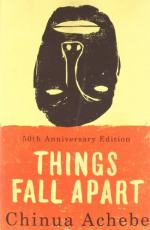
Things Fall Apart, an African-based novel by Chinua Achebe, and "The Second Coming," a poem by William Butler Yeats, has many similarities. For this reason, Achebe might have chosen to take the title of his novel from Yeats's poem. The similarities and few differences make each work uniquely in its own way.
Erika B. Robles
English Pre Ap, Period 7
Things Fall Apart
March 15, 2005
Things Fall Apart
1.Things Fall Apart, an African-based novel by Chinua Achebe, and "The Second Coming," a poem by William Butler Yeats, has many similarities. For this reason, Achebe might have chosen to take the title of his novel from Yeats's poem. The similarities and few differences make each work uniquely in its own way.
In the Poem, the second coming gives us an idea of a chaotic world and a center on which cannot hold because of its inner conflicts. In the beginning there is a show of gradual loss between the falcon and the calls of the master, giving us a sense of evil. The ones who have the ability to change do not stand up while the non-Christians are making themselves heard. Things happen to be falling apart because the people did not stand up for their own. The sphinx is going to rise up and he is the beast who will destroy all those who do not believe. This is known as the "Second Coming," which is what Christians believe to be the second time that God will come back, bringing death and famine, saving only the ones who believe. The birth of Jesus and the beast seems to be at the same time. The poem leaves us with an eery ending that the second coming is expected to follow in the immediate future, leaving things as worse as they could possibly get.
In Things Fall Apart it seems as if whenever Okonkwo, the main character, gains power or hope into becoming some great leader things happened to just fall apart. When the white missionaries came, they interfered with the tribe's religion and later on with their society and even enforce their British law. Most of the people would just stand by and watch as their whole village was slowly but surely beginning to be controlled by the missionaries and eventually disturbing their ancient ways of life.
Okonkwo on the other hand, indeed attempted to put up a rebel against the Christian religion but it always seemed to fail. Okonkwo is sent away and when he returns the Christians have a strong establishment on the village, leaving the people with fear and unable them to stand up. However, Okonkwo did still try to call meeting to discuss on what to do in order to stop the British missionaries but every time he tried it would be broken up by the officials. Until Okonkwo had enough and fought back against the messenger and killed him. He loses all hope and in the end, hangs himself.
With this said, both the novel and poem include some sort of lack of standing up to what is believed and letting all hope fall. In both, there was a base that could not hold because of its own inner conflicts and in the end they collapse and things just happen to fall apart.
16. In chapter four Okonkwo commits a crime that causes him to be reprimanded. During the Week of Peace there is to be no rebellious acts or harsh speaking to each of their neighbors but Okonkwo's ignorance and anger causes him to beat his third wife, Ojiugo, who did not return early enough to cook the afternoon meal. Values of the culture play a big part in this event because not only are they punishing Okonkwo for beating his wife on Holy Week but the purpose of this punishment is to have their earth goddess forgive the insult that Okonkwo committed by the beating of his wife. This shows us that their crop means a lot to these people and that they really have a lot of confidence toward their gods believing that because of this insult all of the tribe's crops could be destroyed. According to Ezeani, the priest of the earth goddess, everyone was to live at peace with each other in order to honor the great goddess of earth to be able to get the blessings in order to have their crops grow. Ezeani also believes that there is no other way to settle than for Okonkwo to bring offerings to the shrine of Ani in order to have their increase of crops.
Just as every other crime, it must be followed by consequences. In this case the sacred peace had not been broken for many years and nothing else was talked about but of the nso-ani (a sin or grave religious offense) that Okonkwo had committed.
This is the complete article, containing 750 words
(approx. 3 pages at 300 words per page).

