
Summary:
Zeffirellis' most successful aspect was certainly the choice of setting, a harmonious city where love is capitalized. he concentrates on the natural and very laid back scenery of Verona. Luhrmanns, interpretation of the prologue was the more prosperous of the two. He's use of a wide range of camera shots added to the high drama required for the opening sequence, which managed to engage the audiences. His version of Romeo and Juliet is rip roaring and pulls no punches.
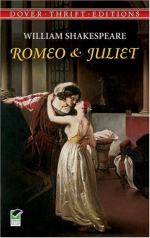
Romeo and Juliet is a famous play derived from an old text 'The tragical history of Romeus and Juliet'. The texts popularity amongst the Elizabethan audience concluded in Shakespeare making it the basis of his own play, which turned out to be a classic hit.
Verona city in Italy is where the upsetting story of the unlucky love affair was set. Romeo a Montague and Juliet a Capulet are 'a pair of star crossed lovers who took their lives in an attempt to bury their parents strife'. The Montague's and the Capulet 'both alike in dignity,' were engaged in an ancient feud, which sadly nothing but the death of their children could stop.
A prologue is a piece is writing or a script that serves as an introduction to a play, movie, story e.t.c. Prologues are used to capture the viewers' attention. Indeed the prologue must be entertaining, engrossing and most of all engaging for the viewers to entwine with then play, movie or story.
Baz Luhrmann a newfangled prolific director was born in Sydney on Friday the 10th of October 1962. He grew up with a fascination for movie and the power of telling stories. His first three movies 'strictly ballroom', 'Romeo and Juliet' and ' Moulin rouge' were dubbed 'red curtain trilogy" as they were all subjected to a particular style of filmmaking. Baz Luhrmann above all was exceptionally famous for his avant-garde, unconventional and modern style films with bright distinct colours and fast paced features.
His desire was to invocate a mainstream audience who as a whole would not comprehend or contemplate with Shakespearean plays. He consequently cast two exceedingly famous actors in the lead roles (Claire Danes and Leonardo DiCaprio), in an endeavour to conjure the younger audience who desire the thrills and spills of action and violence.
On the contrast, Franco Zeffirellis' approach to film making is more traditional and of established form. Being born in the city of Florence in Italy and growing up in its exquisite setting, resulted in Zeffirellis' enamour for classical cinema. Zeffirelli was born on the 12th of February 1923. He was exceedingly famous for making beautiful and memorable images out of Shakespeare's plays, For instance 'Othello', 'Hamlet', 'The Taming of The Shrew' and 'Romeo and Juliet'. His version of Romeo and Juliet proved to be in demand with the mainstream audience of his era, seeing as he received four-academy award from it alone. Regardless of being traditional, Franco is not intimidated by altering things. He took the film industry by surprise when he turned two unknown actors into overnight successes. He did this by placing them in the lead roles of Romeo (played by Leonard Whiting) and Juliet (played by Olivia Hussey).
Zeffirelli filmed Romeo and Juliet in its original Elizabethan setting of Verona, Italy. This movie turned out to be his greatest success with four awards. He filmed it in 1968. However Luhrmann brought his first Shakespeare play to the big screen in 1996 with the discharge of 'Romeo and Juliet'. The Oscar nominated production shifted from its Elizabethan origins to the futuristic urban backdrop of Verona Beach USA.
Lurhmanns' version is at juxtaposition to zeffirellis interpretation. To begin with Lurhmanns potrayal of Romeo and Juliet is contemporary, sensational and avant-garde. His interpretation is defined as Shakespeare for the Tarantino audience. In distinction Zeffirellis' translation is extremely traditional and is targeted to an older more rational audience compared to Luhrmanns.
Zeffirellis' usage of soporific music conveys the audience back to the epoch in which the play was set. While on the contrary Luhrmanns' rendering commences with the audible click of a TV set followed by the emergence of a news report. This apprises the audience that they are in a modern world as they cast into the setting. Luhrmanns' prelude is narrated twice. A dark-skinned female news reporter speaking in Elizabethan English with an American accent firstly recites it. The choice of a dark-skinned female news reporter indicates that the film was directed in a modernized era with egalitarianism.
On the contrary Zeffirelli uses a slow and mellow male voiceover with an establish accent, carefully asserting each and every term with an analogous sound as the setting appears full of calmness, composure and tranquillity. He uses the analogous sound to soothe the audience into the world of archaic Verona city. In contrast to this, Luhrmann uses a tremulous voice over which creates trepidation.
However they both use classical forms of music to create and enhance the setting. Luhrmann delves into a form of high-pitched operatic music, which creates the perception of a fast pace and high-dramatized city. Similarly Zeffirelli uses medieval to which emphasizes on the high-flow setting. Zeffirelli uses the camera to form a calm, relaxed and romantic image. Firstly he uses wide shots with a sepia effect, and then moves on to tracking which he uses to display the landscape of Verona city. However Luhrmann uses a wide range of camera shots. He operates on lots of aerial shots to display the city of Verona Beach USA, and also he uses mid shot to introduce the cast. He zooms in on the statue of Jesus then cuts to fast tracking shot of a police car. The contrast between the statue of Jesus that is interpreted as a holy symbol and the police car, which portrays abomination and murderousness, creates the awareness of the death of the star-crossed lovers and funeral. The thought of death builds the drama and tension and engages the audience. He applies fast frenetic editing that flashes between shots giving the feeling of dramatized energy and excitement. He then adds layers of soaring sound to be incorporated into the fast match cut editing. Collatively, explosions of abomination and fire on screen are matched by powerful and seemingly angry outbursts of sound. Where as Zeffirellis' choice of slow and gentle changes of shots build up on the peaceful and tranquil setting. Comparatively close ups of the sun and the static shots of the castle give the romantic effect which older audiences would be partial to.
On the whole, I felt Luhrmanns' most successful aspect in the Romeo and Juliet is the choice of sound. He managed to build up dramatic anticipation the audiences were experiencing and build up of many layers of sound, which is incorporated into the scene.
On the other hand Zeffirellis' most successful aspect was certainly the choice of setting, a harmonious city where love is capitalized. he concentrates on the natural and very laid back scenery of Verona city. He's downfall was mainly on the use of camera shots unlike Luhrmann he's tracking was appalling, his he's transitions were disgraceful and certainly he's static shots were discredible.
Luhrmanns, interpretation of the prologue was the more prosperous of the two. He's use of a wide range of camera shots added to the high drama required for the opening sequence, which managed to engage the audiences. His version of Romeo and Juliet is rip roaring and pulls no punches. Its stunning visuals and sound make you think as well as jump the movie could be described as stark, stylish with a memorable chilling climax
This is the complete article, containing 1,195 words
(approx. 4 pages at 300 words per page).

