
Summary:
Madame Bovary has obvious connections with "The Great Gatsby" because both texts have a theme of women's rights and both wives are unhappy in their marriages. Daisy and Emma both seek affairs as an escape from the unhappiness of their marriages. However, while Tom is unfaithful, Charles is faithful to his wife and never once suspects her of her infidelity because he is so in love with her and doesn't for one second believe that she would do anything to hurt him.
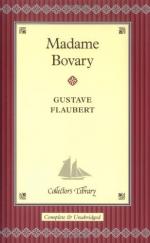
The cover of 'Madame Bovary' suggests that the story is about a woman. Perhaps set in the 19th century about a fairly wealthy woman who is possibly sad. The way that she is resting her head on her hand whilst sitting on the chair suggests that she has lost hope in something or maybe she is just tired of her life.
Gustave Flaubert was a novelist of the Realist style, who lived from 1821 to 1880 in France. His middle-class, materialistic upbringing caused him to rebel against the 'norm', which led to his expulsion from school. He then continued his schooling privately in Paris. During his teenage years, Flaubert fell in love with Elisa Schlésinger, who was married and 10 years his senior. This forbidden love inspired much of his early writing. Looking back, Flaubert described himself when he was younger as being 'afraid of life' and 'cowardly in my youth'.
I chose this text on recommendation from Miss Thomas. I read the blurb and found it intriguing so I decided to study it for my journal. Also, Madame Bovary could easily be related to The Great Gatsby because of the issue of women's rights discussed in both texts. However, due to lack of time, I have decided to study a film as my first text and then relate Madame Bovary to it.
After reading the first five pages, I am a little confused. I think the main character in the part of the book- Charles Bovary, must grow up to be the husband of Emma Bovary. The main thing I am unsure of is who the narrator is. The opening line: 'We were in prep, when the Head came in' shows that the narrator must be one of the students. Also, I don't know for sure yet whether the school is just for boys or co-ed. I like the author's style of writing because it is not too descriptive but has just the right amount of description to keep it interesting.
A connection I can see between 'The Great Gatsby' and 'Madame Bovary' is that neither Emma nor Daisy has a good relationship with their daughter. Both Berthe and Pammy have a nanny who looks after them and they rarely see their mother. When they do, however, they are smothered in kisses and fake smiles.
Madame Bovary has obvious connections with "The Great Gatsby" because both texts have a theme of women's rights and both wives are unhappy in their marriages. Daisy and Emma both seek affairs as an escape from the unhappiness of their marriages. However, while Tom is unfaithful, Charles is faithful to his wife and never once suspects her of her infidelity because he is so in love with her and doesn't for one second believe that she would do anything to hurt him.
One thing I have noticed in Madame Bovary is that Gustave Flaubert defines what he sees as important in the character's lives by how much detail he writes about the event. For example, Flaubert spends almost a whole chapter describing Emma and Charles' wedding. He uses meticulous detail so that we completely understand the dynamics of the wedding as well as what the wedding dress, the cake etc. look like. This contrasts with the ending line of Part one: 'When they set out from Tostes, one day in March, Madame Bovary was pregnant.' One would think that Madame Bovary's pregnancy would be a big event in the book but as I said before, Flaubert distinguishes between how important events are (to Madame Bovary, perhaps) by the amount of description he uses. Flaubert has been described as a realist but he claimed that realism didn't necessarily provide a more accurate view of life than romanticism.
Similarly to 'The Great Gatsby' society had very strict views on what is right and wrong during the time in which the text is set. At the time, society urged that once a woman was married, she would bear and raise children, and put all of her time into the housework and pleasing her husband. Both Daisy and Emma rebel against this image of the 'perfect wife' by having affairs, squandering money and leaving the nurse to look after the children. However, this is tolerated by Charles but not by Tom. I think this is because Charles loves Emma with all his heart but Tom doesn't.
Emma, the protagonist of the novel, has high expectations of love and life. She has such high ideals and romantic illusions that she is unsatisfied with Charles. Her desire for passion and pleasure launch her into two affairs. Emma craves sophistication, sensuality and passion, these desires cause her to lapse into extreme fits of boredom and depression when she doesn't get what she wants. Emma lacks maternal instincts, which is why she isn't close to her daughter Berthe but also because she doesn't believe she has time for such trivial things like children. Occasionally she feels guilty because of the way she treats her husband and child, causing her to repent and bury herself in religion and dedication to be a good housewife. However, these feelings are usually short-lived and she quickly switches back to her careless self. I don't like Emma that much and I don't feel sorry for her because she brings all the trouble on herself. I think she is selfish, insincere and careless. Emma reminds me very much of Daisy from 'The Great Gatsby'. She is the character most like the characters in 'The Great Gatsby' because she longs for their lifestyle and occasionally pretends to live it. Emma is as selfish and careless as a lot of the characters in 'The Great Gatsby'.
Charles Bovary is quite the opposite of Emma; he is simple, kind and considerably dull. He shares the aspects of country upbringing with Emma. However, he is honest and sincere, unlike Emma. Charles represents everything that Emma hates about society. He is incompetent, stupid and unimaginative. Because of his inability to view an idealistic world, Charles views life literally. Therefore, the things that Charles loves the most about Emma are her physical aspects. Whenever Flaubert writes from Charles' point of view, we read about what dress Emma is wearing, how her hair and skin look, what make-up she has on. However, Charles has no idea when it comes to her ambitions and depression.
I can relate to Emma Bovary's need for passion and excitement because often I feel the same way. Sometimes, I would just love to escape from Adelaide and experience something different and new, which is why I love travelling so much. I think Emma experiences the same yearning for change as I do. However, Emma is a character who wants to have her cake and eat it too. This is much like Daisy in 'The Great Gatsby' because Daisy expects that she can do whatever she pleases and still maintain a good reputation and that everything will work itself out for her.
Gustauve Flaubert writes in a way that seems to suggest that written word isn't enough and that life is too hard to catch and translate into words. He does this by writing of the characters' constant inability to express what/how they really feel about something or someone. Madame Bovary is filled with lies. This contributes to the sense of language's inadequacy in the text. In the book, Emma's life is described as 'a tissue of lies'. Flaubert shows with a few examples of lovers that by lying, the lovers make it impossible to speak deeply and truthfully about an issue.
A strong connection between 'The Great Gatsby' and 'Madame Bovary' is the issue of women's rights and the fact that neither of the leading female roles will do anything to change the lack of women's rights. When Daisy's little girl is born she says 'that's the best thing a girl can be in this world, a beautiful little fool' and Emma says something quite similar during her pregnancy, when she is hoping for a boy: 'a woman is always hampered'. Both of these women disagree with the lack of women's rights and the sexist views that are projected onto them but they don't do anything to stop this. Both characters are passionate and determined women but inside, both are cowards.
There are many examples of death and illness in this text. For example, Lestiboudois grows potatoes in the graveyard because the decomposing bodies help them to grow, and Homais keeps fetuses in jars. Similarly, Hippolyte loses his leg to gangrene and the blind beggar with festering skin follows the carriage to and from Rouen.
Windows are a symbol, which are constantly related to Emma. For her, they are a symbol of escape and possible freedom. She shouted out a window to announce her engagement, and she contemplated jumping out of the attic window to commit suicide. Emma's financial mistakes and debt is foreshadowed very early on in the book when Flaubert writes about Charles' family money mistakes. Emma's romantic disappointments are also foreshadowed, when Leon and Rodolphe are introduced into the book, it is obvious that their feelings for Emma are not as strong as hers.
I regret studying Madame Bovary for my second journal because I think it would have been much easier to study a film after I had studied a book. However, I enjoyed reading Madame Bovary although it could be quite morbid from time to time. I found it quite an emotional book even though Flaubert's style of writing isn't extremely thought provoking. 'Madame Bovary' is one of those books that will transport you to another place (i.e. France in the 1800s). I think this is because of Flaubert's use of description.
This is the complete article, containing 1,610 words
(approx. 5 pages at 300 words per page).

