
Summary:
The author of `The Great Gatsby', F. Scott Fitzgerald was an American man who lived in the 1900s. He wrote `The Great Gatsby' in 1924. Fitzgerald was married but in the very same year that he began to write `The Great Gatsby' his wife had an affair with a French naval aviator. This could have influenced his writing of `The Great Gatsby'.
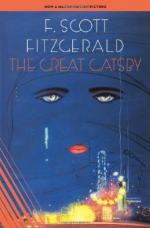
The cover of 'The Great Gatsby' film suggests that this text is a love story set earlier than the present day (1920s). After I viewed the film my thoughts about the cover were proved to be true except for the tragedy theme, which would be hard to portray on a cover without giving away the storyline.
The author of 'The Great Gatsby', F. Scott Fitzgerald was an American man who lived in the 1900s. He wrote 'The Great Gatsby' in 1924. Fitzgerald was married but in the very same year that he began to write 'The Great Gatsby' his wife had an affair with a French naval aviator. This could have influenced his writing of 'The Great Gatsby'. The era that he lived in most definitely influenced his writing because 'The Great Gatsby' is set in the twenties and he lived in that same decade. This means that he had a first hand account of what the twenties were like.
I chose to study this text because I had actually wanted to read/view it anyway and also, Miss Thomas told me that it would be a good text to compare and relate to Madame Bovary.
After viewing the first 5 minutes of 'The Great Gatsby' I can see that there are troubles with Daisy and Tom's relationship. Firstly, when Tom brought Nick into the house, he didn't even greet Daisy even though she was entering through the same door that he was leaving. I think that the flowing white curtains through which they pass, are a symbol of their honey-coated and flimsy relationship. Also, the curtains are see-through which almost suggests that the fake cover of Tom and Daisy's marriage is wearing out and people can see that their marriage is failing. Jordan informs Nick of Tom's affair, which instantly confirms the viewer's doubts about Tom and Daisy's marriage.
By introducing Daisy and Jordan as some of the first characters to appear in the film, it instantly shows the rich lifestyle that 'The Great Gatsby' is set in. Later, when Daisy and Nick are talking under the tree and watching the game of golf, it becomes apparent to the viewer that Daisy is perhaps not as shallow as she first appears to be. Daisy remarks to Nick when recounting the birth of her girl 'that's the best thing a girl can be in this world, a beautiful little fool'. This is a very important part of the film because it underlines one of the main themes: women's rights. Daisy says this but she doesn't really believe it and although she knows that this is attitude is wrong; she doesn't do anything about it. This shows the weak part of her nature and how she is not willing to stand up against what is not right. Later in the film, Daisy rebels against the lack of women's rights but she does not succeed and then loses all hope and becomes a 'beautiful little fool'. When a viewer/reader is studying the foolishness and shallowness of Daisy they must realise that she may be doing this out of necessity. In this same scene, Daisy tells us something else of interest: Tom was unhappy that their child was a girl. A connection can be made between this and when Myrtle gets the puppy at the train station. The man who is selling the puppies tells Myrtle that the beautiful little Airedale puppy is a boy. Tom then checks and says 'No, it's a bitch'. He is angry that the puppy is a girl just like he was unhappy that his child was a girl.
The author/director make us sympathetic viewers towards Nick, Daisy and Jay Gatsby. This is because Nick is a newcomer to the island and is not wealthy like his neighbours. The viewers are made to like him because he is written as such a kind character that enjoys pleasing others. Nick is the narrator of the book, and does the voiceovers in the movie. This makes it hard to analyse him because he gives us an impression of himself that he would like to give. Although, in certain parts of the film, Nick's true self shines through.
I feel two ways towards Daisy, I feel sorry for her because of her cheating husband and her bad marriage but she also annoys me because she doesn't do anything to change her position and her lack of women's rights. Because Daisy felt social pressure to marry a rich man as she reveals later in the film: "Rich girls, don't marry poor boys", she is unhappy and holds a forbidden love for Gatsby. In a way, this is her fault because she didn't challenge society's expectations. Daisy is in a way trapped. She is trapped in an unhappy marriage and in a world where she can't be free and independent. These are aspects of her personality, which show through occasionally throughout the film, especially when she is with Gatsby or at Gatsby's parties.
Gatsby is made to be the rich and lonely man who has few friends but holds parties for everyone. This aspect of him gains viewers' admiration. To fully understand Gatsby, you have to take into account not only the life he lives now but also the life that he tried to create for himself. From an early age he acquired a drive to get what he wanted. He wanted money, so he managed to get it. He also wanted Daisy, but didn't manage to keep her. This means that even when he had so much power and wealth, he is still not content because he did not have Daisy. His drive is what defines who he is, both the good and bad and it is this drive that ends his life.
Tom is a careless man who doesn't take responsibility for the chaos and suffering he causes. He's never had to face up to the consequences of his actions and this is made obvious when he flaunts his affair with Myrtle in public, and also when he and Daisy go away at the end of the film. The author sets Tom up to gain our hatred and disrespect by creating him as a selfish and unkind man.
'The Great Gatsby' has made me contemplate certain aspects of my own life. I have started to notice more frequently what it is I take for granted and have thought how the characters in 'The Great Gatsby' would change if everything they took for granted was taken away from them. I think the character that would be most affected from this would be Tom because he rarely thanks anyone and takes all of his money and possessions for granted. Tom reminds me of Sir Toby Belch from Shakespeare's 'Twelfth Night' because both are selfish. 'The Great Gatsby' can be related to 'Northern Lights' and the other two books from 'His dark materials trilogy' by Philip Pullman. This is because both books have a theme of women's rights, a lack of women's rights.
One aspects of my life that I can relate to 'The Great Gatsby' and it's characters is divorce. Tom and Daisy have a little girl, Pammy, who would have been affected if Daisy did carry through with her plans to leave Tom. When my parents got separated, I would have been just a little older than Tom and Daisy's child. I know what feelings Pammy would have experienced if Tom and Daisy had separated: guilt, pain, confusion, blame and sadness. This is one of the ways that I can relate 'The Great Gatsby' to my life and one of my experiences that has affected my viewing of the text. In 'The Great Gatsby' Pammy is told to wear certain clothes, not by her mother but by her nanny, and I'm sure that most viewers can relate to this. My mother like most dressed me in what she deemed suitable and then as I got older, advised me on what to wear. I think I speak for most people when I say that mothers often make the worst decisions when it comes to our appearance. I can relate to the way that Pammy feels, although of course she is terribly spoilt.
There are a couple of words which sum up the main themes in this text: position and carelessness. 'Position' encompasses the ideas of class, wealth and social standing. Gatsby spends the most of his life trying to gain money and power to increase his status, and therefore win back Daisy. Also, people like Tom and Daisy, show how people can use their position in society to belittle others and live their lives carelessly. Jordan, Tom and Daisy live their lives carelessly. This is because they have easy lives and have never had to work hard. Fitzgerald uses these characters to expose this careless life, which was so popular in the 'roaring twenties', with their selfish actions. Jordan shows a good example of this careless and selfish behaviour when she is driving past the gas station and almost crashes into another car at the intersection because she was driving carelessly. She says that she doesn't worry because the other people on the road aren't as careless as her and that she makes sure she surrounds herself with people who won't crash into her.
One of the most obvious symbols in 'The Great Gatsby' is the eyes of T.J Eckleburg. These eyes are set above the island almost like a kind of god and provide the judgement. The eyes on the sign are set quite close to Wilson's garage. This is because this is the setting where most of the careless and selfish acts occur. Wilson's garage is the setting for Myrtle's death and Tom's affair with Myrtle. The eyes are a symbol that reminds the characters of the guilt that they forget to feel. Also, throughout the film, these bespectacled eyes on the sign slowly deteriorate and planks of wood on the sign fall down. This is a symbol of how the order breaks down on the two islands -East Egg and West Egg and also how the selfish acts are become more frequent during the text. This is a very good connection to 'Lord of the Flies' because 'LOTF' has many symbols to represent the order breaking down on the island. One of these is Piggy's glasses. In the beginning of the text, Piggy's glasses are in immaculate condition but slowly become more and more damaged until finally the glass is actually broken. This can be related to the glasses and eyes of T.J Eckleburg on the sign in 'The Great Gatsby' because as I already said, throughout the film, the eyes and the sign slowly become ruined.
The director of 'The Great Gatsby' used many different film techniques to express the themes and cultural issues in the text. Fairly early on in the film, the director uses an extreme long shot, which encapsulates the size difference between Gatsby's mansion and Nick's bungalow. This establishes the feel of West Egg and sets the scene for future events. When Nick arrives on the yacht to visit Tom and Daisy on the East Egg, there is a close-up of Tom's face, which is full of smugness and happiness at being able to show off his possessions to Nick. On one of Nick's first nights on West Egg, Gatsby has a party. Whilst Nick is watching the figures on Gatsby's property having a marvellous time, the director uses a low angle shot to represent Nick's view of Gatsby's party. Also, Nick's house is on lower ground than Gatsby's mansion and therefore low-angle shots are constantly used when filming from Nick's house to Gatsby's house. This shows the power and authority Gatsby has over Nick, even though later in the film they become great friends. The director uses interesting parallel shots between Nick and Gatsby and their lives. For example, on the night that Gatsby has a party (one of Nick's first nights on the island), the director shows all the chefs preparing and cooking the food for Gatsby's party in the huge stainless-steel kitchen. This shot is then contrasted to a shot of Nick preparing his own dinner. This shot simply contains a close-up of Nick's hand and a frying pan with steak in it. These two shots are intertwined and create a very interesting parallel that captures both men's lifestyles.
I enjoyed watching 'The Great Gatsby' but I didn't find it as interesting or thought provoking as many people made it out to be. Perhaps, if I had read the entire book I would have found it more rewarding. I think that 'The Great Gatsby' has many morals to be learnt and is similar to 'Lord of the Flies' in the sense that it is an allegory and also, the society on Long Island is used as a microcosm of social standing throughout the world.
This is the complete article, containing 2,147 words
(approx. 7 pages at 300 words per page).

