
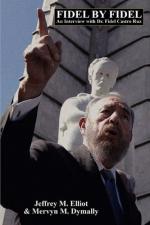
A review of the history of Fidel Castro up until the Bay of Pigs.
Fidel Castro was born on a farm in Birán, Cuba, near Mayarí, on August 13, 1926. He received a Jesuit education while attending a boarding school in Havana by the name Colegio de Belen. When he finished high school, he attended the University of Havana. In 1950 he graduated from the university in 1950 with a degree in law in 1950.
Fidel was a member of the social democratic Ortodoxo party. This party strongly criticized the way Fulgencio Batista (held power in Cuba, first as president, later as dictator) way of running the government. Castro charged Batista with violating the constitution because Batista overthrew the government of Carlos Prio Socarras (man who was the current president of Cuba, who was overthrown by Batista) leading to the cancellation of elections. Castro's petition was refused. Because the court refused Castro's petition, on July 26, 1953 Castro led an attack on the Moncada army barracks. This attack failed miserably. Many of his men were killed, and he was captured and sentenced to jail for fifteen years. Although the attacked failed, it brought him national recognition. While he was in trail, he gave his famous "History will Absolve Me" speech, explaining his actions and his political views. He was pardoned and let out of jail just after years and exiled to Mexico.
While in Mexico he founded the 26th of July Movement, stating that he would return to Cuba and fight against Batista. In December 1956, he and about 8 other men, including Che Guevara, returned to Cuba and went to Sierra Maestra and they launched a successful guerrilla war. Castro proved himself to the people of Cuba that he was a strong and capable leader who had clever political skills. Castro convinced people that he had an obligation to change the character of Cuban society. Batista noticed that he could not count on the support of the United States and seeing his army collapse, Batista fled on January 1, 1959. Batista's fleeing of Cuba is what paved the way for Castro's rise in power.
In February 1960, Cuba signed an agreement to buy oil from the USSR. When the U.S. owned refineries in Cuba didn't want to process the oil they were annexed, and the United States broke off political affairs with the Castro government soon after. Cuba established closer relations with the Soviet Union. A lot of pacts were made and signed between Castro and Khrushchev (Soviet Premier), and Cuba began to receive large amounts of economic and military aid from the USSR.
The CIA came up with a plan to invade Cuba and hope to cause a popular movement against Castro. The invasion is now referred to as the Bay of Pigs invasion. Although the U.S. did decided to invade, there was no uprising against Castro. The invasion failed miserably. The group that made it onto shore was captured, and President Kenned withdrew his support at the last minute. Two U.S. supplied support ships were sunk by Cuban aircrafts. Castro was personally calling the shots on the battlefield. By doing this, he gained even more support from ordinary Cubans.
Although Castro is a strong military leader, the Castro regime has been frequently accused of numerous human rights abuses, including torture, random imprisonment, unfair trials, and extra-judicial killings. Many argue that several thousand unjustified deaths have occurred under Castro's decades-long rule.
This is the complete article, containing 556 words
(approx. 2 pages at 300 words per page).

