
BookRags.com Literature Guides Literature
Guides
Criticism & Essays Criticism &
Essays
Questions & Answers Questions &
Answers
Lesson Plans Lesson
Plans
My Bibliography Periodic Table U.S. Presidents Shakespeare Sonnet Shake-Up
Research Anything:        
History | Encyclopedias | Films | News | Create a Bibliography | More... Login | Register | Help

Not What You Meant?  There are 14 definitions for Handel.

Student Essay on The Villains of "Great Expectations"

Print-Friendly  Order the PDF version  Order the RTF version
Charles Dickens
About 5 pages (1,561 words)
Great Expectations Summary

Bookmark and Share Know this topic well? Help others and get FREE products!

The Villains of "Great Expectations"

Summary:   Villainous behavior is a main theme of "Great Expectations," the classic novel by Charles Dickens.


Villains are vital in literature as they allow the plot to surge ahead. They also provide the protagonist with an opponent. No matter where a person looks, there are many villains present, as well as examples of villainous behaviour.

Within the text Great Expectations, by Charles Dickens, there is one very obvious villain - Miss Havisham. Pip calls Miss Havisham "the strangest lady I have ever seen." Miss Havisham is an old woman living in Satis House, a large house located close to Pip's village. She lives with her adopted daughter named Estella. Miss Havisham has not left the house since being jilted on her wedding-day, and she still wears her faded wedding dress. Her wedding cake is decaying on a table and the house is almost in ruins.

Miss Havisham is a villain because she isolates herself from the outside world. Dickens informs the audience of this, when Pip describes Miss Havisham's house, "We came to Miss Havisham's house, which was old brick... and had many iron bars to it. Some of the windows... were rustily barred." Dickens uses great detail to emphasise that Miss Havisham is isolating herself from the outside world. The technique Dickens uses to describe Miss Havisham's isolation is atmosphere. He quickly informs the audience of the dark nature of the surroundings, and allows them to predict something dark is going to occur. Dickens also conveys this scene to the audience through descriptive language, which has a great effect on the audience. It allows the audience to easily picture Satis House as they read.

Miss Havisham is also isolated in the sense that she has no real family. The audience learns that her mother passed away when she was a baby, and that her father left her his entire fortune when he died. This form of isolation can be closely linked with Magneto, a villain out of X-Men. As a young boy Magneto was a survivor of the Auschwitz death camp. He witnessed the murder of his family and his entire village by the Nazis during the Holocaust.

Miss Havisham was also isolated on her wedding day, by her lover Compeyson. Since this Machiavellian act, she has sworn revenge on men, and uses Estella, her adopted daughter, to wreak this revenge. This is another reason why Miss Havisham is a villain.

When Pip goes to play at Satis House, he falls in love with Estella. Due to Miss Havisham knowing that this love will end in tragedy, she encourages Pip to love Estella. She knows that it will end in tragedy because she has raised Estella as her own, and taught her to hurt men mentally. The following quote show Miss Havisham manipulating Pip, and making him feel affectionate towards Estella. "What do you think of her"""I think she is very proud...I think she is very pretty...I think I should like to go home""And never see her again, though she is so pretty"" In this quote, Dickens uses every day language to accentuate that Miss Havisham is a villain. The effect this has on the audience is that of bitterness and revulsion towards Miss Havisham.

Another reason why Miss Havisham is a villain is because she literally tells Estella to break Pip's heart. When Pip is in Satis house Miss Havisham instructs Pip and Estella to play. Estella responds to this by saying, "He is a common labouring boy." And Miss Havisham replies, "Well, you can break his heart."

Miss Havisham is later horrified by Pip's suffering and regrets her actions.

"O, what have I done! What have I done!" This informs the audience that Miss Havisham truly does regret her actions and that she has changed her ways.

Abel Magwitch is another villain within the text.

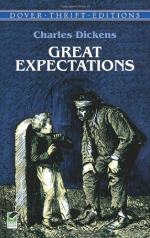
The audience is first introduced to Magwitch on the marshes, after he escapes from a convict ship. Magwitch forces Pip to bring him a file and some food. Dickens uses colloquial language in this scene to highlight to the audience Magwitch's villainy, "what fat cheeks you ha' got." The use of colloquial language emphasises the point that Magwitch is a villain. His appearance also highlights this point. He is, "A fearful man, all in course grey, with a great iron on his leg." Dickens uses descriptive language in this quote, to further portray to the audience, Magwitch's villainous traits. This effect is very effective as it allows the audience to imagine Magwitch very clearly.

At the beginning of the novel Dickens uses Pip's innocence in contrast with Magwitch's evil. This effect gives the illusion that Magwitch is actually more evil than he really is. The audience is tricked. Also, due to the text being written in Pip's subjective view, Magwitch has been exaggerated greatly, "a man who had been soaked in water, cut by flints, torn by briars; who limped and shivered and glared and growled." Pip's exaggeration of Magwitch persuades the audience to believe that Magwitch is extremely villainous, just because of his appearance.

Magwitch is isolated through his lack of wealth. This can be seen by the clothes he wears, "course grey...smothered in blood", and also his lack of cleanliness, "soaked in water, cut by flints, torn by briars." He is unable to purchase clothes or wash himself due to his lack of money.

Magwitch isolated himself socially throughout the course of the novel. His appearance influences his isolation. His chains naturally inform people that he is a convict, in which they avoid him. Also because of his appearance, people do not want to be around him.

Another reason why he is isolated socially is because later in the novel, he became a farmer, and lived by himself. During this time alone, Magwitch changed from being a villain and sent all of the money he earned to Pip. This educates the audience that Magwitch has some elements of kindness within him, and that he is not a stereotypical villain. He is not a stereotypical villain because; most villains become evil during isolation, whereas, Magwitch changed for the best during his isolation.

Towards the end of the novel Magwitch is recaptured by the police and dies in prison, with Pip by his side.

Despite Pip beginning the novel as an innocent, little boy, he is another example of a villain in the text.

Pip is very innocent at the start of the novel. The audience is informed of Pip's innocence in the first scene, when he is confronted by Magwitch. The audience is informed that Pip is very timid, "I was dreadfully frightened." Dickens uses very descriptive language to allow the audience to picture the scene, "dark flat wilderness beyond the churchyard." Dickens also contrasts Pip with Magwitch's villainy to exaggerate Pip's innocence.

When Pip first moves to London he is very eager to learn, and Herbert teaches him basic table manners, "My dear Handel, to remark, a dinner napkin will not go into a tumbler" "O Thank-you." In this quote, the audience is exposed to Pip's innocence and is shown that he is yet to become arrogant.

However, as the novel progresses, Pip becomes arrogant and begins to neglect his friends and family. He becomes arrogant in an attempt to climb the social status ladder and become a gentleman. Pip is trying to become a gentleman for one reason - so he can marry Estella. When Pip first met Estella in Satis house, Estella called Pip, "a common labouring boy." These words drove Pip to improve his social status. Pip is a villain because he is becoming a gentleman so that he is able to receive personal gain, in the form of Estella.

An example of Pip's arrogance is when Joe visits him in London. Pip hears someone climbing the stairs and recounts, "I knew it was Joe, by his clumsy manner of coming up stairs - his boots always too big for him." Pip is a 'gentleman' at this stage of the text, and is extremely arrogant and self centred. Dickens uses Pip's subjective view in this quote to exaggerate his point. Another example which shows Pip's arrogance is when Joe and Pip are talking in London. Pip narrates, "I felt impatient of him and out of temper with him; in which condition he heaped coals of fire on my head." This quote allows the audience to judge Pip as a character and make the assumption that he does show villainous traits. Due to the text being an autobiographical narrative, Pip's subjective view is naturally exaggerated, as it is in the previous quote.

Another reason why Pip is a villain is because he takes his friends for granted. As Pip is an arrogant man, he neglects Herbert, and changes his attitude towards him. "Well, Herbert. Is that all you have to say? Well"" In this quote, the audience is able to identify that Pip is losing patience with Herbert. Pip takes Herbert for granted.

Pip is isolated mentally because of his arrogance. He is also isolated financially because the richer he becomes the more arrogant he becomes. Lastly, he is isolated socially because he forgets about his roots and pushes his friends aside during his quest for Estella's love.

In the final chapters of the novel Pip changes significantly. He was arrogant and self centred, but he realised his mistakes, "I can do it now. There have been sore mistakes", and changed his attitude. He turns out to be a caring gentleman.

Villains are vital in literature as they allow the plot to forge ahead.

This is the complete article, containing 1,561 words (approx. 5 pages at 300 words per page).

More Information
  • View The Villains of "Great Expectations" Study Pack
  • 14 Alternative Definitions
  • Search Results for "The Villains of "Great Expectations""
  • Add This to Your Bibliography
  • More Products on This Subject
    Do 19th Century Writers Regard Criminals as 'Irredeemably Other'?
    `Nineteenth century writers are fascinated by criminals, but they are content to regard them as soci... more

    Great Expectations
    The opening of the chapter reads: "I was three-and-twenty years of age. Not another word had I ... more


    View all | View only answered questions | View only unanswered questions
    What is the plot, setting, point of view, conflict, symbol, theme, style, tone and irony of "great expectation"?
    30

    What Points Mean

    The best answer to this question will earn 30 points. All other answers will earn 1 point. Click for more information.
    In College Courses & Majors | Asked by anna lynyx | 1 answer | Open for 6 more days
    Asked from the Great Expectations study pack
    (1 question)
    Ask any question on Great Expectations and get it answered FAST!
    Answer questions in BookRags Q&A and earn points toward
    discounted or even FREE Study Guides and other BookRags products!
    Learn more about BookRags Q&A
    Copyrights
    The Villains of "Great Expectations" from BookRags Student Essays. ©2000-2006 by BookRags, Inc. All rights reserved.


    Join BookRagslearn moreJoin BookRags


    About BookRags | Customer Service | Report an Error | Terms of Use | Privacy Policy

