BookRags.com Literature Guides Literature
Guides
Criticism & Essays Criticism &
Essays
Questions & Answers Questions &
Answers
Lesson Plans Lesson
Plans
My Bibliography Periodic Table U.S. Presidents Shakespeare Sonnet Shake-Up
Research Anything:        
History | Encyclopedias | Films | News | Create a Bibliography | More... Login | Register | Help

Not What You Meant?  There are 7 definitions for Absalom.  Also try: Cry, the Beloved Country (film).

Student Essay on Selected Themes from Cry, the Beloved Country.

Print-Friendly  Order the PDF version  Order the RTF version
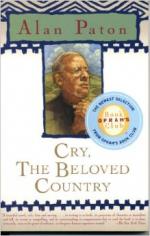
Alan Paton
About 9 pages (2,567 words)
Cry, The Beloved Country Summary

Bookmark and Share Questions on this topic? Just ask!

Selected Themes from Cry, the Beloved Country.

Summary:   Racial divide in South Africa occured during the era of colonialism. The book written By Alan Paton it tells of a tragic story of a young man who was sentenced to death by hanging for a crime he did not intend to commit. In a country where justice is granted to whites and blacks have none illustates a tragedy which befell on this young man that his father, a pastor, faced great difficulty in bearing the thoughts of losing his son.


Although set in South Africa, Cry the Beloved Country has themes that

have permanent and universal interests. These are themes of crime and punishment,

the human cost of power and wealth, and division and reconciliation.

The underlying cause of crime in Johannesburg is rural-urban migration.

The aborigines had small farmlands which are arid and dry making it difficult for them to

cultivate any food crop the popular one being maize. The white farmers on the other

hand, had large acres and fertile farmlands making it possible for them to grow different

kinds of crops. They had farming equipments such as the tractor which the black folks

lacked or haven't even seen one before. In the harsh conditions of the weather, where

there is little or no rain, their state of affairs worsens. The white farmers really do not

suffer since their scale of production was high; they were able to survive during

unfavorable weather conditions. With this, they were able to export their produce to the

outside world and also to neighboring towns and cities making them rich while the black

farmers lived in adverse poverty.

Hearing the trumpet sound of Johannesburg they set out from their farmlands one

after the other. Like the story in Aesop's fables The Pied Piper of Hamelin where we find

children following the sweet sounds of a bagpipe from the Pied Piper only to find

themselves trapped in a cage. Over a long period of time the long full dangers were not

seen, but fathers, mothers, sons, and daughters went to work in Johannesburg and never

came back. In time, black folks tried to set up new homes and began to experience with

bewilderment and shame the shocks of disobedient children, pregnant daughters, and

delinquent sons. Home life decayed in the overcrowded slums; and it also putrefied

in the tribal reserves, where men did not come back, and where women went to look

for them and often found someone else. Among those, for example, who went to work

was the husband of Gertrude, who in turn, went to look for him and found other men

instead. And in Absalom with his girlfriend we have instances of a delinquent son

and a pregnant daughter. In the quest for survival, they find themselves in the

negligence to their responsibilities and face the full wrath of the law which doesn't

favor them and the society as a whole.

This created criminal cases; rape, robbery, and murder. There were instances

where white housewives were raped, murdered and robbed when their husbands were

away. The black folks who were regarded as a menace to society being prime suspects to

such criminal activities and so they were looked upon as outcasts. For this they were

either tortured or murdered when caught and put into prison. Absalom found himself in

such a predicament after going to prison and having been reformed, he was faced with the

claws of the law for murder which he admitted.

His judgment opens, in a language of solemn formality, with a description

of the setting for the trial in a segregated South African courtroom. This description

develops into a commentary on the majesty of the law, the status of judges who must

administer them. The Judge does not make the law it is made by the whites. Therefore if

the law is unjust, and if the Judge judges according to the Law, that is justice, even if it is

not just. Under these harsh laws, which generally intensified the dilemma of judges, the

authorities were given vast powers of punishment outside the courts and legal system.

These powers included detentions without trial, house arrests, and white mob justice.

In the climate created by these laws, Absalom makes a poor witness on his own behalf;

and the prosecutor has little difficulty in supporting his case for a verdict of premeditated

murder. His defense collapses in the face of the strategy devised by his uncle, John

Kumalo, when his cousin, Matthew, and friend Johannes Pafuri deny their presence at

the scene. After the proceedings, he was sentenced to death by hanging. In this case if it

had been a white man he would be exonerated on the basis of self defense even if it

wasn't the case. Indeed the justice or legal system is flawed. John Fitzgerald Kennedy, in

his inaugural speech as president of The United States of America, stated:

When at some future date the high court of history sits in judgment

on each one of us- recording whether in our brief span of service

we fulfilled our responsibilities to the state our success or failure,

in whatever office we may hold, will be measured by the answers

to four questions: Were we truly men of courage ? Were we truly

men of judgment ? Were we truly men of integrity? Were \ we truly

men of dedication"

Referring to Kennedy's first question, in the case of Absalom he was courageous because

he came to terms with his wrongdoing and he felt sorry for what he did as it wasn't his intention.

On the other hand, the judge, prosecutor, and the defense lawyer were not because they failed to

execute their duties for fear of being thought weak in the minds of both the white and black folks.

Secondly, the judgment pronounced on Absalom was based on hatred towards him for

Killing a white and not on the motive for the crime he committed. For Absalom being able to

confess his crime to the hearing in expressing regrets and repentance, he should have been

awarded a lesser sentence for instance, a limited years in prison. The blood of Absalom

was what they wanted therefore, judgment based on vengeance was carried out-an unfair trial.

Thirdly, there was lack of sincerity on Absalom's lawyer because, he put up a poor

defense for his client making it easier for the prosecutor to win the case. In other words, if indeed

he were sincere on his profession he could have declined defending Absalom. Like his peers he

wanted the same thing-vengeance.

Lastly, Absalom was dedicated to one thing which was to tell the truth. He may have

taken an unwise decision by not lying in order for him to save his life just as his cousin and

friend did. Unlike the judge who dispensed a death penalty on Absalom was not loyal to his

profession. In a court of law the weight of judgment must be in equilibrium to a case in question

considering the motives or intentions. There was an imbalance of measure in Absalom's murder

trial because justice was rendered to protect the whites and oppress the blacks. With this, there is

an element of favoritism therefore the society in itself is lawless.

As can be seen, the theme of new gold discoveries-this time, not from the

perspective of mine owners and shareholders, but from the point of view of those

seeking to unionize black workers. The valor and popularity of Johannesburg was

the presence of mineral wealth such as gold and diamonds which the whites clamored

for at the expense of the blacks. The wealth was used in creating sophisticated towns

and cities at their luxury whereas the blacks resided in slums and even some had to

sleep on the streets particularly the black miners. All roads lead to Johannesburg like

the spokes of the wheel it calls out for blacks residing in the rural areas not to come

for a share in the wealth, but to come and enslave themselves at the mercy of the

white man. This is for him to enjoy the lavishness and sophistication of life while the

blacks struggle and toil in order for them to survive. They pay high taxes, their

transportation fares are high but the income given to them is just not enough for them to

meet their basic needs such as food, shelter, and clothes. It's like spending a dime while

earning a nickel no love for the people who are really suffering.

The greater part of this event was how John Kumalo used his wealth and

influence on various people. These include Dubula, who organized the bus boycott and

the building of Shanty Town. John Kumalo is here represented as a man gifted with a

voice amazing power, who, if he dared, could stir black men to frenzy of revolt. All who

hear him agree on this? John Kumalo, has a good cause, and he presents a good case.

After all, he is attacking the slaving mining interest satirized earlier. But as his

associates, Dubula and Tomlinson know, he is not committed to the cause of the

downtrodden. He is only interested in himself and the applause of the crowds. He will

not risk losing what he already has-the carpenter's shop, which brings in a good, reliable

income, and the adulation of admirers who gather there. There follows a scene which

contemplates the possibilities of a strike, and then it sketches a scenario of events that

may occur. Two white people who realized how dependent they are on black labor, the

thought of miners' strike escalating into a general strike of all black workers is terrifying.

There had been some trouble, but it was contained within the mines and did not intrude

on the lives of the public. All is now quiet. In the strike's aftermath a few concerned

people continue to discuss the case for a black miners' union; a spokesman for the

Chamber of Mines responds that simple miners are not qualified to run a union and

would only become the tools of agitators. Others continue their endless talking about

social problems without offering to do anything practical.

The murdered man, Arthur Jarvis, never comes on the theme before us in

the novel. He is nonetheless the character about whom we learnt the most. It becomes

known to us that Arthur Jarvis, as his father, James Jarvis, belatedly comes into

reconciliation with him: through his letters and writings; through the many books in his

study; and even through his choice of pictures on the walls which later placed him on the

same page with his son later.

James Jarvis's first introduction to the quality of his son's mind comes

from the letters on the dead man's desk-the invitations to speak, for example, at the

Claremont African Boys' Club, of which he was president-and from several writings

on social justice his son left behind. These writings argue the case for racial recon-

ciliation in South Africa from the Christians' point of view. They begin to open James

Jarvis's eyes to the real plight of both urban and rural Africans as consequence of the

destruction of their tribal organization without provision for its replacement by something

better.

The many books in the Afrikaans's language, for example, reveal a

mentality of wonder and jumbled questions and it is quite evident, too, that some

amounts of knowledge of Abraham Lincoln were obtained from young man's writings.

James Jarvis, a man of little reading, was astonished to find in his son's study a whole

bookcase full of books about Lincoln. Browsing in these, he reads Lincoln's Gettysburg

address and, later, his Second Inaugural address. His father's subsequent actions are

motivated by what he encounters in Lincoln's writings where he slipped the volume of

Lincoln's book into his pocket for further reading after discovering that Lincoln was the

world's greatest champion of racial justice-who was not a South African.

The value James Jarvis placed on his son's was very great as he respected

the pictures on the wall. The first picture which really caught his attention was the

Crucifixion of Christ representing his son's Christian faith. There was an emphasis on

Christians' responsibility in a country where the term "Christian Civilization" was

adopted as a self-description by most of the white community. It was a theme based on

moral responsibility which the whites breached.

Secondly, there was a picture of a historic architectural gem, which

was the house of Simon van der Stel. The house Simon built was based on his

aftermath on arriving in Cape of Good Hope, and from which an architecture

recognizably South African was derived. Lastly, there was a picture, "the painting of

leafless willows by a river in a wintry veldt", symbolizes Jarvis love of the land itself in

the most bleak and desolate seasons; the veldt speaks of home, South Africa.

It is very difficult to see two fathers coming together as friends and

neighbors in the midst of a tragedy that has befallen them. One has a murdered son

and the other has a murdered son and the other has a son who would soon receive a

death penalty. For example, kumalo's actions of sitting with his head bowed, of

dropping the stick and hat, of struggling to rise, and of dropping the papers from his

trembling hands, are actions of an actor might have thought up to interprete a character in

such an emotional situation since it was Kumalo's first time being in a house belonging

to a white man. He was drowned in fear just as his son Absalom when he shot Arthur. So

are Jarvis's hesitant movements in picking up a stick and hat and restoring them to the

old man. This showed how clearly Jarvis understood his son and how slowly he moved

into a new dispensation of his moments and days.

In this theme, too, that we first observe the direction of growth in

Jarvis's character. He is moved by the old man's distress and by his humility, and he

pulls himself together, resolutely, after the shock of recognition. When his wife's niece

returns and says that she dismissed Sibeko's daughter for bad behavior, that she doesn't

know where her former maid is, and, what's more, that she doesn't care, Jarvis softens

the edge of her rudeness by not translating her "I don't care" into Zulu. This was made

possible on the part of Jarvis by the readings of his son's essays and passages from

Abraham Lincoln, which opened his mind to change and took the determination to carry

his son's work. He also went as far as donating some amount of money to Stephen

Kumalo in order for a new church to be built just as his son established a youth center

for the black community in Johannesburg and his Christian faith.

The life experiences of the old clergyman, Stephen Kumalo, in

Cry, the Beloved Country encompasses love in three senses which are love for his wife,

his son and daughter in law, and his love for God. As an Anglican priest he is a married

married man. Now on the verge of old age, the mutual love between him and his wife-

which can be defined from love called passion-is still strong.

So is his paternal affection for his wayward son that draws him to

undertake the arduous quest that is the novel's more conventional theme. His love for

Absalom extended through the boundaries by officiating the marriage between his son,

Absalom, and his pregnant wife. He forgave his son, by attending all the court

proceedings on his son's case on a charge for murder.

Lastly, as the east brightens with the rising sun, Kumalo rises,

uncovers his head, and prays for his son on the mountain. Throughout his night of

tribulation, subconsciously reenacting the sacred sites of his priestly function, he had

remained faithful to his calling. He never held Absalom's wrongdoing and reports

against him rather, he forgave him and that's the biggest reconciliation a parent can give

to a child.

Rather than waiting for time or governments to bring about change, each

of these characters set about whatever good is within his power; for each has come to

recognize how individual fear and indifference infects society with moral paralysis,

and each also realizes that the antidote to moral paralysis is individual courage and the

willingness to go forward in faith. They do not wait for some miraculous healing of this

paralysis to be brought about by the direct intervention of God, or through the

implementation of some theoretical scheme for a final solution, or through the flowering

of some political manifesto.

This is the complete article, containing 2,567 words (approx. 9 pages at 300 words per page).

More Information
  • View Selected Themes from Cry, the Beloved Country. Study Pack
  • 7 Alternative Definitions
  • Search Results for "Selected Themes from Cry, the Beloved Country."
  • Add This to Your Bibliography
  • More Products on This Subject
    The Universal Theme of "Cry the Beloved Country"
    While Alan Paton's Cry the Beloved Country is set in South African and discusses social problems pre... more

    Slumber and Cry the Beloved Country
    Slumber What naught could quench nor words appease    A beast was there to feast ... more


    Ask any question on Cry, The Beloved Country and get it answered FAST!
    Answer questions in BookRags Q&A and earn points toward
    discounted or even FREE Study Guides and other BookRags products!
    Learn more about BookRags Q&A
    Copyrights
    Selected Themes from Cry, the Beloved Country. from BookRags Student Essays. ©2000-2006 by BookRags, Inc. All rights reserved.

    Join BookRagslearn moreJoin BookRags


    About BookRags | Customer Service | Report an Error | Terms of Use | Privacy Policy