
BookRags.com Literature Guides Literature
Guides
Criticism & Essays Criticism &
Essays
Questions & Answers Questions &
Answers
Lesson Plans Lesson
Plans
My Bibliography Periodic Table U.S. Presidents Shakespeare Sonnet Shake-Up
Research Anything:        
History | Encyclopedias | Films | News | Create a Bibliography | More... Login | Register | Help

Not What You Meant?  There are 9 definitions for Common sense.

Student Essay on "Common Sense" Versus the Declaration of Independence

Print-Friendly  Order the PDF version  Order the RTF version
Thomas Paine
About 3 pages (836 words)
Common Sense (pamphlet) Summary

Bookmark and Share Know this topic well? Help others and get FREE products!

"Common Sense" Versus the Declaration of Independence

Summary:   Could a mere pamphlet state just as much or even more than one of the nations most precious and highly regarded document? Thomas Jefferson drafted the Declaration of Independence in 1776, but this was after Thomas Paine wrote and published "Common Sense" in January of that same year.


"Common Sense" versus The Declaration of Independence

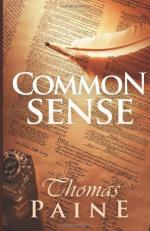
Could a mere pamphlet state just as much or even more than one of the nations most precious and highly regarded document? Thomas Jefferson drafted the Declaration of Independence in 1776, but this was after Thomas Paine wrote and published "Common Sense" in January of that same year. Because of this, many believed that it was this pamphlet which evoked the rise of the Second Continental Congress and ultimately, the Declaration of Independence. A question commonly asked would be, "Is 'Common Sense' more important than presentation of the Declaration of Independence"" There are many who believe it was but the majority does not believe that it was more or less important or more necessary. They do feel, however, that if it was not for the publication of "Common Sense", it would have meant more lives lost and a more difficult struggle to unite the thirteen colonies. Within this essay, it will be explained that if "Common Sense" wasn't written, the Declaration may not have been...that "Common Sense" literally knocked some sense into the people of the colonies, and that finally, these colonies had the right to be free and independent states.

As mentioned before, "Common Sense" was written by Thomas Paine. Paine was inspired to create this pamphlet due to certain events, such as the Boston Tea Party. He realized that these colonies were being taxed by a government who didn't give them any representation. He wrote "Common Sense" to try to inspire the colonists to rebel and fight for independence, or to at least consider it. The King of Great Britain didn't even acknowledge his own people, let alone the people of a continent across the ocean. Thomas Paine decided to put into words what everyone was thinking...Independence from England must come sooner or later and it is ridiculous for an island to have rule over a continent...Many lives had been lost due to the unfairness and uncivil liberties inflicted onto the colonists. British soldiers and colonists alike were sacrificed in the fight for independence. There are even those who say that the British soldiers were fighting for their King's opinions and views and that theirs were not taken into consideration.

Thomas Paine knew what the colonists were thinking. He knew that they wanted their freedom and their independence, but they didn't seem to be putting out many complaints. What Paine did in writing "Common Sense" was to describe how the British rule over the colonies was unjust. He made it clear that the colonies did not have their own beliefs and choices acknowledged by the King of England. Any wars or disagreements that Britain had with other counties, the colonies would unnecessarily be involved with. These statements are also found in the Declaration of Independence. One other thing as said by Thomas Paine was that if Britain was to be the "Mother Country" and America was the child, then all of Britain's actions were even worse...no mother should ever treat her child so terribly. With these words in his pamphlet, the colonists had found the fire within themselves and it ignited in them a new determination to become their own nation. As Thomas Paine put it : the United States of America.

Thomas Paine's "Common Sense" placed an awakening on the American conscience. This small pamphlet which could fit into your pocket inspired the colonists to strive for independence. The controversial issue was American independence and the expressions of the American mind became recognized by others. Over 600,000 copies of "Common Sense" were sold where a population of 3,000,000 resided. Many who had been neutral on the issue of independence were now convinced that a monarchy could no longer address their needs and that their separation from England was necessary. "Common Sense" prepared the colonists fro what would be written and proposed in the Declaration of Independence, which would surface later that year. In the Declaration, as in "Common Sense", it is written that '...we are endowed by our Creator with certain unalienable rights, that among these are Life, Liberty, and the Pursuit of Happiness...'

"Common Sense" first said it and the Declaration 'declared' it...that these united colonies had the right to be free and independent states.

So, the question is: could a mere pamphlet state just as much or even more than one of the nations most precious and highly regarded document? "Common Sense" was the pamphlet which evoked the rise of the Second Continental Congress and ultimately, the Declaration of Independence. Is "Common Sense" more important than the of the Declaration of Independence"" No...it was just as equally important and necessary. "Common Sense" however was the doorway through which the thirteen colonies were prepared for the proposition of the Declaration of Independence. All of the issues contained within the pages of "Common Sense" are stated and detailed in the Declaration. Thomas Paine's

"Common Sense" and Thomas Jefferson's (and the Second Continental Congress') Declaration of Independence are the foundations of this country and signify the birth of the United States of America.

This is the complete article, containing 836 words (approx. 3 pages at 300 words per page).

More Information
  • View "Common Sense" Versus the Declaration of Independence Study Pack
  • 9 Alternative Definitions
  • Search Results for ""Common Sense" Versus the Declaration of Independence"
  • Add This to Your Bibliography
  • More Products on This Subject
    Common Sense
    Thomas Paine wrote this document because of a want for independence. It appeared around 1776 and qu... more

    Common Sense
    Common Sense, a political pamphlet, written by Thomas Paine in 1775, was meant to persuade American ... more


    Ask any question on Common Sense (pamphlet) and get it answered FAST!
    Answer questions in BookRags Q&A and earn points toward
    discounted or even FREE Study Guides and other BookRags products!
    Learn more about BookRags Q&A
    Copyrights
    "Common Sense" Versus the Declaration of Independence from BookRags Student Essays. ©2000-2006 by BookRags, Inc. All rights reserved.

    Join BookRagslearn moreJoin BookRags


    About BookRags | Customer Service | Report an Error | Terms of Use | Privacy Policy

