
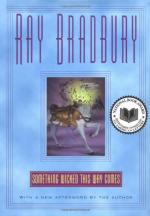
Something Wicked This Way Comes: Charles Halloway Analysis
Summary:
Something Wicked This Way Comes, by Ray Bradbury contains a character named Charles Halloway. who develops and reforms, proving himself to be hero. A remoreseful and bitter man, he evolves an audacious, outgoing character finally able to laugh.
Heroes come in many forms, and not all heroes come in Marvel Comics. The novel Something Wicked This Way Comes, by Ray Bradbury contains a character named Charles Halloway. Charles Halloway, a developing reforming character, proves himself as quite a hero. In the story, Mr. Halloway starts as a person who has many regrets, then a person forced to change, and finally evolves into a hero. The first part of the book begins with a remorseful gentleman.
In part one of Something Wicked This Way Comes, Bradbury shares Halloway's regrets with the reader. When Will Halloway was a young boy, he drowned in a river. Mr. Halloway did not know how to swim at the time; therefore, Will's rescuer was his best friend's father. Halloway never had the chance to play ball with his son neither. He regrets his lack of presence throughout his son's life and his lack of ability to help him throughout Will's life. Ray Bradbury writes, "It's just, you know, seeing them pass, that's how they'll be all their life; they'll get hit, hurt, cut, bruised, and always wonder why, why does it happen? how can it happen to them"" (14) Soon Throughout the beginning of the story Charles plays a sad and unhappy man who hides in the library. This library, Charles' safe-haven, proves his need to isolate himself. Soon Charles Halloway goes through a transitional stage in an evolutionary process.
During part two of Something Wicked This Way Comes, Mr. Halloway finds himself becoming a man of valor to his son. Charles researches the carnival. The reader finds the dark secrets of the carnival at this time. Halloway no longer segregates himself from his son, because Jim and Will must communicate with Will's father to find these secrets as revealed to the reader. Mr. Halloway starts to expose his inner strength during his confrontation with Mr. Dark and the Dust Witch. Mr. Dark offers him a chance of a lifetime when he asks Charles for the location of his son and his son's friend. In the story Bradbury writes what Halloway says, "'Oh it's nice to be young, really. Wouldn't forty be nice, again? Forty's ten years nicer than fifty, and thirty's twenty years nicer by an incredible long shot.'" "'Tell you what,' said Mr. Dark, casually, waving his cigarette. 'If you can help me within fifteen seconds I'll give you your fortieth birthday. Ten seconds and you can celebrate thirty-five. A rare young age.'" (157) The proposal of youth, rejected by Mr. Halloway, shows his unyielding attempt in his progressive process. Halloway's victory over the Dust Witch in the library allows him to start to free himself from regrets and temptations. In the next part of the book these regrets and temptations are let free.
In part three of Something Wicked This Way Comes Charles Halloway experiences his final step in his evolution. Charles' courage, shown during the bullet trick, proves to be a big turning point in the fight between good and evil. He kills the Dust Witch by carving a smile into a bullet shot at the Dust Witch. Afterwards, he destroys the carnival by releasing a cry of freedom. Ray Bradbury writes about this cry. "It was as if Charles Halloway, once more a choirboy in a strange sub-sub-demon church had sung the most beautiful high note of amiable humor ever in his life which first shook moth-silver from the mirror backs, then shook images form glass faces, then shook glass itself to ruin. A dozen, a hundred, a thousand mirrors, and with them the ancient images of Charles Halloway, sank earthward in delicious moonfalls of snow and sleety water." (191) This cry of freedom destroys the carnival. In the eyes of William Halloway, his father proves himself a hero.Due to Mr. Halloway's evolution, in the fight between good and evil, good wins.
Ray Bradbury's novel Something Wicked This Way Comes contains a character named Charles Halloway, a developing reforming character and ends up a man of honor due to his cool nerves and inner strength. In part one of the story, Charles proves himself as a timid man with many regrets. During part two he starts to change by getting involved in his son's life. By the end of the book Charles Halloway becomes an audacious character. His laugh, given with such certainty becomes the death of the carnival because Charles now knows who he is.
This is the complete article, containing 735 words
(approx. 2 pages at 300 words per page).

