
|
This section contains 1,080 words (approx. 4 pages at 300 words per page) |

Mockingbird
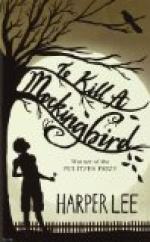
To Kill a Mockingbird is about two children, Scout and Jem, growing up in a town called Maycomb, Alabama in the 1930's. Neighbors and a man next door with the name of Boo Radley make up most of the drama and suspense throughout the story. Scout and Jem put up with a bunch of trash talk when their father, Atticus, defends a black person. As the novel goes on, the children loose their innocence. They learn the injustice of the world when Tom Robinson, a black man falsely accused of rape, was convicted guilty. Harper Lee uses the symbol of the mockingbird to show that justice back in the old days isn't always the way it should be, but the exact opposite by using her characters as "mockingbirds." She wants to tell us that prejudice is more powerful than an equal legal system.
Atticus Finch, the father of Scout and Jem, is well known lawyer in Maycomb, Alabama. He introduces the symbol of the mockingbird by stating, "Shoot all the bluejays you want, if you can't hit `em, but remember it's a sin to kill a mockingbird." Atticus wouldn't teach Scout and Jem how to shoot after he gave them air rifles. Scout didn't understand his philosophy so she asked Miss Maudie about it. She just replied, "Your father's right. Mockingbirds don't do one but make music for us to enjoy. They don't eat up people's gardens, don't nest in corncribs, they don't do one thing but sing their hearts out for us. That's why it's a sin to kill a mockingbird. " Lee's uses the symbol of a mockingbird to represent the innocence of Tom Robinson and Boo Radley and the way justice has been twisted to a point where individuals are no longer able to receive equal treatment.
Tom Robinson, the black man Atticus is defending, represents the mockingbird. He never did anything to hurt anyone, only helped people out, especially Miss Mayella Ewell, the caucasian he is accused of raping. He felt sorry for her and helped her out with daily tasks such as chopping up a dresser for her, but this backfires on him. She accuses him of grabbing her, beating her, and taking advantage of her. Since racism is a factor in Maycomb, nobody believes that Tom is innocent even though there is evidence proving that he was unwilling to do this . The town's racist attitude gets out of hand so much that some of the Town's men form a mob. Atticus is protecting Tom at the jail where he is being held that night. They yell for Atticus to step aside but he does not. Jem and Scout sneak out of the house to go see what Atticus is doing. The mob is armed but Scout is the one that breaks it up by making them realize who they are and they think about their actions and leave. When they go to court, Atticus shows the court that Tom does not have use in his left arm because Heck Tate, the sheriff, testifies that Miss Mayella has hand marks all around her neck from two hands. To prove this, he threw a glass and told him to catch it. Tom catches it with his right hand proving he is right handed and he can not move his left arm. Tom explains that the reason he can't use his left arm is because he caught it in a cotton gin when he was younger keeping him from use of the arm. Even though this evidence was proof enough to prove Tom innocent, the verdict comes back to guilty. On the way to the jail Tom tries to ecsape because he figured out that justice, in that time, is unfair and racially unjust. Heck Tate shoots to hurt him but his fire is wrong so he misses. The "mockingbird" was killed.
Throughout the book, Scout and Jem torment a man by the name of Boo Radley. There are many rumors going on about him such as stabbing his father in the leg with scissors. The kids always snoop around his property trying to get a glimpse of him. Boo leaves random little presents, including carved soap figures of both Jem and Scout, for them in a tree. At first, Boo is represented as a shadow of creepiness but as the story progresses he helps out the children. The first encounter with Boo is when Scout, Jem, and Dill, their summertime friend, are trying to get a peep at him. They get scared away and in the hustle to get away, Jem rips and leaves his pants at the Radley house. He goes back for them, but it was as if someone was waiting for him to come back and retrieve his pants, because they were folded on a fence. Another encounter is when Ms. Maudie's house is on fire and the children are waiting outside in the cold. When they come home after the fire was out, Scout comes home with a blanket around her shoulders. Atticus told them that he said not to go back inside the house and since she came back with that blanket he thought they went back. Scout is puzzled at this but soon finds out that Boo put the blanket around her causing her to have the shivers. The last encounter was when the children were attacked by Bob Ewell after a play at school. Luckily Boo was there to protect the children, by killing Bob Ewell. To protect Boo, Heck Tate says that Bob Ewell fell on his knife. Boo's actions show us that he is truly a good person but rumors made him appear like an evil person. The "mockingbird" characteristic is present in Boo; he doesn't hurt anything but instead, he helps people out. Boo fears the outside world because he is injured from the evil of mankind. He learns that people judge people and he is judged by the rumors going around. He knows that if he were to go outside and try to become sociable, he would be shunned so he just decides to stay in his home, safe and protected from the outside world.
The dictionary defines justice as the quality of being just, impartial, or fair. In the small town of Maycomb, Alabama, justice holds another definition, one of holding unjust and racism. By using Harper Lee's characters as "mockingbirds" she proves that this justice isn't fair. However, since the 1930's, justice has become more fair.
|
This section contains 1,080 words (approx. 4 pages at 300 words per page) |


