
BookRags.com Literature Guides Literature
Guides
Criticism & Essays Criticism &
Essays
Questions & Answers Questions &
Answers
Lesson Plans Lesson
Plans
My Bibliography Periodic Table U.S. Presidents Shakespeare Sonnet Shake-Up
Research Anything:        
History | Encyclopedias | Films | News | Create a Bibliography | More... Login | Register | Help

Not What You Meant?  There are 8 definitions for Machiavelli.  Also try: Old Nick.

Student Essay on Machiavelli: the Philosophy behind a Renaissance Man

Print-Friendly  Order the PDF version  Order the RTF version
About 3 pages (880 words)
Niccolò Machiavelli Summary

Bookmark and Share Questions on this topic? Just ask!

Machiavelli: the Philosophy behind a Renaissance Man

Summary:   Niccolo Machiavelli gained a certain notoriety through a misinterpretation of history. Few realize that his writings were by one of Italy's last true patriots, and with his brilliant humanistic and secular ideals he hoped to politically unite Italy. The ideas of the humanist, author, statesman, and Renaissance man will always be placed among the most influential documents on political theory. Machiavelli's most famous work The Prince, is by far his most interesting piece. The book was written as a guide to ruling, but explored a more infamous aspect of the leadership role.


Machiavelli: The Philosophy Behind a Renaissance Man

At the turn of the fifteenth century, Europe took a drastic change of culture and appearance that would change history. The Renaissance, or rebirth, of Europe from the Dark Ages which had overturned the beauty and slender of the magnificent Greco-Roman vestige. This was a time of both individual excellence, and cultural growth. Philosophical concepts such as Humanism emerged to dominate attitudes and beliefs for centuries to come. Among the humanists were exceptional personalities such as Niccolo Machiavelli. Machiavelli lead a eventful life during these exciting times. Machiavelli's accomplishments are few in number, but there tremendous power and influence would change the direction of much political thought for years.

To completely understand the ideas of Machiavelli, one must first examine the basis of Humanism. Humanism was the most popular form of philosophical thought of the time. Among the humanists were some of the most famous thinkers in history; including Dante. The founding belief of Humanism was the emphasis on the individual. This self-centered belief also was a part of the secular conception which took hold of most humanists. They advocated classical learning, and were prolific writers. The humanists were the first to write in Tuscan Prose, setting the basis for the modern Italian language. These scholars looked to the ancient Greeks and Romans for inspiration in their effort to persuade others to their beliefs. The humanist philosophy of the Renaissance established a basic part of the Western approach to science, political theory, ethics, and law.

The rise of humanists was most extraordinary because of it's independence from the Church. The Roman Catholic Church of the Middle Ages had immense power and influence over it's subjects, which included most of Europe. Machiavelli was part of a generation who took the Church's weakness during the Renaissance to help liberate their thoughts. It was an age of secular thought with freedom to believe and express your mind. Thinkers wanted to enjoy life, and there was the development of the virtu. Virtu relates strongly to humanism, in which it's an emphasis on the outstanding achievements of the individual. During a time of such change individuals of extraordinary ability and prowess went from strength to greatness to history.

Niccolo Machiavelli was born on May 3, 1469, in Florence, Italy, into a well established family. His childhood was dominated by a humanistic education typical of the age. He quickly became acquainted with politics, and joined the government of his independent city-state, Florence. The Florentine establishment was in a time of upheaval and instability. As defense secretary he familiarized himself with the military structure and the disunity among the Italian city-states. He dreamed to one day unite all city-states to create a powerful united Italy. The Medici family returned to power in 1512, and Niccolo was immediately dismissed. Machiavelli tried desperately to return to his former position, but was humiliated and tortured by the Medici family. It was at this time of anguish and despair that Machiavelli decided to write what he had gained from his experience as a political officer.

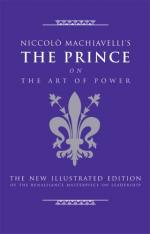
Machiavelli's most famous work The Prince, is by far his most interesting piece. The book was written as a guide to ruling, but explored a more infamous aspect of the leadership role. Historians disagree over whether it is written as a political satire or a serious work. Though Machiavelli's dedication to the Medici family at the start of the novel implies that he was possibly still making a plea for his former position. The aspect of The Prince which gained most notoriety was the way it presented a leaders role. The book explained quite objectively how a ruler or politician must be sly and conniving in order to gain and maintain power.

A segment which perfectly exemplifies the nature in which The Prince sees a leadership role is; "As a prince must be able to act just like a beast, he should learn from the fox and the lion; because the lion does not defend himself against traps, and the fox does not defend himself against wolves. So one has to be a fox in order to recognize traps, and a lion to frighten off wolves." The head of the Medici family did not think lightly of the material presented in the book, and did not return Machiavelli to his former position.

The humanist ideals in Niccolo called him to express his individualism and character in the novel. Though his more informative political writing never gained the acclaim of The Prince. However, the adjective Machiavellian has come to be a synonym for cunning and deceptive control of power. This is not accurate with Machiavelli himself, who was hoping to capture the favor of the ruler of Florence by portraying him positively. Machiavelli's dreams of uniting Italy by guiding them through political obstacles with his writings was never accomplished. His works were widely read and respected, but no Italian leader was inspired to lead as Machiavelli wrote.

Niccolo Machiavelli gained a certain notoriety through a misinterpretation of history. Few realize that his writings were by one of Italy's last true patriots, and with his brilliant humanistic and secular ideals he hoped to politically unite Italy. The ideas of the humanist, author, statesman, and Renaissance man will always be placed among the most influential documents on political theory.

Sources:

www.sparknotes.com

Encarta Encyclopedia

This is the complete article, containing 880 words (approx. 3 pages at 300 words per page).

More Information
  • View Machiavelli: the Philosophy behind a Renaissance Man Study Pack
  • 8 Alternative Definitions
  • Search Results for "Machiavelli: the Philosophy behind a Renaissance Man"
  • Add This to Your Bibliography
  • More Products on This Subject
    Niccolò Machiavelli
    The Italian author and statesman Niccolò Machiavelli (1469-1527) is best known for The Princ... more

    Niccolò Machiavelli
    Best known for his works The Prince and The Art of War, fifteenth-century Italian statesman Niccol&... more


    Ask any question on Niccolò Machiavelli and get it answered FAST!
    Answer questions in BookRags Q&A and earn points toward
    discounted or even FREE Study Guides and other BookRags products!
    Learn more about BookRags Q&A
    Copyrights
    Machiavelli: the Philosophy behind a Renaissance Man from BookRags Student Essays. ©2000-2006 by BookRags, Inc. All rights reserved.


    Join BookRagslearn moreJoin BookRags


    About BookRags | Customer Service | Report an Error | Terms of Use | Privacy Policy

