
BookRags.com Literature Guides Literature
Guides
Criticism & Essays Criticism &
Essays
Questions & Answers Questions &
Answers
Lesson Plans Lesson
Plans
My Bibliography Periodic Table U.S. Presidents Shakespeare Sonnet Shake-Up
Research Anything:        
History | Encyclopedias | Films | News | Create a Bibliography | More... Login | Register | Help


Student Essay on Master and Builder

Print-Friendly  Order the PDF version  Order the RTF version
Henrik Ibsen
About 4 pages (1,253 words)
The Master Builder Summary

Bookmark and Share Know this topic well? Help others and get FREE products!

Master and Builder

Summary:   Henrik Ibsen's plucks a melancholy tune on the strings of married men of all ages in his masterpiece about life and the road to self-actualization, The Master Builder. Ibsen's Master Builder stops looking to himself and his family for validation and instead seeks that approval through the ignorance and innocence of youth, an unreliable and misleading source.


Henrik Ibsen's plucks a melancholy tune on the strings of married men of all ages in his masterpiece about life and the road to self-actualization, The Master Builder. Three years before it was penned Ibsen, age 61, met an 18 year-old girl and feel in love with her. The subsequent love nearly destroyed both of their lives. Ibsen, according to critic

Bill Hagerty, "came to his senses in time" to prevent this. Another critic writes, "his marriage was joyless, but a few episodes of friendship with young women broke the austerity of his life." Solness did not come to his senses "in time," to save himself. His end is Ibsen's way of letting the rest of us know it is only too late to change once it is

actually too late to change. I really enjoyed this play and its genius about our social plight. Solness was no doubt a manifestation of the journey of self-discovery and perhaps a sliver of guilt Ibsen felt over his affairs of heart.

Like Ibsen, Solness is an artist. Ibsen and Solness create from nothing something lasting. The metaphorical parallel between a builder and a playwright are surely the subject of several papers in the pile on your desk. So let's be a bit more original than that. I am primarily interested in his denial of religion as a scapegoat for his own guilt, and the journey of self-awareness he, and most men, go through as they reach

what we call "the seven year itch." I am surrounded daily by Solness-like type-A personalities. I hate to admit being one, but you have to pass a (strange) psychological battery as step one of getting into the flight program to ensure you are - I must be this way too, I didn't lie that much on the test. Solness is an attention-needy control freak who discounts the aptitude in others through the lens of a bloated perspective of his own ability. Like us. His attitude toward the other characters, sans a few, is curt. This does not push them away from! him however. I have found in this play as in real life, people are drawn to strong, even arrogant, personalities to almost a self-destructive degree - at a vigorous pace no less. Like nearly all the quality authors and playwrights I have studied, Ibsen's sociological commentary skillfully lining the sub-text hits the mark again and again.

Solness is in no way a stranger to relationships. In Act One, he confesses to Dr Herdal that he has known a good many women in his time and has been "quite fond of some of them." Slowly then, the audience is able to see the Master Builder as a faulted man. Like most of us. We learn about a tragedy in his life and his subsequent abandonment of God in the form of not building Churches any longer. Like any man searching for new answers, or scapegoats for the old answers, Solness finds his form of peace in denial. In a later conversation with Dr. Herdal he claims that his wife never got over the loss of their children, "in all these twelve or thirteen years." The tone suggests that he believes did.

This is clearly not the case. Suggesting an abandonment of God or perhaps hope, we learn about the lack of building Churches since. The continued designing of three nurseries for his new house even though no children are forthcoming does not suggest to me a hope for more chi!ldren, but rather denial of reality that the first ones are not coming back or are gone in the first place.

At the end of Act One when Hilde arrives, Solness says perhaps the truest statement he has made up to that point, "You're the very person I've needed most." The attraction to and of a young(er) lady can add color to the blood. The primordial need to feel young, attractive, strong, witty, needed, in charge, smarter-than-thou, and what is simply called "manly," is one of the pathetic, simplistic truths about all of us. Women are far more sophisticated than this I believe. At some level, women may have their own form of "the itch." But Brandie says not. Ibsen does not address the female side deeply in this play, but everyone knows about A Doll's House (1879), and therefore would know that Ibsen ould have seen into the mind's eye of his female characters if he wanted

to, or felt it was needed. It is not. This play is about the plight of man, and how we commonly call "bringing it on ourselves." These needs are easily surfaced after a life of having that ego fed constant!ly by others or just by yourself. Dangerous and/or challenging jobs, when complete, also feed this male need for domination of surroundings.

Ibsen selected the weather vane as Solness physical challenge, in modern times he just as easily could have chosen a number of other ego-sports like parachuting, rock-climbing, football, flying, or whatever else do in our spare time to prove ourselves to...ourselves. Never before have I read in such clear format the humiliating and obvious nature of a man in the declining years of his life. Solness grasps at straws for love,

acceptance and worth. He overlooks the love, acceptance and worth he already has at home. He denies his age as unworthy of youth instead of celebrating the wisdom it (potentially) brings. He attempts to execute, as we all do, physical (and emotional) tasks that our bodies and minds simply aren't meant to perform anymore as we age. Of course that leads to the fall for our fictional protagonist and us. For him it was the building of a vaulted castle and climbing to the vane, for the rest of us it's tackle football at age 33 with young twenty-somethings in Australia. For Solness it was the woes of Hilde, for the

rest of American mankind it is Thailand, Vladivostok, or Las Vegas (or whatever the other real world has). Solness had his journey to self discovery presumably handed to him during a ten-second fall through the trees. He may have not, like most of us, gotten the message at all. Solness isn't just this unfortunate man, he is everyman. Like I

mentioned in the beginning, I know there is a lesson for society in this play.The lessons are host specific, but universal in application. Ibsen's Master Builder stops looking to himself and his family for validation and instead seeks that approval through the ignorance and innocence of youth, an unreliable and misleading source. Setting unrealistic, inconsequential goals robs life from all us, for Solness it was literal. In

Ibsen's own life, he recovered from a similar plight with maturity of thought; a mature look at Solness can save the rest of from our own social inequities. I'm not stressing not the adulterous nature of "the itch," I'm talking about the male need for external sources of gratification and validation that drives us to poor behavior, social conflict, and

general "manliness" that is so ape-like. Solness is our warning.

Works Cited

Clay, Carolyn. "Tower Power, Art Takes On The Master Builder." Theatre

Reviews. 25 Feb

1999. The Boston Phoenix. 18 Oct 2004.

http://www.bostonphoenix.com/archive

Gibaldi, Joseph. MLA Handbook for Writers of Research Papers 6th ed.

(New York: The Modern

Language Association of America, 2003)

Hagerty, Bill. "The Master Builder." The Master Builder. XX June 2004.

John Good Holbrook.

18 Oct. 2004. http://www.masterbuildertheplay.com

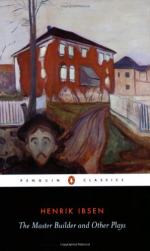
Ibsen, Hanrik. The Master Builder and other plays. Trans. Una

Ellis-Fermor. Middlesex:

Penguin Books, 1981

This is the complete article, containing 1,253 words (approx. 4 pages at 300 words per page).

 
Ask any question on The Master Builder and get it answered FAST!
Answer questions in BookRags Q&A and earn points toward
discounted or even FREE Study Guides and other BookRags products!
Learn more about BookRags Q&A
Copyrights
Master and Builder from BookRags Student Essays. ©2000-2006 by BookRags, Inc. All rights reserved.


Join BookRagslearn moreJoin BookRags


About BookRags | Customer Service | Report an Error | Terms of Use | Privacy Policy

