
BookRags.com Literature Guides Literature
Guides
Criticism & Essays Criticism &
Essays
Questions & Answers Questions &
Answers
Lesson Plans Lesson
Plans
My Bibliography Periodic Table U.S. Presidents Shakespeare Sonnet Shake-Up
Research Anything:        
History | Encyclopedias | Films | News | Create a Bibliography | More... Login | Register | Help


Student Essay on A Trip to Narnia

Print-Friendly  Order the PDF version  Order the RTF version
C. S. Lewis
About 4 pages (1,161 words)
The Lion, the Witch and the Wardrobe Summary

Bookmark and Share Questions on this topic? Just ask!

A Trip to Narnia

Summary:   An overview of the plot in C.S. Lewis' The Lion, the Witch, and the Wardrobe, as well as the symbolism portrayed in the story.


Literary Encounter

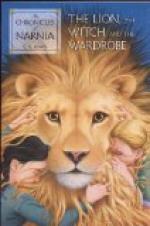
For my first encounter I chose to read the novel The Lion, the Witch, and the Wardrobe, written by C.S. Lewis.

This fictional story takes place in London and begins when four siblings, Peter, Susan, Edmund, and Lucy are sent to Professor Digory Kirke's house because of the evacuation that took place during World War II. I believe that much of this story was written by C.S. Lewis to show his view of religion. In the story, I think it is correct to assume that the White Witch is symbolic of Satan and his reign over men, and that the children are symbolic of those very men, with Edmund being one who follows Satan and sides with evil. He later repents and is forgiven by Aslan, whom we can symbolically see as Jesus Christ; considering the sacrifice of his life on behalf of ridding the people of Narnia from the Witch and restoring its rightful leaders.

The story continues when the children are playing a game of Hide and Seek and Lucy chooses to hide in a wardrobe. She finds that the back of the wardrobe consists of not a smooth wall made of wood, but the entrance to a wintry forest, complete with an unusual lamppost in a small clearing. She meets Mr. Tumnus, a Faun, and he explains to her the ruler of Narnia, the evil White Witch who turns her enemies into stone and makes it always winter but never Christmas. Lucy returns to tell her brothers and sister about her findings, and when the four go back to find this magical world, the wardrobe turns out to be just that; a wardrobe. Some time later, both Lucy and Edmund enter Narnia. Lucy meets Mr. Tumnus again, but Edmund encounters the White Witch herself, and her Dwarf. This is the beginning of Edmunds fall. The author is portraying to his audience that this is how Satan and evilness work. Edmund is tricked by the witch's kindness and "Turkish Delight", and through his foolishness gives the witch the important details she is seeking.

When Lucy and Edmund get back, Edmund pretends that he has not really been in Narnia. Peter and Susan are worried about Lucy and they confide their troubles to the Professor, expecting him to speak with Lucy about her "story." Instead, he defends Lucy, asking the others to compare her record of truthfulness against Edmund's. This is another interesting part of the story. The Professor seems almost mysterious to me, as if he already knows about the prophesie we discover towards the end of the book.

Finally, all four children get into Narnia by accident. They discover that Mr. Tumnus is gone, and his house has been destroyed. They then meet Mr. and Mrs. Beaver, who speak of Aslan the Lion, who is the one who is supposed to save Narnia. They decide to set out to find the Stone Table and Aslan, and realize that Edmund is gone. This is when Peter and Susan know that Edmund has been in Narnia before, and that he has betrayed them. They continue on to the Stone Table and on their way they meet Father Christmas, which is our first clue that the Witch's reign is being threatened, as she never allowed Christmas during her neverending winters. Father Christmas gives them all gifts which consist of a sword and shield for Peter, a horn and bow for Susan, and a healing cordial and dagger for Lucy. This part of the story helped me to compare Father Christmas to God. The gifts that Father Christmas gives the children are similar and symbolic of the very gifts that we can receive from God in our aide to fight Satan. I believe the author was showing that if we choose to follow Christ, we can be willing partakers of these gifts that are uniquely designed for our individual needs.

The story then turns to Edmund, who is traveling with the White Witch in her massive sled. On their way, they pass a table of celebrating creatures and the witch turns them into stone. This is when Edmund realizes the evil he is joined with, and he becomes afraid. Before the story returns again to the other children, we read that the Witch and Edmund eventually have to abandon their sled, because the snow around them is starting to thaw. This is our second clue that the Witchs tyranny is faltering.

The other three children meet up with Aslan who explains to them a prophesie from long ago that named them the future kings and queens of Narnia. A wolf comes to attack them, and Peter kills it. Aslan then tells the children to follow the wolf's tracks and find Edmund, who is about to be killed by the Witch in order to destroy the prophesie. The witch flees, and later tries to get Edmund back; but Aslan has made a counterproposal, which we later find is his own life. The witch binds Aslan to the stone table and shaves off his mane, humiliating him and finally killing him. This sacrifice of life is referred to as "Deep Magic from the Dawn of Time." I believe that this part of the story is very closely related to the atonement of Christ. Those that persecuted Christ humilated him and watched him die painfully bound to the cross, in the very same way the the witch humilated Aslan and watched his death bound to the Stone Table.

However, the next morning, a "Deeper Magic from before the Dawn of Time", which applies to the willing self-sacrifice of an innocent person on behalf of a traitor, raises Aslan from the dead, and the Stone Table is broken in two. The Witch is destroyed, and the four children become the Kings and Queens of Narnia. Peter, the eldest, is crowned High King.

This work is very well written and connected to the universal concept of God and Satan. When I first read this story in about third grade, I had no idea of the Symbolic references and allusions made in the story. Rereading now, I have had the opportunity to evaluate and analyze this book and compare it to my own life and beliefes. My favorite part of the book is when the children are required to use their own individual gifts in the battle. This is a pivotal part of the book; essentially a battle against evil, and the children are equipped with these strengths that Father Christmas has bestowed upon them to help them win the fight. It is a triumphant and altering part of the book that shows how simply we can use our attributes to conquer the adversary. I have learned through my interaction with this novel that we can overcome evil if we know who to follow, and if we are brave enough to face and reach higher than selfishness, fear, and even death, we will emerge triumphant when the battle is over.

This is the complete article, containing 1,161 words (approx. 4 pages at 300 words per page).

More Information
  • View A Trip to Narnia Study Pack
  • Search Results for "A Trip to Narnia"
  • Add This to Your Bibliography
  • More Products on This Subject
    An Overview of "The Lion, the Witch, and the Wardrobe"
    The Lion, The Witch, and The Wardrobe was one book out of a collection that reveals The Chronicles o... more

    The Lion, the Witch and the Wardrobe
    The Lion, the Witch and the Wardrobe In C.S. Lewis' The Lion, the Witch and the Wardrobe, the main ... more


    Ask any question on The Lion, the Witch and the Wardrobe and get it answered FAST!
    Answer questions in BookRags Q&A and earn points toward
    discounted or even FREE Study Guides and other BookRags products!
    Learn more about BookRags Q&A
    Copyrights
    A Trip to Narnia from BookRags Student Essays. ©2000-2006 by BookRags, Inc. All rights reserved.


    Join BookRagslearn moreJoin BookRags


    About BookRags | Customer Service | Report an Error | Terms of Use | Privacy Policy

