
Summary:
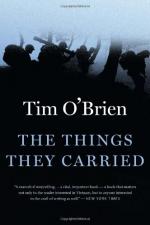
Unlike the song "Blowing in the Wind," Tim O'Brien's novel The Things They Carried does not necessarily take an antiwar stand. The soldiers in the novel are not mature enough to grasp the cruelties of war, and war gives them a sense of security and belonging. By writing about how the cruelties of war provide a greater understanding in life, O'Brien shows that war is enlightening rather than corrupting.
Evaluation of The Things They Carried and "Blowing in the Wind"
Unlike "Blowing in the Wind", The Things They Carried is not an anti-war novel because it does not directly stress the fact that war is detrimental. Instead, the author, Tim O'Brien implicates that the cruelties of war are educational.
In the beginning, O'Brien runs away from war because he opposes the principles of the Vietnam War. However, shame overtakes him and compels him to be drafted. At war, he is introduced to the brutalities of war. He is always hungry, sleepy, and in danger. Throughout the novel however, he never says that these aspects of war are unacceptable, instead, he introduces them as a test for soldiers. As in the story of the troop that is sent to the mountains on a listening post operation, the soldiers are challenged to remain quiet without losing control. The soldiers failed and imagined an entire village having lavish parties. O'Brien proved with this story that not everyone is fit for war and that war can teach an individual how weak or strong he is.
O'Brien also stresses that war teaches soldiers about life. During war, soldiers see death in all forms. They are exposed to gory images of deformed faces and mangled bodies. In order to cope with the grief from death, the soldiers do not view the dead as actual dead bodies. They relate the bodies with objects and make conversations with them as if they were alive. For example, when Kiowa died, the soldiers related his untimely death with a boor rather than a body covered in shit. This taught the soldiers how to deal with war and accept death. O'Brien continues to depict several stories of corpses as a way to indicate that war can teach soldiers to accept death and allow the dead to live on through stories.
By writing about how the cruelties of war provide a greater understanding in life, O'Brien shows that war is enlightening rather than corrupting.
The characters of The Things They Carried would not agree with the song "Blowing in the Wind", because they are not mature enough to grasp the cruelties of war and therefore do not see the war as harmful.
The majority of the soldiers drafted into war are teenagers on the verge of adulthood. They are more childlike than adult and have not lived enough life to understand the meaning of war. Because they were forced into war in their youth, the soldiers had no previous knowledge of war; all they knew was that they had to fight in a foreign country. For example, when Azar accompanies O'Brien, who takes revenge on Bobby Jorgenson for never treating him for shock after getting shot, Azar sees war as a game. After O'Brien decides that he has avenged his injury, Azar continues to set off flare at Jorgenson. He never realizes the damages he can cause and instead concentrates on the thrill of scaring someone. Azar mirrors the childish character of the soldiers and reveals how the soldiers are unaware of the consequences of war.
Furthermore, the soldiers do not agree with "Blowing in the Wind", because war provides a sense of belonging. The soldiers see each other as family, because they have been together through grave danger and happiness. They love each other and the action of war because it gives them a home. Many of the soldiers such as Mark Fossie, have lost their girlfriends and can only depend on the other soldiers for comfort. For instance, when O'Brien is removed from war after being shot, he has lost his friendship with the other soldiers. He is unable to experience the fear and adrenaline of his friends, and can therefore, no longer relater to their lives. As a result, O'Brien feels betrayed because war was the only aspect that brought the group of soldiers together. War brings the soldiers together and allows them to be united rather than alone.
Because the soldiers are young and dependent on the war, they would not agree with "Blowing in the Wind" as war gives them a sense of security and belonging.
This is the complete article, containing 682 words
(approx. 2 pages at 300 words per page).

