
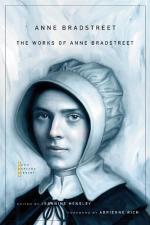
rhetorical essay arguing the significance of Anne Bradstreet's poetry. contains all elements of rhetoric triangle as well as numerous rhetorical devices.
The Writings of Anne Bradstreet: Rhetoric
The works of Anne Bradstreet have become a staple in American Literary studies, and rightly so. The most prominent educators in the field utilize her writing to connect American colonial/Puritanism with early American literature. Teachers at every level agree that these parallels are immensely valuable. Anne Bradstreet's poetry retains educational significance on a myriad of levels as it can facilitate discussion on a variety of important subjects.
The significance of Anne Bradstreet's writing in historical context is unquestionable. Puritanism in the 1600's played a vital role in the founding of American ideals and set the tone for faith in the colonies. Her writing also offers a very unique historical perspective, as women in all forms of colonial society (not to mention the extreme patriarchy of Puritanism) have been intellectually undermined. She is also a tremendous manifestation of early feminism in the colonial life, which eventually gave way to the woman's suffrage movement. Can Bradstreet be considered a feminist, despite the common themes of servitude in her poetry? Anne Bradstreet is without a doubt a feminist, as any woman who wrote in this time stepped outside their appropriate sphere, pushing the social perimeters concerning the role of women in the religious, intellectual and artistic communities.
Anne Bradstreet's writing is also an important curriculum tool because unlike most historical documents, her poetry engaging and entertaining through the use of poetic language and device. These aspects of her writing create an indispensability based not only on historical context, but on its legitimacy as pivotal American literature. Bradstreet's heartbreaking description of her home in flames is enough to stir emotion in even the most detached reader, just as her undying devotion to her husband reminisces of an all too familiarly engulfing emotion: love. These emotions beckon to the reader in a rhythmic whisper, create a connection that almost all historical accounts lack.
Bradstreet's poetic style is also very important to its curriculum legitimacy as Bradstreet's attention to form and technique is usefully studied in the context of two quite different literary styling, both of which influence her. The first and most widely discussed is Puritanism's so-called "plain style" (marked by didactic intent, artful simplicity, accessibility, and an absence of rhetorical ornamentation). The second is seventeenth-century versions of classicism (which stressed poetry as imitation, exalted the genres of tragedy and epic, and worked toward unity of action, place, and time). It can be well argued that discussions could be taken from a variety of puritan and seventeenth century classicalist ( John Newton, Samuel Rutherford), but few of these authors are applicable to such an abundance of subject matter.
It seems only logical that Anne Bradstreet's writings be ever present in American Literature text and classrooms. Her life and writing embody so much of the American spirit, from the struggle for religious freedom of her ancestors, to her own struggle against the patriarchy of the intellectual and artistic community of the colonial period. Her writing is a multilateral platform from which learning can be launched, and she should be considered an irremovable element of both American literature and history.
Glossary of Rhetorical Devices
Dirimens Copulatio: mentioning a balancing or opposing fact to prevent the argument from being one-sided or unqualified
Hypophora consists of raising one or more questions and then proceeding to answer them, usually at some length. A common usage is to ask the question at the beginning of a paragraph and then use that paragraph to answer it
Parenthesis, a final form of hyperbaton, consists of a word, phrase, or whole sentence inserted as an aside in the middle of another sentence
Personification metaphorically represents an animal or inanimate object as having human attributes--attributes of form, character, feelings, behavior, and so on. Ideas and abstractions can also be personified.
This is the complete article, containing 627 words
(approx. 2 pages at 300 words per page).

