
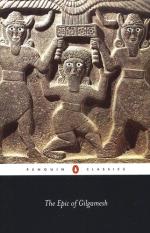
Summary:
The story of the king of Uruk, Gilgamesh, is believed by some to be one of the world's oldest true stories. In "Epic of Gilgamesh" by Herbert Mason, the king is portrayed as a selfish tyrant who displeases the gods. Gilgamesh becomes a better ruler after the death of Enkidu.
The story of Gilgamesh, and the time he ruled over Uruk, is based on tablets from ancient Babylonia where the Gilgamesh epic occurred thousands of years ago. The tablets were found in the 19th century by archeologists in the old ruins. The tablets contained a rough version of their king's life and quest, some tablets were indecipherable and some tablets had been damaged. Though it is impossible to pinpoint when the Gilgamesh epic was created, many scientists, archeologists, historians and scholars estimated a time period around 2000 B.C. If Gilgamesh was from this estimated time period, then Gilgamesh is the oldest story in the world. Not only is there scientific evidence from the tablets, Gilgamesh's name is on the Sumerian kings list sometime in these years also, it is also believed by multiple historians that the Gilgamesh epic is not just a child's story from this time period but the real life story of one of their greatest kings. Because these ages were strongly based on religion they used several of their gods to become major figures in their stories. In this age they used to blame things they couldn't explain on their gods, such as bad crops on the gods' anger. Many similarities between their religion and the bible have been found; the relations to their gods' actions are very similar to the biblical god's actions towards his people.
In the book "Epic of Gilgamesh" by Herbert Mason, the king of Uruk, Gilgamesh, is a tyrant and is a very selfish, uncaring king who is too hard on his people. The gods become angry with Gilgamesh for being so insolent and hard on his people and begin to wonder why they ever created him, but they can't destroy him because he is two-thirds god. So they create another, equal to him in every way except caring and gentler, Enkidu the wild who one runs with the animals. The gods created Enkidu to be a friend for Gilgamesh and when they meet they become inseparable. Together they defeat Humbaba the evil guardian of the forest, and the gods became angered and sent down The Bull Of Heaven, which Enkidu killed to save his friend. Later on the gods say to Enkidu in a dream that one of them must die and they tell Enkidu it must be him. When Enkidu dies Gilgamesh is overcome with grief and sets out on a mission to bring his friend back to life. He meets Utnapishtim, his spiritual father, and is sent to pick a plant from the bottom of the river and its prick will give you new life. Gilgamesh pricks himself, however loses the plant to a snake before he has a chance to prick Enkidu. Gilgamesh returns to Uruk where he becomes a better king because of his friend's influence and gentle nature. Gilgamesh finally gets over Enkidu's death and sees his friend's death as a positive thing that helped him to learn, grow and change instead of a negative thing the gods had done to hurt him for his insolence.
Herbert Mason ends his "Gilgamesh" with Gilgamesh becoming a better king and moving on past Enkidu's death. There is one thing Herbert Mason neglected to put in this book and that is the last tablet of the epic, the last tablet tells of a brief illusionary meeting between Gilgamesh and Enkidu in dreams while Gilgamesh prays to the gods to see his friend. For one moment Gilgamesh and Enkidu talk, until Enkidu disappears and Gilgamesh is overjoyed and becomes a better king. So although the out come is the same it is for a different reason. There are also multiple tablets that can be viewed as sequels to Herbert Mason's: one ending shows the death and funeral of Gilgamesh and another shows more adventures of Enkidu and Gilgamesh in a Semitic version.
When Herbert Mason was in Harvard and other schools he heard different versions of the story Gilgamesh and felt compelled to read and understand all the different versions of Gilgamesh. Herbert Mason rewrote the book "Gilgamesh" in his own style because he felt a strong connection to the character of Gilgamesh and felt like his own life related very strongly to the challenges that Gilgamesh and Enkidu faced. Herbert Mason said he felt like he "had received a wound, or rather a wound in me that had been exposed. My own father had died when I was seven. This had been a shattering loss for me" he felt that was what he had in common with Gilgamesh and understood Gilgamesh's desperate attempts to get Enkidu back. In the autobiographical postscript Mason said he felt that anyone who had lost someone important to them and desperately wanted them back, before finally accepting that they were gone, would understand and empathize for Gilgamesh.
I related the flood sequence in the verse narrative "Gilgamesh" by Herbert mason to the bible story "Noah's ark" in the similarity of the anger of the gods or god at all mankind and their wanting to destroy man as a lesson, in both stories the gods and god choose one man and his family to build an immense boat or ark in which they were to get two of every kind of animal on board before the flooding. These two are also similar in the sense of each having a new beginning completely cleansed of previous humans and a new chance at life.
All of Herbert Masons perceptions and views throughout "Gilgamesh" are defensible and found on the recovered stone tablets that he studied while he was at Harvard. Herbert Mason got all of his basic information from the tablets then put some of his own thoughts and feelings in to emphasize what Gilgamesh and Enkidu were going through. Herbert also discussed the book with his colleagues and friends and spent a lot of time with his professors and people from the museum that the tablets are in to find out more and the authentic translations with the aim of a more correct version of the ancient epic. Herbert mason put meaning into every part of the book he felt was important, but because the tablets were so old and were written in an unknown language some of the text would have been indecipherable. So in the places of where there was no readable text Herbert Mason would have had to fill the voids with an estimate of what would have come next and during the missing texts and this is where Herbert's Mason's generalization and judgment would come into play.
The book "Gilgamesh" strongly emphasizes the importance of friendship and how significant friends are no matter what you do. Enkidu gave Gilgamesh support and guidance on his quest and was willing to sacrifice himself to save his friend from the Bull of Heaven and vice versa in different circumstances, like the journey Gilgamesh took after Enkidu's death to bring him back to life. The feelings of grief and loss are overwhelming to Gilgamesh who has never cared for another like he cared for Enkidu and that shows as Gilgamesh tries to get over Enkidu in taking the long journey and although in the book its says the journey was solely to bring Enkidu back to life I think it was more a journey for Gilgamesh to understand what had happened and to realize he could do nothing and because of what occurred during his mission I found it was really a journey to find himself.
While I was reading the book Gilgamesh I was thinking about what the focus was on and I realized that the focus was not on how strong people were, which is common in verse narratives, but on how the book was focusing more on people's thoughts and emotions rather than on their beauty or strength. What I also found amazing was that even though Gilgamesh knew Enkidu was going to die he was still unprepared for the grief and misery that followed it even though he knew it was coming and after Enkidu's death the book changed and focused even more on grief and misery and I wondered why Gilgamesh handled his sorrow by trying to resurrect Enkidu. I think that in the book Gilgamesh a lot of the things are symbolic and go deeper than just what the author is saying, such as in the scene with Enkidu and the prostitute, it was not just something that happened it was emblematic of Enkidu's changing form and leaving the wilderness. There was one example of the symbolism in a larger perspective and that was the Bull of Heaven in the back of the book it said "Bull Of Heaven: figure of drought created by Anu as punishment for Gilgamesh's arrogance" but what I don't understand about this is how Enkidu killed the bull of heaven to save his friend if it was a drought, it raised a question in my mind of 'what did Enkidu do to "kill" the drought"'
I also related Enkidu's life with the animals to the story of Tarzan in the likeliness of both of them living with animals and though there are some slight differences in their stories I found they are both basically related. Tarzan's parents were killed by a feline animal in the jungle where they lived and he was found by a group of gorillas or apes. This must have happened to Enkidu somewhere along the track orphaned or abandoned by his parents to be taken in by animals and be brought up as a feral child with a few human instincts. Both came into contact with humans later on in their lives and were intrigued by these strange humans. For Enkidu it was the prostitute and for Tarzan it was Jane Porter and The Professor, after meeting with the humans both of the wild men turned away from the animals and became humanized.
I think a book like Gilgamesh makes people realize that although there were more than thousands of years between Gilgamesh and current years I found the way people express emotions is still basically the same: they aren't prepared for the anguish that is to follow even when they know it is coming, they are hurt and desperately want whoever had just died to come back, before finally accepting the loss and moving on. Because people will know on the surface how they would react to such a painful loss but deep down nobody, who hasn't lost someone, really knows how they will react until they have felt that grief and loss by losing someone who is important to them. Like walking down in the woods you know there could be wolves and you know what to do around them but until you have come face to face with one you don't really know how you will react. Gilgamesh puts a new perspective on death and loss, makes losing someone a little bit easier knowing that you will be able to get over it and it gives people who have never felt that grief and loss a little bit of insight into what they will feel if that ever happens to them.
This is the complete article, containing 1,864 words
(approx. 6 pages at 300 words per page).

