
BookRags.com Literature Guides Literature Guides Criticism/Essays Criticism/Essays Biographies Biographies My Bibliography Periodic Table U.S. Presidents Shakespeare Sonnet Shake-Up
Research Anything:        
History | Encyclopedias | Films | News | Create a Bibliography | More... Login | Register | Help

Search "The Glory of Greece Vs. the Glory of Rome"

Essay Navigation
 

Student Essay on The Glory of Greece Vs. the Glory of Rome

Print-Friendly  Order the PDF version  Order the RTF version
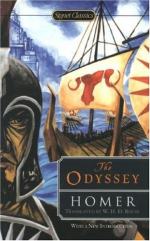
Homer
About 5 pages (1,337 words)
Odyssey Summary

Bookmark and Share

The Glory of Greece Vs. the Glory of Rome

Summary:   A comparitive narrative plane analysis between Homer's The Odyssey and The Gladiator movie of modern times.


The Glory of Rome vs. The Glory of Greece

"I am Odysseus, Laertes' son. The whole world talks of my stratagems, and my fame has reached the heavens. My home is under the clear skies of Ithaca" (Book IX l. 19-21). This quote comes from Odysseus introducing himself to King Alcinous, and, in turn, he announces the goal and purpose of his quest: to go home. In the same way, in the film Gladiator, the hero introduces himself to his enemy saying, "My name is Maximus Decimus Meridius...Father to a murdered son, husband to a murdered wife. And I will have my vengeance, in this life or the next." This is the response Maximus gives to the Caesar Commodus as he removes his helmet and announces his goal and purpose: gaining peace and restitution through the vengeance of his family. These works demonstrate two similar stories arranged in different narrative planes. The Odyssey operates as a quest, whereas the Gladiator operates within the plane of restitution. When compared, these two works are similar, yet they attain their respective purposes in two opposite trajectories.

There have been speculations against The Odyssey as a quest because of Odysseus' willingness to be delayed. Yet, there is plenty of evidence proving that Odysseus' struggle is a true quest, as is reflected in is his role on the island of Calypso. In book five, "Homer" uses words like "imprisonment" and "misfortune" to describe Odysseus' time on the island of Calypso. Not to mention the fact that when Odysseus was finally released, he delivers a speech to Calypso in which he acknowledges her beauty but states, "Nevertheless I long to reach my home and see the day of my return. It is my never-failing wish" (Book IV l. 216-221), confirming that the deterrents of Odysseus are not of his own choosing.

Yet, the most convincing evidence of The Odyssey as a quest is the resounding motif of the goal. In every new adventure that Odysseus confronts, he states and keeps his goal in front of him. In his first announcement to King Alcinous he tells him his exact purpose when he says, "My home is under the clear skies of Ithaca...So true it is that a man's fatherland and his parents are what he holds sweetest, even though he has settled far away from his people in some rich home in foreign lands" (Book IX l. 19-36). Even in the halls of splendor Odysseus declares the goal of his quest as his only intention and implies that he does not plan to be delayed any longer.

Yet, nowhere is the quest narrative more realized than when Odysseus finally arrives in Ithaca. Instead of rushing straight home to Penelope he still follows the wisdom of Athena in order to set everything back to the way it was when he left. Had he rushed home as expected, he would have been overwhelmed by the suitors. Yet, he followed reason and planned out his attack and reclaimed his home for himself in order to attain the goal that he had sought since he left for Troy: to be back at home with Penelope and Telemachus as King of Ithaca. This was Odysseus' quest.

The true purpose of The Odyssey is not the adventure, or the quest, but the virtues and values that are derived from the characters and activities. In this novel, "Homer" seems to outline his ideas of the purposes of the genders, and how a culture should behave, and what values to uphold as virtuous. For those reasons, he takes his character Odysseus through trials and toils in order for him to finally arrive at his destination. For instance, the adventure of the Cyclops shows that people must not be as rude and vile as the Cyclops race, but also that when successful one should not boast like Odysseus did, lest the gods become insulted.

The quest narrative is what allows Homer to take his audience through this recipe of how to behave. Had the Odyssey been a true chaos narrative, as it can seem at times, the audience would have been too distracted at the ups and downs of the story to be able to see the aims of Homer. The quest is the only plot narrative that can achieve such a profound and lasting effect on culture because it sets forth a direct plan and goal. But, more importantly, it sets up a hero that the audience can rally behind and relate to, and can be easily translated into everyday living.

In the beginning of the film Gladiator the main character Maximus is a General of the Felix Legions in the Roman Army. Throughout the introduction of the film Maximus repeats his wish of returning home to his family, even in battle he states this through a rousing speech, "Three weeks from now, I will be harvesting my crops. Imagine where you will be, and it will be so." Caesar asks him, "How can I reward Rome's greatest general"" Maximus then answers him, "Let me go home." Yet, when Caesar was murdered by his evil son Commodus, Maximus is set up for a downfall.

Commodus orders Maximus to be executed. He realizes he has lost everything when he asks the emperor's aide Quintus tells him, "Your family will meet you in the afterlife." He is picked up by slave traders where he is sold into slavery as a gladiator in the ownership of Proximo. This changes Maximus' journey from a quest to return home into a restitution plot to regain what he has lost and return back to his original prowess and gain vengeance for his family. This need to bring himself back to his starting point makes this film run on a restitution narrative plane.

In the end Maximus triumphantly defeats Commodus despite Commodus' stabbing him before the match. Yet, Maximus only lasts long enough to set Rome back in order as a republic before he dies. Lucilla, the daughter of Marcus Aurelius, asks the Coliseum, "Is Rome worth one good man's life? We believed it once. Make us believe it again. He was a soldier of Rome. Honor him." Senator Gracchus then asks, "Who will help me carry him"" This sets Maximus back into the glory and honor that he had attained before Commodus came into power. In death he is shown in the fields of Elysium reuniting with his family, while his body is being carried out of the Coliseum. This ending completes the circle of Maximus' journey, and ends the movie with a mood of satisfaction. His downfall necessitated the restitution plot. Maximus was restored to his original stature and reunified with his family.

In both The Odyssey and the Gladiator the heroes are warriors with the goal of reaching home in their heart. They also have to overcome enemies in order to be reunited with their respective families. However, Odysseus is a man who humbles himself and is on an unfortunate journey, and Maximus is a man of the utmost strength and virtue who has been stricken with ultimate grief. Each story focuses on the hero overcoming his situation and gaining victory in the end, something every person would like to see themselves doing.

The successful endings of these works are both accomplished by their respective narratives. The quest trajectory pushes Odysseus from being a hero at Troy to being lost with his men. He then starts his quest to reach home in which he accomplishes through his wits and wiles. The restitution trajectory of the Gladiator stretches our emotions as Maximus starts out on top of the world and descends to the lowest order and is pushed to climb back up to the top in order to achieve his original goal of reuniting with his wife and son.

Works Cited

Homer. The Odyssey. London, England: Penguin Group, 1991.

Translated by E.V. Rieu. Revision by C.H. Rieu in consultation with Dr. Peter V.

Jones, University of Newcastle Upon Tyne.

Gladiator. Dir. Ridley Scott. Perf. Russell Crowe. Universal Studios, 2000. DreamWorks Pictures, 2000.

This is the complete article, containing 1,337 words (approx. 4 pages at 300 words per page).

Copyrights
The Glory of Greece Vs. the Glory of Rome from BookRags Student Essays. ©2000-2006 by BookRags, Inc. All rights reserved.

Join BookRagslearn moreJoin BookRags


About BookRags | Customer Service | Report an Error | Terms of Use | Privacy Policy

