
BookRags.com Literature Guides Literature Guides Criticism/Essays Criticism/Essays Biographies Biographies My Bibliography Periodic Table U.S. Presidents Shakespeare Sonnet Shake-Up
Research Anything:        
History | Encyclopedias | Films | News | Create a Bibliography | More... Login | Register | Help


Student Essay on The Roles of Women in the Good Earth

Print-Friendly  Order the PDF version  Order the RTF version
Pearl S. Buck
About 5 pages (1,621 words)
The Good Earth Summary

Bookmark and Share

The Roles of Women in the Good Earth

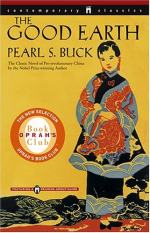
Summary:   Even for Pearl. S. Buck's pre-Revolutionary Chinese of "The Good Earth",Chinese women of the pre-Revolutionary Era are destined for prejudice since birth. While the arrival of a male infant is met with much pomp and celebration, the arrival of a female one is grossly overlooked and considered as burdensome.


In the Old Testament of the Bible, it is told that God created Eve to serve Adam. As written in Genesis 3:16, "thy desire shall be to thy husband, and he shall rule over thee." Even for Pearl. S. Buck's pre-Revolutionary Chinese of "The Good Earth", who have never read the Bible, this is true. From the moment O-Lan is betrothed to Wang-Lung, she becomes little better than a possession, hardly elevated from her previously social class of kitchen slave. Throughout the book, women are consistently mistreated and thanklessly used as tools to better the lives of their husbands. Women of that era, no matter how clever, beautiful, or helpful, are subservient in their roles as children, as wives, as mothers, as aslaves, or as general members of society.

Initially, Chinese women of the pre-Revolutionary Era are destined for prejudice since birth. While the arrival of a male infant is met with much pomp and celebration, the arrival of a female one is grossly overlooked and considered as burdensome. As O-Lan vacantly says after the birth of their first girl, "It is only a slave this time-not worth mentioning." (Chapter 7, pg. 46) The birth of a female child not only means one more mouth to feed, it also burdens the family in that she will need to be married off and thus require a dowry. Wang-Lung even goes as far thinking that the birth of the girl means that an era of bad luck will befall him. When his eldest son's wife becomes pregnant, Wang-Lung desperately wishes for a grandson instead of a granddaughter. He even dares to tempt the wrath of the gods by threatening them when he says, ."..now here comes the fruit of my sons body, and if it is not a son there will be nothing more for the two of you." (Chapter 29, pg. 303) Comparing to previously passage, Wang-Lung has always respected and revered the gods. The fact that he is now threatening them shows the importance of the birth of a male child in the family.

During childhood, it is considered inappropriate for girls to talk with men outside of the family. Wang-Lung is enraged when he sees the daughter of his uncle talk freely with men. Wang-Lung, upon seeing his uncle's daughter do this, "was so angered for the disgrace done to the family that he dared to go to his uncle's wife and [reproach her]." (Chapter 7 pg. 59) It is commonly assumed that girls are evil creatures who let their lust control their actions. Wang-Lung certainly feels this way as he says, "Whoever heard of a bitch-dog who was allowed on the streets who did not give birth to a litter"" (Chapter 7 pg. 60) The phase of childhood for a female in that era is strictly to learn the skills necessary to be wed. If she becomes pregnant before she is betrothed, her life is considered worthless.

Wang-Lung is a poor farmer, and farmers depend on their land to grow food, when land fails, there is famine. And to survive in a famine, families with girls almost always sell them as they would a piece of cloth. Throughout the book, we see a plurality of incidences where this occurs. For example, when Wang-Lung is met with a dilemma of whether or not he should sell his daughter, a friend of his tells him, "Last winter we sold two girls and endured, and this winter, if this one my woman bears a girl, we will sell again.... it is better to sell than kill...there are those that prefer to kill them before they draw breath." (Chapter 13 pg. 119) This mere passage may disgust modern readers, but at the time, the practice of selling daughters is as widely accepted as it is performed. To hear Wang-Lung's friend speak of selling his daughters like selling pieces of furniture further proves that as children, girls have no place in society. Even the mothers, who supposedly unconditionally love their children, gives in and indulges in the trade of human flesh in order to survive.

After the necessary stages of childhood and adolescence pass for a woman, all that she is good for is to be wed. Marriages of that time are always arranged with no choice given to the female, who does not even see her groom until wedding day. After being married off, the woman is treated little better than a tool. Indeed, the first thing that Wang-Lung says to his wife is, "Here is the box and basket." (Chapter 1 pg. 19) Although in his heart, Wang-Lung feels sympathy for this "creature" of a wife. He dares not show it because the unwritten laws of society decree that a man should not feel for his wife. We see multiple occasions of this, foremost, the fact that Wang-Lung was, "ashamed that he wished for the house to look neat on his wedding day." (Chapter 1 pg. 1) Furthermore, he was "ashamed to tell his father that he wishes his body clean for a woman to see." (Chapter 1 pg. 5) A man's wife is his property; she has no right to self-interest. Everything that the woman owns, she turns over to the man. This is shown most prominently when Wang-Lung demands the pearls that O-Lan keeps. She must hand them over willingly because all her property belongs to her husband.

Further proving the fact a wife is a man's property, Wang-Lung says on his wedding night, "There is this woman of mine, the thing is to be done. (Chapter 1 pg. 24) This shows that besides sweeping and cooking and cleaning and mending and sewing and whatnot, a wife is also used as a sexual slave to her husband. Completely contrary to our modern conception of mutual willingness, in the era of The Good Earth, the man's decision was final and undisputable.

Next, after a woman is married and becomes pregnant, she becomes a mother. Of course, as previously discussed, a male child is infinitely more preferable than a female one. However, if misfortune befalls and a woman does bear a female child, she is expected to bind her feet. The practice of foot binding is to make it such that when a woman moves, she moves in small, delicate steps. O-Lan is a homely woman, yet it is her large, unbound feet that bother Wang-Lung the most. As is written, "The most hideous of all were her big feet in their loose cotton shoes." (Chapter 18 pg. 171) Unbound feet in a woman are tantamount to her low social status. This is why O-Lan promises Wang-Lung that the younger girl's feet will be bound.

Before O-Lan was betrothed to Wang-Lung, she was a slave in the household of Hwang. The role of the female slave in the era of The Good Earth is one of extreme depravity. When asked about her treatment in the House of Hwang, she replied bitterly, "Everyday I was beaten." (Chapter 14 pg. 135) Although she was physically abused, O-Lan's beauty, or lack thereof, actually contributed to better treatment than her beautiful counterparts. According to her, the pretty slaves were, "beaten or carried to a man's bed" (Chapter 14 pg. 135) Female slaves were the lowest of life forms, unattractive ones were worked to death, and pretty ones were serially raped.

Yet not all slaves were so depraved. A female slave's social class can never be changed, but with enough cunning, she may make a comfortable living. Of course, this refers to Cuckoo, the cunning slave to Wang-Lung's mistress. Cuckoo acts as a sort of businesswoman to manage transactions within the Great House of Hwang before its fall. And after, she becomes the "maitre-dame" of the Great Teahouse/brothel. Although well off, she is below even a farmer's wife in status, as a dying O-Lan says to her, "you may have lived in the courts of the Great Lord, and you were account beautiful, but I have been a man's wife...and you are still a slave." (Chapter 26 pg. 261) Referring back to the role of the mother, it becomes evident that no matter how financially successful a woman is, her greatest achievement is motherhood. Cuckoo, although beautiful and rich, can still never compare to O-Lan simply because Cuckoo has never born sons. Indeed, the role of a female slave, no matter what, is undesirable.

There are many roles that women play in the era of The Good Earth. The roles of child, wife, mother and slave have already been discussed. But what role do women play in society as a whole? The answer is none at all. A good woman is invisible to men. As O-Lan tells us when she first arrives as Wang-Lung's wife, "I will hand you the bowls...I do not like to come out before men." (Chapter 1 pg. 23) Furthermore, as previously discussed, a woman must never talk to men outside of her family. We have seen this through Wang-Lung's rage at his uncle's daughter. A woman's bound feet, in addition to making her dainty and delicate, also prevents her from walking at all. Thus ensuring that she will never go far from the home. The bound feet of a woman acts effectively as a leash, keeping her away from other men.

Ultimately, the role of a woman is as a tool, to be used, neglected, discarded, or replaced at the whim if its owner. Although women like Lotus may be spared of abuse, she is nonetheless subservient to her "lord", who basically owns her. All in all, the Chinese of The Good Earth epitomizes the antifeminist principles laid out in the book of Genesis: That the woman shall serve the man, and that he shall be her lord.

This is the complete article, containing 1,621 words (approx. 5 pages at 300 words per page).

More Information
  • View The Roles of Women in the Good Earth Study Pack
  • Search Results for "The Roles of Women in the Good Earth"
  • Add This to Your Bibliography
  • More Products on This Subject
    Is Wang Lung a Good Man?
    Appreciably, Pearl S. Buck depicted her very characters on such a detail basis that everyone in her ... more

    The Good Earth (based mostly on the movie)
    Social Classes     Throughout The Good Earth Wang Lung and his fellow peasants face f... more


    Copyrights
    The Roles of Women in the Good Earth from BookRags Student Essays. ©2000-2006 by BookRags, Inc. All rights reserved.

    Join BookRagslearn moreJoin BookRags


    About BookRags | Customer Service | Report an Error | Terms of Use | Privacy Policy

