
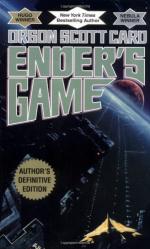
Childhood Lonlieness in Ender's Game and Indian Killer
Summary:
Childhood loneliness is a considerable problem that can affect young children in many ways, and may have long-term negative consequences. In the novels, Indian Killer, by Sherman Alexie, and Ender's Game, but Orson Scott Card, the powerful portrayal of childhood loneliness is overwhelming. Some instances are quite obvious while others are a little harder to see.
Childhood Loneliness
Childhood loneliness is a considerable problem that can affect young children in many ways, and may have long-term negative consequences. In the novels, Indian Killer, by Sherman Alexie, and Ender's Game, but Orson Scott Card, the powerful portrayal of childhood loneliness is overwhelming.
After years of being monitored by government officials, Ender Wiggins, the main character of Orson Scott Card's Ender's Game, finds himself completely alone. The loneliness set's in as he finds himself in a new school, away from the watchful eyes of the government and bared to the world. He is a Third. This feeling of being a third makes Ender feel even more isolated, "It was not his fault he was a Third. It was the government's idea, they were the ones who authorized it - how else could a Third like Ender have got into school"" (Card 5). There was no one there to keep the bullies away now. Although he never really liked the monitor, he now found himself alone and missing the advent ages of having it on and knowing that someone, somewhere was always with him and watching him. At battle school, Ender knows that he will be isolated from the other students. Colonel Graff tells the other students of Ender and how superior his talents and intelligence is compared to the rest of the group. The other students don't like Ender and don't trust him. Throughout battle school, Ender is kept from his family and isolated from other children.
Bernard makes life even more miserable and lonely for Ender as he doesn't like him and builds a gang of other kids to help torture, insult, and abuse Ender. This gang torments Ender to the point were he feels backed into a corner and has no choice but to fight his way out. With this new found power, Ender gains a friend in Shen. His loneliness seems to subside for a short time as he makes a small group of friends. The adults see how he has gained followers and decide to move him to the Salamander Army in hopes that re-isolation would ignite that same spark in him. Once again, loneliness finds Ender. Because of his superior power and intelligence, he continually finds himself isolated and alone. Colonel Graff states that "Isolation is the optimum environment for creativity" (Card 149). Ender is under the realization that Graff had been isolating him all along. This loneliness was to make him the best soldier at battle school. Ender understands this, but it's still very difficult being sheltered from friends and a family. Ender is feeling that although it's painful and hard for him, he knows that isolating himself would make him a better commander. He knows with the help of Colonel Graff that he must stay isolated to reach his full potential and to beat the "games" he plays. In his final stages of training, Ender is more and more aware of the growing loneliness and feeling of being isolated and these feelings start to destroy him. These feelings and stages of loneliness that Ender goes through throughout the novel were very difficult and painful for a child in any situation, but it did make Ender the soldier that the government needed him to be.
In the same way that Ender was isolated by the commander for what was thought to be, his own good, John Smith, the main character of Indian Killer, by Sherman Alexie was also isolated, not only by his parents, but also by his own doing as well. John Smith was a Native American, born in a Native American hospital, to a young Native American woman. He was quickly swept away and placed in to the awaiting arms of his white, adoptive parents. John parents knew full well of his ethnicity and overly encouraged him to participate in Native American activities, which, all the way around, made him feel completely alone. John knew that he was different, his parents reminded him of that everyday. They didn't realize that trying to make him understand his culture was driving him into a deep, dark loneliness brought on by knowing he was different. All John wanted to do was fit in. He never fit in. Having parents that are constantly reminding you of how different you really are didn't help his situation. "Different? He's always been different, hasn't he"....Yeah, but now he's really different" (Alexie 81). After leaving home, John found himself a job for a construction company, to build the last skyscraper in Seattle. He had no real friends. He sat alone to eat lunch. He would never go out for a beer after work with his fellow employees, he simply went home...alone, and sat there...alone.
Being thrust into a stark white world did some serious emotional damage on John Smith. There is no way to reconcile this now, the damage has been done. Although his parents do love him dearly, the blame truly is theirs as to why John felt so alone and secluded as a child. Even in high school, he had a few friends but never felt that he really fit in "John felt insignificant at those times and retreated into a small place inside himself..." (Alexie 17). John isolates himself even further as he slips in and out of a delusional fantasy life of righting the wrong that have been inflicted on Native Americans over the years.
The powerful portrayals of childhood loneliness are quite evident in both of these novels. These are fictional works, but that thought of what the effects of this loneliness might do in today's society is unfathomable. Loneliness doesn't only effect ones emotions, but as shown in both of these novels, it also effects on ones mental health and psychological functioning.
Works Cited
Card, Orson Scott. Ender's Game. New York: Tom Doherty Associates, LLC. 1991
Alexie, Sherman. Indian Killer. New York: Time Warner Book Group. 1998
This is the complete article, containing 980 words
(approx. 3 pages at 300 words per page).

