BookRags.com Literature Guides Literature
Guides
Criticism & Essays Criticism &
Essays
Questions & Answers Questions &
Answers
Lesson Plans Lesson
Plans
My Bibliography Periodic Table U.S. Presidents Shakespeare Sonnet Shake-Up
Research Anything:        
History | Encyclopedias | Films | News | Create a Bibliography | More... Login | Register | Help

Not What You Meant?  There are 3 definitions for Menecrates.

Student Essay on Shakespeare's Use of Allusions

Print-Friendly  Order the PDF version  Order the RTF version
William Shakespeare
About 2 pages (463 words)
Antony and Cleopatra Summary

Bookmark and Share Questions on this topic? Just ask!

Shakespeare's Use of Allusions

Summary:   In his plays, William Shakespeare foreshadows and emphasizes tragic love by making allusions to famous lovers, such as Dido, Cleopatra, and Thisbe, all of whom were torn apart by tragedy. Through these allusions, Shakespeare is able to enrich his work for his audience.


Shakespeare's Use of Allusions

"Dido a dowdy, Cleopatra a gypsy, Helen and Hero hildings and harlots, Thisbe a grey eye or so, but not to the purpose." (Shakespeare,) This quote is from Mercutio, a character from Shakespeare's highly acclaimed "The Tragedy of Romeo and Juliet," when he mocks the tragic love of famous mythological characters. Shakespeare foreshadows and emphasizes tragic love by making allusions to famous lovers, such as Dido, Cleopatra, Thisbe--all torn apart by tragedy.

Through the allusion to Dido, Shakespeare is able to emphasize leaving. Dido, Queen of Carthage, who had given Aeneas and his men refuge in Carthage after they lost the Trojan War, had fallen in love with Aeneas and gave him more love than he could take. Aeneas eventually left Dido because of his destiny to establish a new kingdom in Italy. When Aeneas leaves, Dido kills herself. This allusion emphasizes the tragic love of Romeo and Juliet when Romeo is exiled and leaves Juliet.

Cleopatra was Egypt's pharaoh and had fallen in love with Marc Antony of Rome. When Marc Antony left Rome for Cleopatra, the Emperor of Rome, Octavious, began his invasion of Egypt. Marc Antony's fleet eventually fell to Octavious, and Antony fled to Cleopatra; but, believing she was dead, he stabbed himself. On learning that Cleopatra was still alive, he carried himself to her and died in her arms. Then, Cleopatra allowed herself to be bitten by a venomous snake and died. This miscommunication foreshadows the miscommunication in "The Tragedy of Romeo and Juliet" when Friar Lawrence's letter does not reach Romeo, and Romeo, believing Juliet to be dead, rushes off to kill himself.

The story of Thisbe and Pyramus is very similar to the one of Juliet and Romeo. Thisbe was the fairest maiden in Babylon, while Pyramus was the fairest man. They loved each other dearly, but their parents opposed their love. They soon ran away, and one day, when Pyramus had left Thisbe alone in the woods, a lion came up and attacked Thisbe. Luckily, Thisbe was able to evade the lion, and ran off, leaving a bloody scarf behind. When Pyramus returned, he grieved for Thisbe, thinking that she had been devoured by the lion, and stabbed himself. When Thisbe returned, she found Pyramus lying there, dead. In her grief, she too stabbed herself. This tragic story links together the fate of Thisbe and Pyramus and the fate of Juliet and Romeo. Juliet had planned to be carried away to Mantua by Romeo, where they would live together happily, but a miscommunication occurred, and Romeo believed Juliet to be dead, killing himself; Juliet, too, then killed herself.

Through the allusions Shakespeare uses in his plays, he is able to enrich his work for his audience. Many of Shakespeare's allusions foreshadow tragic events.

This is the complete article, containing 463 words (approx. 2 pages at 300 words per page).

More Information
  • Notas de Libro en Español
  • View Shakespeare's Use of Allusions Study Pack
  • 3 Alternative Definitions
  • Search Results for "Shakespeare's Use of Allusions"
  • Add This to Your Bibliography
  • More Products on This Subject
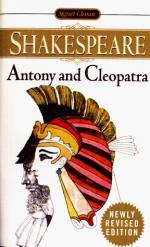
    Antony and Cleopatra
    tragedy in five acts by William Shakespeare, written in 1606–07 and published in the First Fo... more

    Tragedy or Satire? How successful in either form do you find Anthony and Cleopatra?
    Tragedy or Satire? How successful in either form do you find Anthony and Cleopatra? A tragic play i... more


    Ask any question on Antony and Cleopatra and get it answered FAST!
    Answer questions in BookRags Q&A and earn points toward
    discounted or even FREE Study Guides and other BookRags products!
    Learn more about BookRags Q&A
    Copyrights
    Shakespeare's Use of Allusions from BookRags Student Essays. ©2000-2006 by BookRags, Inc. All rights reserved.


    Join BookRagslearn moreJoin BookRags


    About BookRags | Customer Service | Report an Error | Terms of Use | Privacy Policy